🍞 MissVickie bread machine yeast math
Bread Machine Yeast Converter
Convert active dry, instant, rapid-rise, fresh, or osmotolerant yeast into a bread machine yeast amount that fits your flour weight, loaf size, cycle speed, kitchen temperature, sugar, salt, and altitude.
Pick a common bread machine situation, then fine-tune the yeast type, flour weight, cycle, room temperature, salt, sugar, and altitude.
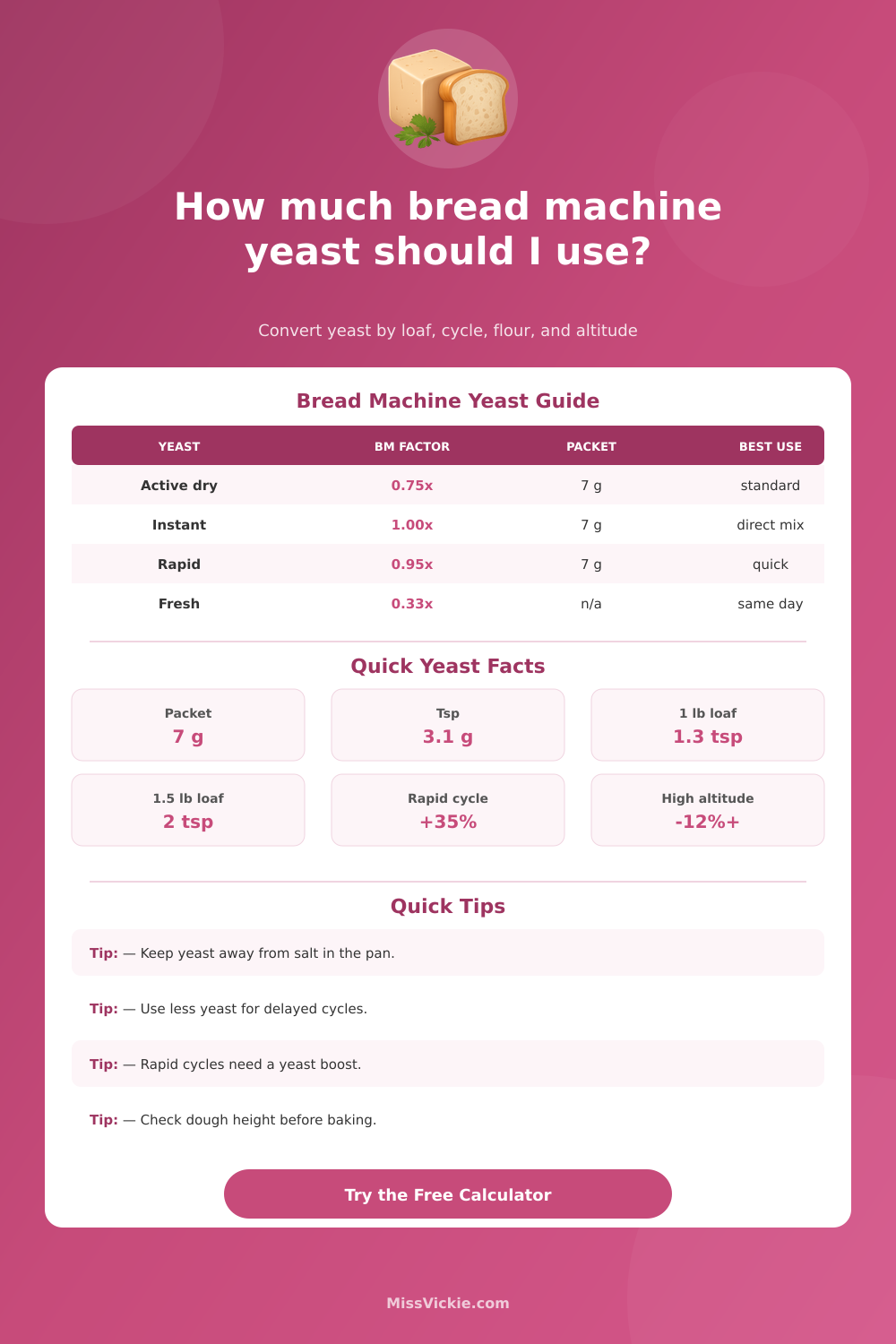
| Yeast Type in Recipe | Use This Bread Machine Yeast Factor | 7 g Packet Converts To | Best Bread Machine Note |
|---|---|---|---|
| Bread machine yeast | 1.00 x recipe amount | 7.0 g, about 2 1/4 tsp | Designed for direct mixing into dry ingredients. |
| Instant yeast | 1.00 x recipe amount | 7.0 g, about 2 1/4 tsp | Nearly interchangeable with bread machine yeast. |
| Active dry yeast | 0.75 x recipe amount | 5.3 g, about 1 3/4 tsp | Use a bit less bread machine yeast because it hydrates faster. |
| Rapid-rise yeast | 0.95 x recipe amount | 6.7 g, about 2.15 tsp | Close to bread machine yeast, but rapid labels vary. |
| Fresh cake yeast | 0.33 x recipe amount | Fresh is not sold as packets | Use about one-third as much bread machine yeast by weight. |
| Osmotolerant yeast | 0.90 x recipe amount | 6.3 g, about 2 tsp | Best for sweet dough; regular machine yeast may need a boost. |
| Gluten-free instant yeast | 1.05 x recipe amount | 7.4 g, about 2.4 tsp | Gluten-free programs often need stronger lift. |
| Machine Setting | Typical Flour Weight | Standard-Cycle Yeast Range | Rapid-Cycle Yeast Range |
|---|---|---|---|
| Mini or 0.75 lb loaf | 250-320 g flour | 3.2-4.5 g, about 1-1 1/2 tsp | 4.3-6.1 g, about 1 1/2-2 tsp |
| 1 lb loaf | 320-400 g flour | 4.0-5.4 g, about 1 1/4-1 3/4 tsp | 5.4-7.3 g, about 1 3/4-2 1/3 tsp |
| 1.5 lb loaf | 430-520 g flour | 5.2-6.8 g, about 1 2/3-2 1/4 tsp | 7.0-9.2 g, about 2 1/4-3 tsp |
| 2 lb loaf | 560-680 g flour | 6.5-8.5 g, about 2-2 3/4 tsp | 8.8-11.5 g, about 2 3/4-3 3/4 tsp |
| Dough-only batch | 400-650 g flour | 4.5-7.0 g, about 1 1/2-2 1/4 tsp | Usually not needed unless rising fast. |
| Condition | Yeast Adjustment | Why It Matters | Machine Clue |
|---|---|---|---|
| Rapid cycle | Add about 35% | Shorter rise time needs faster gas production. | Loaf is dense if yeast stays too low. |
| Express cycle | Add about 65% | Very short programs rely heavily on yeast speed. | Use only with recipes meant for quick bake. |
| Delayed timer | Reduce about 15% | Yeast sits longer before mixing and can overproof. | Keep yeast dry and away from liquid. |
| Warm kitchen | Reduce 7-15% | Warm dough rises faster inside the pan. | Sunken top often means too much yeast. |
| Cool kitchen | Add 7-15% | Cool ingredients slow early fermentation. | Loaf may be short but not collapsed. |
| Above 5,000 ft | Reduce 20% or more | Lower air pressure makes dough rise faster. | Watch for overexpansion before bake. |
| Formula Factor | Low Level | Normal Level | High Level |
|---|---|---|---|
| Sugar or honey | 0-3% sugar: use 0.95 x | 4-8% sugar: use 1.00 x | 9-16% sugar: use 1.18 x |
| Very sweet dough | Not usually needed | Use sweet cycle if available | Over 16% sugar: use 1.35 x |
| Salt | Under 1.5%: use 1.05 x | 1.8-2.2%: use 1.00 x | 2.3-2.8%: use 1.10 x |
| Osmotolerant yeast | Use normal conversion | Helpful in enriched dough | Reduces the sweet-dough boost |
Fine granules, direct mix, reliable in timed programs.
Works like bread machine yeast in most home machines.
Convert down when replacing with faster machine yeast.
Best for same-day doughs; not ideal for delay timers.
Close match, especially for quick or rapid cycles.
Strong choice for cinnamon bread and sweet loaves.
Useful when a gluten-free cycle needs extra lift.
Typical starting point for standard bread machine cycles.
Using a bread machine yeast convertor is an important process in determining the proper amount of yeast to use in the bread machine to help the loaf of bread rise. If you use a standard recipe, the recipe might not work if you change the type of flour, the cycle on the bread machine, or the temperature of the room in which the bread machine are locate. The bread machine yeast converter will adjust for these variables and ensure that the amount of yeast that is added to the bread machine is the correct amount to match the variables of that bread machine.
Different types of yeast requires different amounts of yeast to activate and work proper in a bread machine. If the recipe states the amount of instant yeast or bread machine yeast, you can use the same amount of either of these types of yeast. However, if the recipe uses active dry yeast, you must use less active dry yeast since it takes longer to activate then the other two types of yeast.
How to Use a Bread Machine Yeast Converter
Rapid-rise yeast is another type of yeast that is different from both active dry yeast and fresh yeast. With a bread machine yeast converter, the converter will convert the amount of yeast that is indicated in the recipe to the proper amount of yeast for the specific type of yeast that is to be used in the bread machine. Another factor that affect the amount of yeast to be used in the bread machine is the size of the loaf of bread that is to be made.
A one-pound loaf of bread requires less flour and less yeast than a two-pound loaf of bread. If the same amount of yeast is use for both a one-pound and two-pound loaf, the one-pound loaf will rise too quickly, while the two-pound loaf will not rise enough. A bread machine yeast converter takes into account the weight of the flour that will be used and the weight of the loaf that will be produced, and then ensures that the amount of yeast that is provided is the proper amount to allow for adequate rising of the dough.
The cycle on the bread machine will also impact the amount of yeast that should be used in the bread machine. If a standard cycle is used for the bread machine, there will be a great deal of time for the dough to rise. However, if a rapid cycle or an express cycle is used for the bread machine, there will be less time in which the dough can rise.
To compensate for this shorter period of time for the dough to rise, a bread machine yeast converter will increase the amount of yeast that should be used in the bread machine for rapid cycle. For bread machines with a delayed timer cycle, the yeast will remain in the pan of the bread machine for a longer period of time before the dough is mixed. To avoid overproofing the dough in these situations, a bread machine yeast converter will reduce the amount of yeast that must be used.
Another variable that will affect the activity of the yeast in the bread machine is the temperature of the room in which the bread machine is locate. In rooms with a cool temperature, the yeast will not be as active as in warmer rooms. Thus, if the bread machine is located in a cool area of the kitchen, the bread machine yeast converter will increase the amount of yeast that is to be used in the bread machine.
Conversely, if the bread machine is located in a warm area of the kitchen, the activity of the yeast will be increased, thus requiring a reduction in the amount of yeast that is used in the bread machine. Two ingredient that will impact the activity of the yeast in the bread machine are the amount of sugar and salt that is used in the recipe. Too much sugar will slow the rising of the dough.
Additionally, too much salt will also slow the activity of the yeast. To account for these ingredient, the bread machine yeast converter will adjust for the amount of sugar and salt that will be used in the recipe to ensure that the amount of yeast will be appropriate for the amount of these ingredients. One more factor to consider is the altitude at which the bread is to be baked.
At high altitude, the air pressure is lower than at sea level. This lower air pressure will cause the dough to expand at a faster rate than it would at sea level. To combat this rapid expansion of the dough, the amount of yeast will be reduced when the bread is being baked at high altitudes.
The bread machine yeast converter will provide a target amount of yeast in both weight and volume. This target amount will have a checkmark next to the weight of the flour that will be used in the bread machine. Additionally, the target amount will display the percentage of the weight of the flour that the yeast account for.
This percentage should be within an appropriate range. If not, then the settings of the bread machine should be checked before beginning to mix the ingredients. One way to improve the results of the bread machine is to write down the amount of yeast that the bread machine yeast converter suggest should be used.
Additionally, write down the settings of the bread machine that are to be used with the recipe. With these notes written down, it is possible to monitor how the bread machine and the kitchen (especially the temperature of the area in which the bread machine is located) impact the yeast that is used in the bread machine over time. Finally, bread machine yeast converter are useful for adapting recipes that are already known.
You can maintain the flavor and texture of the bread by adhering to the recipe for the bread. However, the bread machine yeast converter can adjust the amount of yeast that is used in the bread machine. By adjusting only the amount of yeast that is used, the process within the bread machine will remain the same, as will the amount of bread that is produced.
Additionally, the bread machine yeast converter will ensure that the amount of yeast that is baked will produce the type of bread that is expected.