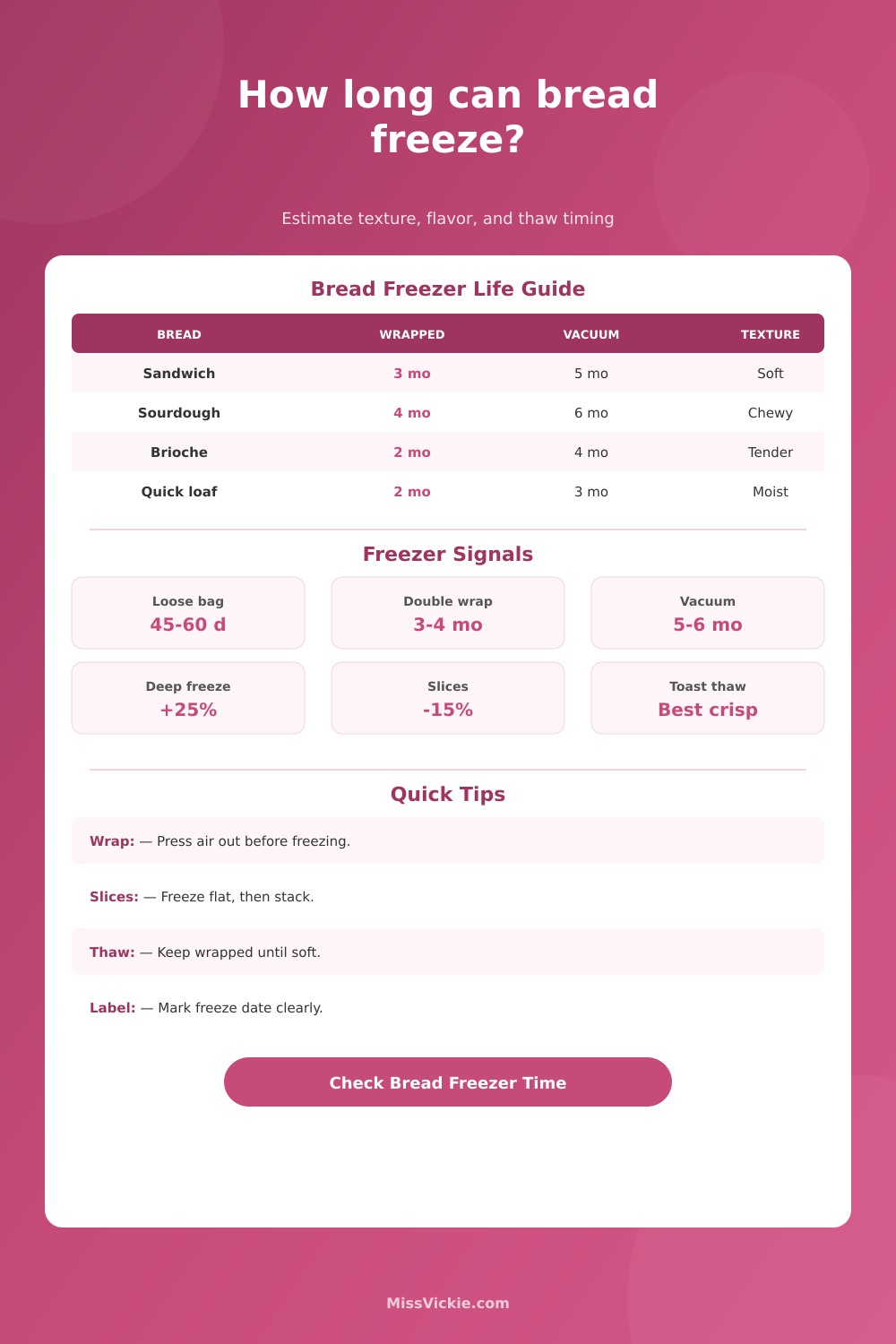
Bread Freezer Shelf Life Calculator
Estimate the best freezer window for sandwich loaves, sourdough, brioche, rolls, flatbreads, and quick breads using slice state, wrap quality, freezer temperature, freeze date, crumb richness, thaw plan, and storage goal.
Pick a bread storage scenario, then adjust the wrap, temperature, date, and thaw plan to match your loaf.
Freezer Quality Estimate
Your bread storage estimate will appear here.
Storage Breakdown
Texture Breakdown
Full Calculation Path
| Bread Type | Best Wrapped Window | Texture Risk After Window | Best Use If Older |
|---|---|---|---|
| Soft sandwich loaf | 75 to 110 days | Dry edges and muted aroma | Toast, grilled sandwiches, breadcrumbs |
| Lean sourdough boule | 95 to 150 days | Crust dulls before crumb fails | Oven refreshed slices, croutons |
| Baguette or batard | 55 to 95 days | Crust flakes and crumb dries fast | Garlic bread, soup bread, crumbs |
| Brioche or challah | 55 to 95 days | Butter aroma fades and crumb compacts | French toast, bread pudding |
| Dinner rolls or buns | 70 to 115 days | Cut sides dry first | Sliders, toasted buns, stuffing |
| Banana bread or quick loaf | 45 to 85 days | Moist crumb can pick up ice crystals | Toasted slices, dessert cubes |
| Pita, naan, tortillas | 90 to 140 days | Edges crack if air reaches stack | Warm skillet refresh, chips |
| Rye or seeded loaf | 80 to 135 days | Seeds taste stale before crumb dries | Toast, open-face sandwiches |
| Packaging | Quality Factor | Best For | Bread-Specific Watch Point |
|---|---|---|---|
| Original bread bag only | 0.52x | Short toast backup | Air pockets cause frosty slice edges |
| Single freezer bag | 0.78x | Weekly slice rotation | Press bag flat around slices |
| Plastic wrap plus freezer bag | 1.00x | Whole loaves and family bread | Wrap cooled bread before bagging |
| Wrap plus foil plus freezer bag | 1.18x | Crusty loaves and holiday rolls | Foil shields crust from dry air |
| Vacuum sealed portions | 1.38x | Long backup storage | Freeze soft slices firm before sealing |
| Rigid freezer container | 0.92x | Frosted breads and tender buns | Fill extra headspace with wrap |
| Thaw Method | Best Bread Match | Texture Outcome | Planning Note |
|---|---|---|---|
| Wrapped on counter | Whole loaves, rolls, quick bread | Most even moisture return | Keep wrap closed until bread softens |
| Direct to toaster | Sandwich slices, flatbread wedges | Crisp edges, dry surface | Best for older slices |
| Wrapped warm oven refresh | Sourdough, baguette, rye | Revives crust and crumb warmth | Unwrap near the end for crust |
| Refrigerator overnight | Filled buns or very moist loaves | Safer for condensation control | Can firm starches faster |
| Short microwave thaw | Single serving emergency thaw | Soft at first, tough if overheated | Use low bursts and eat soon |
| Quality Score | What It Means | Good Serving Plan | Texture Fix |
|---|---|---|---|
| 85% to 100% | Near fresh freezer quality | Sandwiches, dinner table, guests | Thaw wrapped, then slice or toast |
| 70% to 84% | Good everyday quality | Toast, lunch bread, buns | Short toast or warm oven refresh |
| 50% to 69% | Noticeable freezer drying | Grilled bread, croutons, crumbs | Add heat, butter, or sauce |
| Below 50% | Strong texture loss likely | Stuffing, bread pudding, crumbs | Trim frosty edges if needed |
Less exposed surface, slower dry edges, longer aroma retention.
Easy toast portions, but each slice has more exposed crumb.
Parchment or wrap between pieces keeps breads from tearing.
Use the freshest freezer window for soft texture and aroma.
This calculator estimates freezer quality, not food-safety permission. Discard bread with mold, off odors, heavy frost contamination, or damaged packaging.
The day arrives when you open the bag and discover that the last slice of bread is gone, leaving you with a single remaining piece in the jar. What about the loaf still tucked away in the freezer? Was it wrapped? And if so, what’s inside?
The answer to this question doesn’t just involve time spent in the ice box; it’s also dependent off which ingredients went into the dough and how well it was packaged. Although freezing a loaf couldn’t be simpler, keeping it fresh is another matter entirely, and knowing how air and moisture impact it will help you get it right.
How to Freeze Bread Correctly
What happens in your freezer? What’s the main concern here? Freezing actualy keeps foods well. It’s not really the coldness itself. Air circulation are problematic in freezers. Water on the surface of the frozen bread evaporate into the dry freezer air, creating ice crystals elsewhere and leaving behind a desiccated crust. Over time this makes for dry bread.
A regular grocery store bag won’t do much to protect your bread because over time it will let moisture escape. If you can get the air out (you want to squash it down so there isn’t any) then double-wrapping it in a heavy duty freezer bag and some plastic cling film will form a good enough barrier. Remove even more air by vacuum sealing, and get rid of the thing that carries the moisture across.
Freezing affects various kind of bread in different ways, depending upon what they’re made from. An open-structured bread with lots of holes, such as a baguette or sourdough, lets air reach deep into the loaf causing it to stale more quickly. A dense, enriched bread, such as challah or brioche, contains milk, butter and eggs, all natural insulators for preventing moisture loss. Unfortunately, those same fats will also start to oxidize during storage, leading to a subtly rancid flavor (though still soft) in older enriched loaves that you freeze. Rich vs.
The calculator takes this into account when adjusting the estimated shelf life for your loaf. It knows that although an enriched brioche might keep its shape longer, it won’t keep its aroma longer then a hearty whole wheat boule.
Freezing also has a big impact on how it goes when you slice bread after freezing. If you have room, it’s always best to simply freeze a full loaf instead of pre-sliced ones. Every time you make a slice, you’re exposing a new surface area to all that air in your bag. The more surface area, the more chance of freezer burn. To minimize amount of air inside your bag, if you do need to freeze slices then flatten each one out inside the bag.
The better option is to avoid slicing until you need to so you keep the texture of the bread much longer. It is a mechanical advantage in how it affects the finished product. In the case of bread, the calculator takes that into account by shortening its estimated time for things once they’ve been sliced vs their uncut versions.
It’s not so much about cold as it is about stable cold: Frequent cycling between warmer than zero degrees Fahrenheit and colder will cause your freezer to form condensation on the inside of whatever you’re storing, including your packaging. Then, when that water freezes again, it’ll grow into nasty, damaging crystals that wreck the starch structure of the bread. Keeping your freezer consistently cold keeps the ice in a harmless microscopic state. Even the most air-tight seal won’t save your bread if your freezer’s temperature swing like a wild pendulum.
A lot of people mess up an otherwise-frozen loaf by how they thaw it. Never microwave your bread or it will go all rubbery and tough in no time. This happens because when you heat water molecules too vigorously, they expand quicker than the starch can get them out the door. Simply allow the bread to slowly defrost, still wrapped. This holds the moisture that escapes near the surface as it thaws. This allows the moisture to work its way back into the crumb as it warms up.
With crusty loaves, a brief burst in a hot oven at the end brings the outer crust right back without drying out the middle.
This doesn’t require any fancy gear. You just need some bread and some care, treating the bread like a delicate sponge that will soak up water. Wrap it well. Keep it at a cool temperature. Cut it only when needed. Use the calculator above to work through all the factors involved in moisture-loss and oxidation-rates, leaving you with more time to savor your meal.
And when that defrosted piece comes out, all puffed-up and fragrant, you’ll know for sure why the additional wrap is worth it. It is not because of the freezer but because of the air.