MissVickie bread dough math
Salt in Bread Dough Calculator
Size bread dough salt from total flour weight, baker's percentage, hydration, yeast type, bread style, fermentation speed, salt grain size, preferment salt, and batch scaling.
🍞Pick a bread scenario
Each preset fills a real dough profile, then you can adjust the flour, hydration, salt percent, yeast, preferment, and loaf count.
⚖Choose units
🧂Dough inputs
Enter dough details to calculate salt.
📊Dough snapshot
Dough weight estimate includes flour, water, salt, and the other ingredient percentage. Evaporation and bench flour are not included.
📘Reference tables
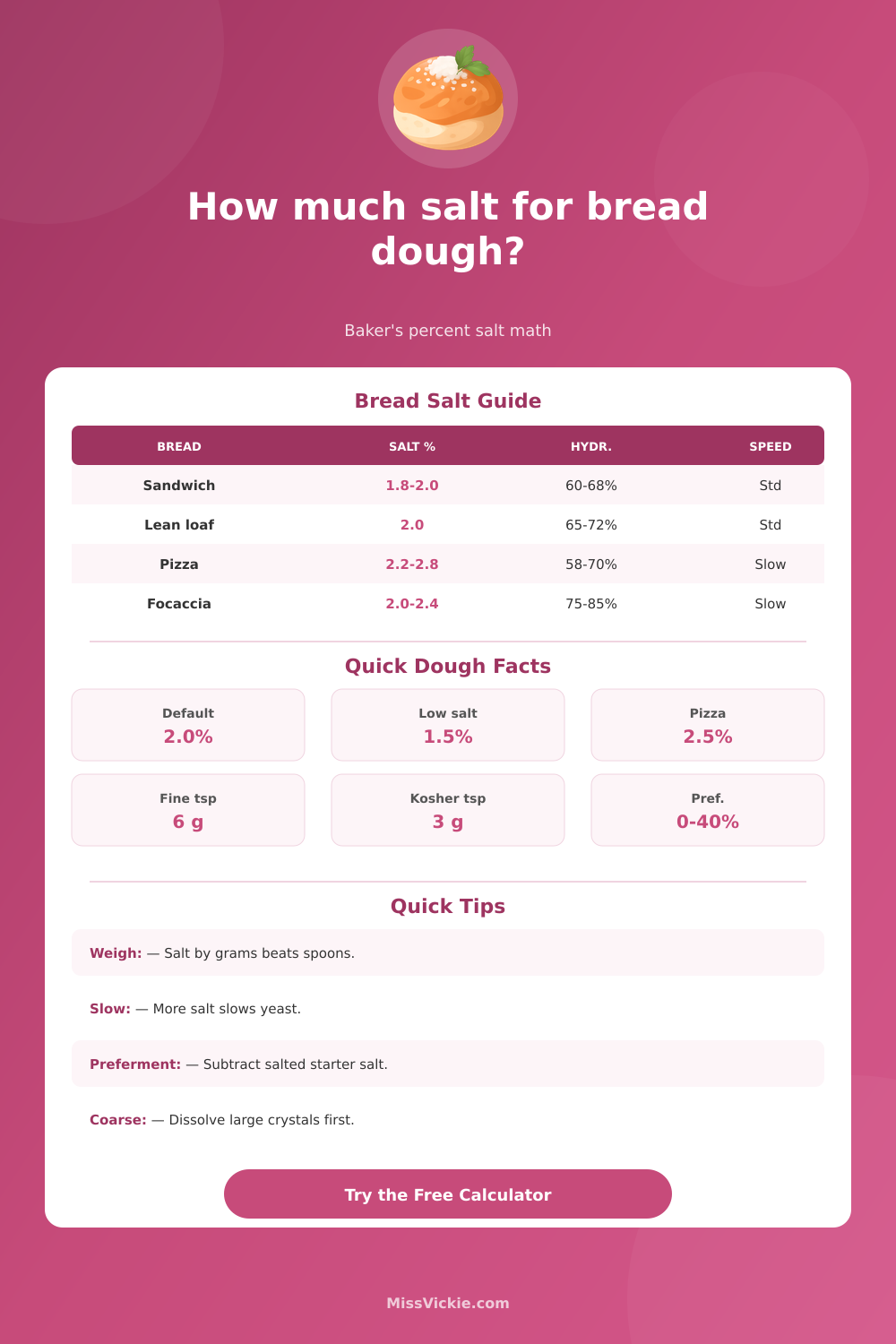
| Bread style | Typical salt | Hydration range | Fermentation note |
|---|---|---|---|
| Sandwich pan loaf | 1.8% to 2.0% | 60% to 68% | Balanced flavor without slowing a soft, enriched rise too much. |
| Lean hearth bread | 1.9% to 2.2% | 65% to 75% | Good structure and flavor for straight or prefermented dough. |
| Pizza dough | 2.2% to 2.8% | 58% to 70% | Higher salt helps long fermentation and browning control. |
| Focaccia or ciabatta | 2.0% to 2.4% | 75% to 90% | Wet dough often tastes flat if salt is too low. |
| Bagels and pretzels | 1.8% to 2.1% | 50% to 58% | Stiff dough disperses coarse salt slowly, so fine salt is easier. |
| Sourdough | 2.0% to 2.3% | 68% to 85% | Salt moderates acid build and gluten softening during long proofs. |
🥄Salt spoon conversions
| Salt type | Approx grams per tsp | Best dough use | Mixing note |
|---|---|---|---|
| Fine sea salt | 6.0 g | Everyday bread formulas | Dissolves quickly and measures predictably. |
| Table salt | 6.1 g | Precise small dough batches | Use a scale if iodized flavor is noticeable. |
| Diamond Crystal kosher | 2.8 g | Hand mixing and pinch seasoning | Large volume for the same salt weight. |
| Morton kosher | 4.8 g | General baking | Denser than Diamond Crystal, so spoon swaps differ. |
| Coarse sea salt | 5.0 g | Autolyse or dissolved additions | Dissolve before mixing if knead time is short. |
| Flake salt | 2.0 g | Finishing more than dough | Crush or dissolve for even bread dough salting. |
🧪Batch scaling examples
| Total flour | Salt at 1.8% | Salt at 2.0% | Salt at 2.5% |
|---|---|---|---|
| 500 g flour | 9 g | 10 g | 12.5 g |
| 1000 g flour | 18 g | 20 g | 25 g |
| 1500 g flour | 27 g | 30 g | 37.5 g |
| 2500 g flour | 45 g | 50 g | 62.5 g |
| 5 kg flour | 90 g | 100 g | 125 g |
✨Practical salt notes
Salt is a necessary ingredient in bread recipes because salt add flavor to the bread and strengthens the gluten in the recipe. Additionally, salt also regulate the activity of the yeast in the bread. If you dont use the correct amount of salt in your bread recipe, your bread may taste blandly or it may rise to quick during baking and develop structural issue.
Many people experience difficulty measuring the salt that should used in bread recipes. This is due to the fact that different types of salt has different densities. For example, table salt is more denser than kosher salt; therefore, one tablespoon of table salt contains more salt by weight than one tablespoon of kosher salt.
How to Use a Salt Calculator for Bread
Because of the different densities of salt, the baker must calculate the weight of the salt prior to baking the bread to ensure that every batch of bread that is baked contain the same amount of salt. The salt calculator that is available above allow you to calculate the amount of salt that should be added to your bread recipe. Specifically, the salt calculator will use the weight of the flour that will be used in the batch of bread, the hydration level that will be used in the batch of bread, and the percentage of salt that will be used in the batch to calculate the weight of salt that should be used in the batch.
The salt calculator will account for preferments, such as levain or biga, since these preferments may contain salt within them. If the preferment that is calculated in the salt calculator contain salt, the salt calculator will automatically subtract the weight of the salt that is contained in the preferment from the total weight of salt that is calculated for that batch of bread. This prevents the salt from being added to the batch of dough in excess; adding too much salt to bread dough will make the finished bread product taste too salty, while adding too little salt will make the bread taste bland.
The percentage of salt that is used in the batch of bread has a major impact on the flavor of the bread and the rate at which the preferment ferment. For example, lean hearth bread recipe typically use a salt percentage of around 2%. The 2% salt percentage allows the bread to contain flavor while allowing the fermentation process to occur at a steady rate.
Pizza dough recipe often use a salt percentage of 2.5%. This higher percentage of salt prevent the bread from tasting bland after toppings are added to the bread during baking. Additionally, enriched dough recipes that contain butter and sugar use a lower percentage of salt.
The fat content in enriched bread recipes reduces the human palate’s perception of salt. The salt calculator allow you to set these different percentages of salt in your recipe. Depending on the type of salt that is chosen for your batch of bread, the salt calculator will automatically calculate the volume of that type of salt that should be used in your recipe.
The salt calculator also alert the baker if coarse salt crystals are to be used in the batch of bread. The baker must dissolve coarse salt crystals in liquid prior to baking so that the salt can be evenly distribute throughout the dough. Even distribution of salt ensure that every portion of the finished bread product will have the same flavor and structure.
High hydration levels and slow fermentation speeds interact with salt in specific ways. For instance, high hydration level indicate that salt should be added to provide flavor to the dough. However, salt slow the activity of the yeast; therefore, the baker must take into account the impact of this ingredient on the recipe.
If an overnight proof is used, the slowing of the yeast by salt will prevent the dough from over-proofing. Additionally, the salt calculator also estimate the impact of salt on the fermentation speeds of the dough. The estimated fermentation speeds can be used to ensure that adjustments are made to the salt percentage in the batch of bread to achieve the desired fermentation speeds.
Because preferments may contain salt, the salt calculator also calculates the weight of the salt that is contained in the preferment used in the batch of bread. For example, if a poolish is used that does not contain salt, the salt calculator will calculate the amount of salt that should be added to the batch of dough. However, if a poolish that does contain salt is used, the salt calculator will account for the salt that is already contained in that preferment; the salt percentage will be adjusted to account for the weight of the preferments salt.
This allow bakers to make adjustments to the recipe according to the size of the batch of bread that is to be produced. Some common mistake are made in the baking of bread products when the baker is unaware of the different types of salt that exist or the salt content that is contained in the preferment. For instance, bakers often make mistake in using volume measurements instead of weight measurements for salt.
Additionally, many cooks often leave out the salt from a starter that is commonly used in the preparation of dough recipe. Both of these mistake will impact the flavor and structure of the bread. However, the salt calculator allow bakers to automate the calculation of the amount of salt that should be used in their batch; bakers can then focus upon other aspects of the bread recipe, such as the salt percentage and the fermentation speeds.
Once the baker has used the salt calculator to determine the amount of salt and other ingredient that should be used in their batch of dough, they can begin to mix the ingredient together to form dough, and begin the fermentation process altogether.