🍞 Bread Dough Hydration Calculator
Calculate hydration percentage or find the exact water weight for any bread recipe
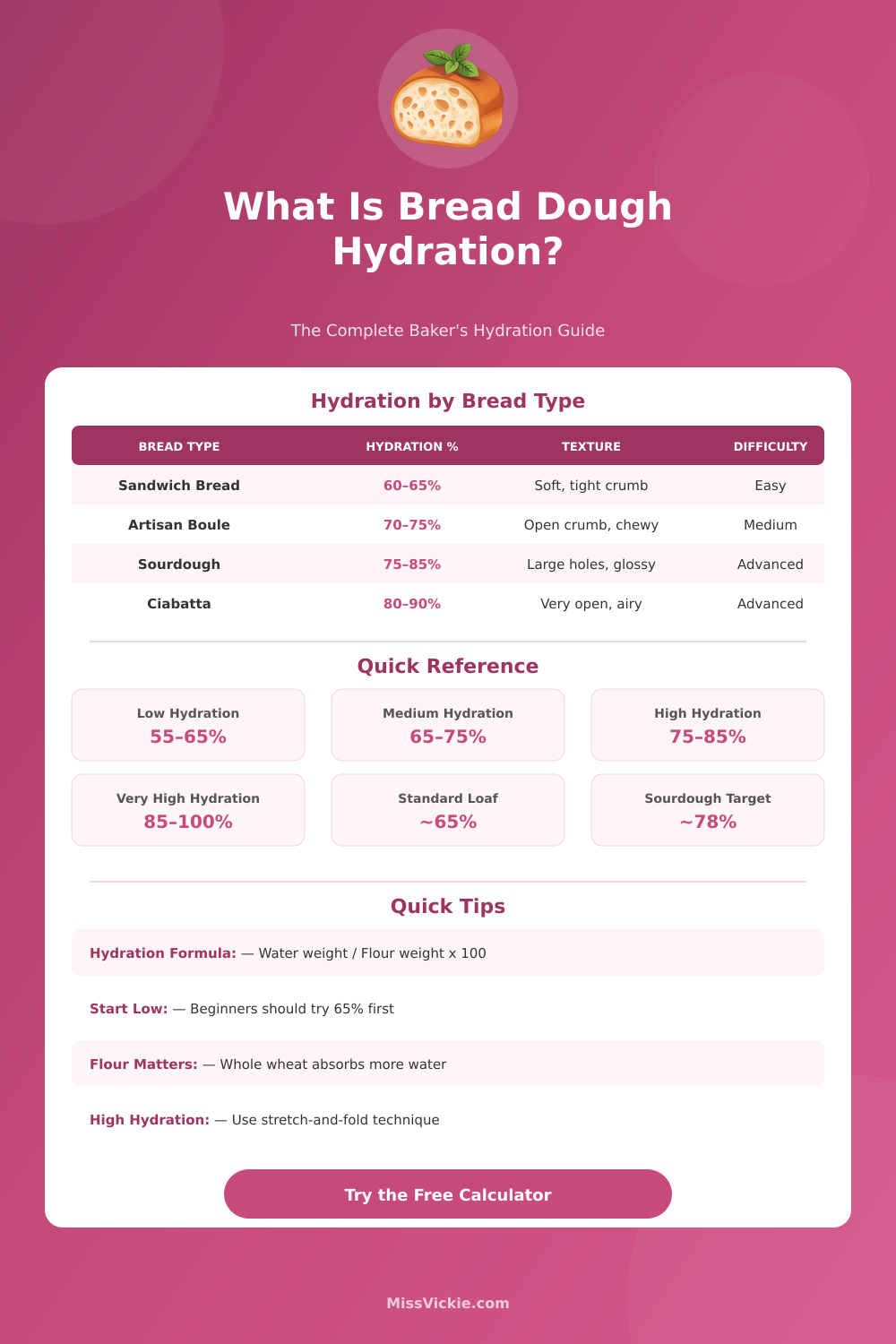
| Bread Type | Hydration % | Water per 500g Flour | Crumb Style |
|---|---|---|---|
| Sandwich Bread | 60–65% | 300–325g | Soft, tight, sliceable |
| Dinner Rolls | 62–65% | 310–325g | Soft, fluffy |
| Baguette | 65–70% | 325–350g | Crispy crust, chewy |
| Artisan Boule | 70–75% | 350–375g | Open crumb, rustic |
| Sourdough | 75–85% | 375–425g | Large holes, glossy |
| Focaccia | 75–80% | 375–400g | Pillowy, oily |
| Ciabatta | 80–90% | 400–450g | Very open, airy |
| Pizza Dough | 60–65% | 300–325g | Elastic, crispy crust |
| Flour Type | Absorption | Recommended Hydration | Notes |
|---|---|---|---|
| All-Purpose Flour | Average | 60–72% | Good for beginners |
| Bread Flour (Strong) | Slightly higher | 65–78% | More protein, holds more water |
| Whole Wheat Flour | High | 70–85% | Absorbs significantly more water |
| Whole Grain / Rye | Very high | 75–90% | Dense; autolyse recommended |
| 00 Flour (Fine) | Lower | 55–65% | Italian pizzas, pasta |
| Spelt Flour | Moderate-high | 65–75% | Weaker gluten, handle gently |
| Hydration Range | Dough Feel | Handling | Best For |
|---|---|---|---|
| 55–62% | Stiff, smooth | Very easy, non-sticky | Bagels, pretzels, pizza |
| 62–70% | Soft, slightly tacky | Easy to knead by hand | Sandwich loaves, rolls |
| 70–78% | Sticky, extensible | Moderate; stretch & fold | Artisan boules, baguettes |
| 78–85% | Very sticky, slack | Advanced; wet hands needed | Sourdough, country loaves |
| 85–100% | Extremely slack | Expert; minimal shaping | Ciabatta, focaccia |
| Hydration % | Water (per 100g flour) | Water (per 500g flour) | Water (per 1kg flour) |
|---|---|---|---|
| 60% | 60g | 300g | 600g |
| 65% | 65g | 325g | 650g |
| 70% | 70g | 350g | 700g |
| 72% | 72g | 360g | 720g |
| 75% | 75g | 375g | 750g |
| 78% | 78g | 390g | 780g |
| 80% | 80g | 400g | 800g |
| 85% | 85g | 425g | 850g |
Bread dough is malleable and sometimes elastic from flour, that comes from grains or legumes. You prepare it mixing flour with a bit of water or other liquid, and commonly add yeast or other leavening agents
All-purpose flour or bread flour works equally, without changes in the recipe. The amount of flour ranges according to height and humidity. Most important is the texture of the dough, it must be smooth and go off the bowl sides.
Bread Dough Basics
Basic recipe for bread uses simple proportion: flour, yeast, sugar, salt and warm water. First mix one cup of flour with yeast, sugar and water, then leave it rest some minutes. Add another cup of flour together with salt.
Knead the dough on lightly floured surface until it becomes smooth. Leave it rise for one hour, then push it down.
The amount of kneading is imoprtant. Too little or too much stops the dough rise correctly. Kneading strengthens the dough by means of development of gluten.
It is possible to use the windowpane test for control elasticity. Common mistake is adding too much flour on the work surface, which commonly gives dense dough and heavy bread.
More yeast boosts the rise, while less slows it. Both modes work well. Less yeast allows more time for flavor.
Like this you get even richer taste with same rise, if the dough leaves to rest in the refrigerator, cold brakes fermentation. Salt is not lacking for good bread.
Hydration is basic notion. Different bread styles need different amounts of water. Baguettes, focaccia and ciabatta require very wet doughs.
Sandwich bread has less water, bagels and pretzels even less. Rich doughs include fat, for instance oil for focaccia, butter for brioche or yoghurt for naan.
During baking, the starch in the dough swells, burst and gelatinizes, which creates gel backing the gluten network. That gel seize gases and form the crumb. Caramelization and Maillard-reaction colors the crust golden-brown and give aroma together with taste.
Bread dough is surprisingly universal. From one basic yeast mass come endless varieties, pizza dough, naan, focaccia, cinnamon rolls, dinner rolls, garlic breadsticks, whole breads and cheesy bread. Dough can freeze until three months.
Do the first rise, push down and wrapit tightly. Formed dough freeze until two weeks, but more yeast (of 10 to 25 percent) helps in the limit. Long cold kills yeast, although less effect after only some days.