
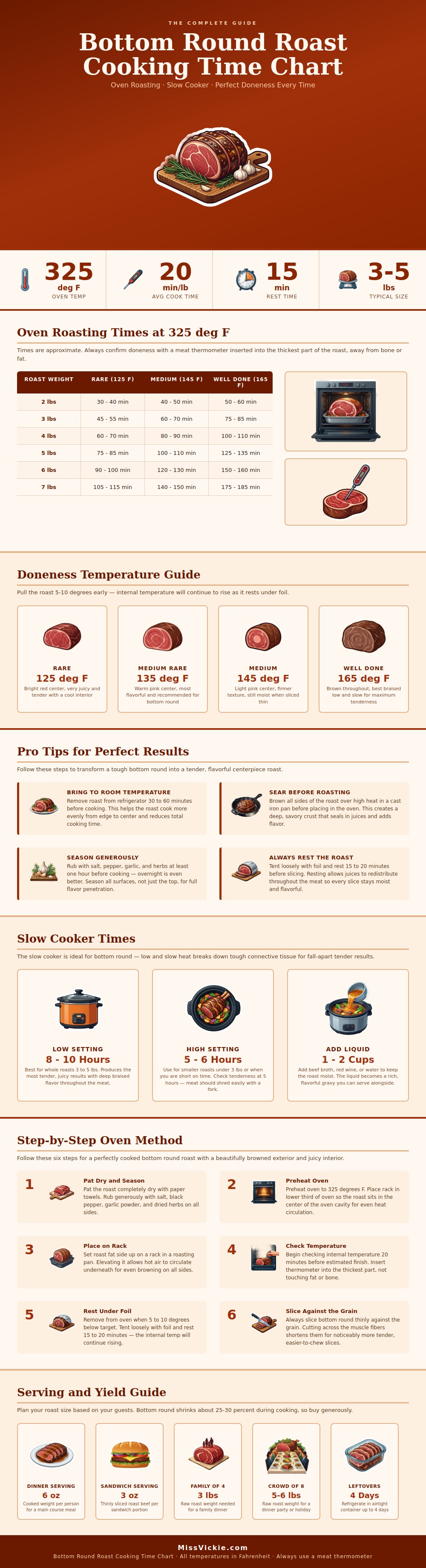
From the back leg of cow, a bottom round roast is a highly stringy cut, as in that area the beast have walked many miles. You cannot simply throw this meat into an oven at high heat and hope for the best. Here’s how to avoid toughness while cooking it, and what not to do.
Bottom round can become dry if overcooked. To tackle their chief problem (connective tissue), here’s how long and when to cook them: For many home cooks, the clock is the tool of choice rather than the thermometer, but what happens when your oven doesn’t match up? And then there’s matter of shape (and size) of meat itself.
How to Cook Bottom Round Roast
The suggested roasting time for this recipe: roughly twenty minutes per pound at 325 degrees Fahrenheit. But that’s just a guess. To determine doneness, you must use an instant-read thermometer, inserting it into the center of thickest section of meat. For most tender and flavorful results, you’re aiming for medium rare, which means an internal temperature of one hundred thirty-five degrees Fahrenheit.
According to visual guide, once you pull the roast out of oven, it will continue cooking on the plate: take the roast out roughly five to ten degrees shy of your desired number. Letting it sit there longer than necessary so that the meat hits the very last degree in the oven would of give a well-done roast at serving time.
When it’s time to serve, allow the roast to rest for a minimum of 15 minutes under loose foil, so that juices has a chance to redistribute from the center outward. Cutting into the meat right away will cause the juices to run out on the cutting board rather than remain within the roast.
To further tenderize each bite, make sure you slices against the grain; aligning your knife at a right angle to the muscle fibers shorten those strands.
If you don’t want to wait for it (or worry about it) in the oven, use your slow cooker instead. Cook a three to five pound roast on low for six to 10 hours, depending on size. The long, slow cooking break down the muscle fibers, making it fork-tender. You’ll need to add some liquid. Wine or beef broth, and, since there’s no one watching over things, the sauce will reduce to a rich, complementary gravy as you go about your business. Plan ahead; this method is also easier than paying active attention.
Whichever method you choose (braise or roast), make sure to prepare your meat beforehand by bringing it up to room temperature which will ensure even cooking. For the same reason (flavor penetrates the lean meat more easily), season the roast liberally with salt and pepper at least several hours ahead of time, ideally overnight. If you’re roasting, searing the meat first creates a nice crust, but use the times/temperatures as a general guideline only; trust your thermometer!
Resting the meat properly, slicing thinly across the grain, and following these few easy steps will turn that tough piece of meat into tender, juicy beef.