
When you’re serving prime rib, there’s nothing quite like having company arrive in 45 minutes. You realize you’ve got three hours into baking a bone-in rib roast, so you open the oven door and notice… No big difference. Panic sets in, did I ruin dinner?
Cooking prime rib isn’t so much about staring at the clock as it is knowing what heat do inside a thick piece of dense muscle. The intuition to use time per pound to check for doneness makes sense…if you pay attention to the physics of carryover cooking. Which is where most folks screw things up. They removes the roast as soon as it reaches their desired internal temp, only to watch it climb another ten degrees while resting on countertop.
How to Cook Prime Rib Perfectly
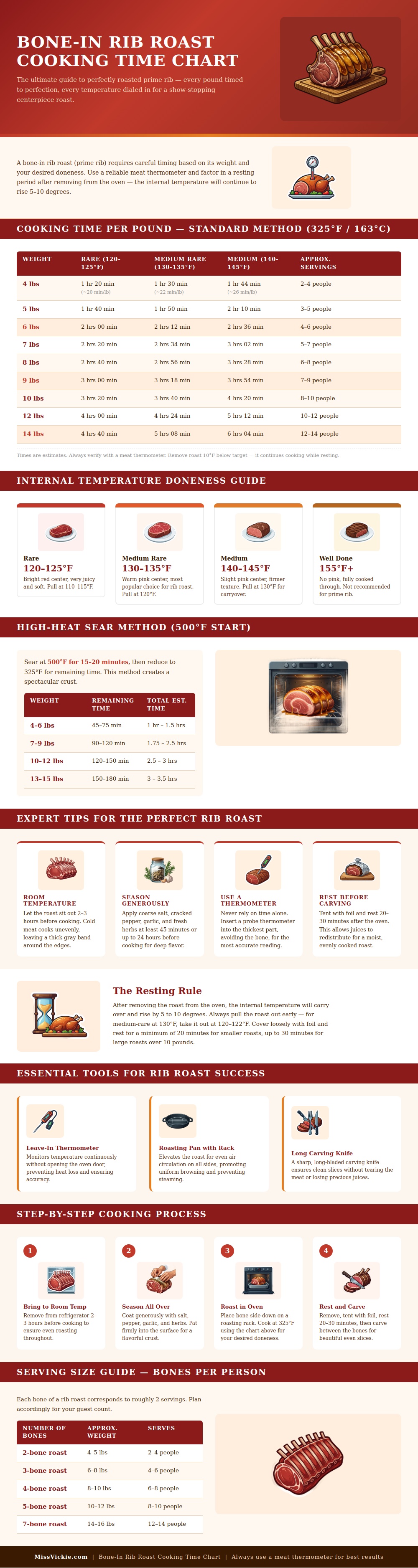
These roasting times are based off a standard 325-degree-Fahrenheit temperature. This chart (above) provides an easy starting point for any roast from four pounds to fourteen pounds. All these roasts will have a nice pinkish-red center. Smaller roasts gets around twenty minutes per pound for the best rare result, while larger ones shift the equation slightly upward due to the way their greater mass holds onto heat. Based on the guide, a nine-pound roast cooked to medium-rare would spend approximately three hours and eighteen minutes in the oven. It’s good to know where those numbers land; they’re meant to be used as guides, not hard-and-fast rules. They takes into consideration that slow and low is what’ll get you through this cooking process, gently breaking down the connective tissue while keeping the outside edges from turning into a dried-out brick. Rush it, and you’ll be left with something terrible: gray overdone meat girding pink inside. No human being deserve that.
Other chefs like to begin with a high blast (500 degrees for fifteen minutes) and then drop down to slow and low. Purists will say this can leads to overcooked edges; plus, they argue, the great crust will form anyway. But there is no question: An aggressive sear cuts the overall cooking time dramatically, shaving almost an hour off a big roast, and forms texture contrast that improves the flavor. Searing first and going easy all the way through? That’s a matter of taste: A certain degree of bark to tender balance is nice, but what kind do you like best? And what’s your oven’s temperament?
Remember: Every oven are different, so these charts above are just starting places; not guarantees. But how you treat the meat before it goes near the heat is just as critical. Two to three hours at room temperature will ensure even cooking from center to edge. The cold center won’t cook as quicky as the rest, resulting in uneven doneness. Generously season with coarse salt and pepper at least forty-five minutes prior (longer if possible) so the flavors has time to soak deeply into the fibers. Chefs swear by salting ahead of time, up to twenty-four hours; even, believing this allows the salt to extract moisture that will reabsorb infused with the flavors, forming a better crust. It is a small detail, but it makes a big difference in the final flavor.
Now, how to carve? You need patience, my friends. You’re going to want to tent the roast loosely with foil before letting it rest for no less than 20 minutes. During this time, the juices will redistribute instead of immediately spilling all over the cutting board when you start slicing. Using a long, sharp carving knife, follow the path of the bones while cleanly separating them from each other. According to the infographic, here’s an easy serving rule of thumb: figure two servings per bone. That’s a nice way to gauge your portions without actualy having to weigh each individual piece.
At the end of the day, it’s not so much about cooking meat as it is about making a moment. And when you finally break through the perfectly rested prime rib and see that even pink color throughout, from edge to edge, you’ll realize it was all worth while. Not a second of planning should of been wasted. Only appreciation will fill the silence around the dinner table instead of worry about when to serve.