Servings, soup style, concentration, protein, vegetables, reduction, gelatin, salt, and starch absorption
Bone Broth for Soup Calculator
Estimate how much bone broth, concentrate, and water to start with for soup after simmer reduction, protein and vegetable load, gelatin richness, salt dilution, and noodle or grain absorption.
Choose a soup style, then tune the serving size, broth concentration, protein, vegetables, reduction, gelatin body, sodium target, and starch absorption.
Batch Breakdown
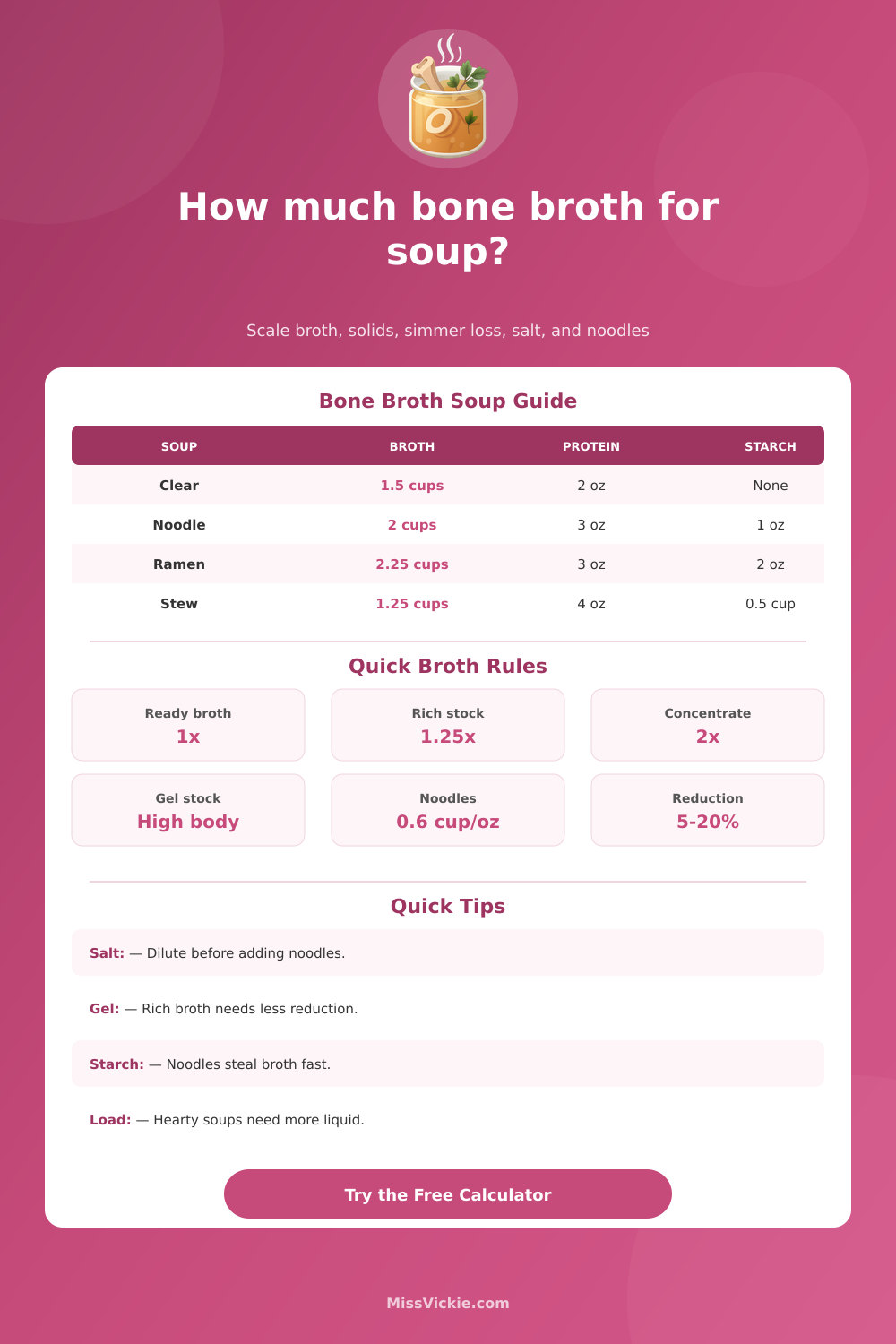
| Soup Style | Typical Finished Portion | Free Broth Target | Best Bone Broth Approach |
|---|---|---|---|
| Clear broth soup | 1.5 to 2 cups | 70 to 82 percent of bowl | Ready broth or light reduction keeps the flavor clean. |
| Chicken noodle soup | 2 to 2.5 cups | 55 to 68 percent after noodles | Add extra liquid for egg noodles and holding time. |
| Ramen or udon bowl | 2.5 to 3.5 cups | 60 to 72 percent, served hot | Use rich stock or concentrate, then season after dilution. |
| Bean, lentil, or barley soup | 1.5 to 2.25 cups | 35 to 55 percent after thickening | Start looser because starches thicken as the soup rests. |
| Creamy soup base | 1.25 to 2 cups | 45 to 60 percent before dairy | Use gelatin-rich broth lightly reduced for body. |
| Sipping bone broth | 1 to 1.5 cups | Nearly all liquid | Dilute salted broth first, then reduce only if needed. |
| Broth Form | Strength | Use For | Dilution Rule |
|---|---|---|---|
| Ready-to-use broth | 1x | Clear soup, quick meal prep | Use full liquid amount as broth. |
| Rich homemade stock | 1.25x | Chicken soup, turkey soup | Use 4 parts stock to 1 part water. |
| Reduced stock | 1.5x | Ramen, stew, sauce-like soup | Use 2 parts stock to 1 part water. |
| Double concentrate | 2x | Freezer pucks, carton concentrate | Use equal parts concentrate and water. |
| Glace or very firm gel | 4x | Small pots, intense broth bowls | Use 1 part gel to 3 parts water. |
| Noodle Or Grain | Broth Absorbed | Final Bulk | Planning Note |
|---|---|---|---|
| Egg noodles | 0.55 cup per dry oz | About 1.15 cups per oz | Add extra broth when noodles simmer in the pot. |
| Small pasta | 0.62 cup per dry oz | About 1.25 cups per oz | Holds broth quickly during leftovers. |
| Ramen or udon | 0.50 cup per dry oz | About 1.05 cups per oz | Serve promptly for a brothy bowl. |
| White rice | 0.75 cup per dry oz | About 1.35 cups per oz | Can turn soup into a thick porridge if held. |
| Pearled barley | 0.90 cup per dry oz | About 1.55 cups per oz | Needs the biggest broth cushion. |
Good for sipping, clear soups, and low-solid bowls.
Needs extra broth because noodles absorb liquid after cooking.
Protein and vegetables replace some liquid in each bowl.
Often needs less simmer reduction to taste full-bodied.
This calculator estimates kitchen planning amounts. Actual yield changes with pot width, lid position, vegetable moisture, noodle brand, collagen level, and how long the soup is held hot.
Making soup with bone broth require precise measurement of the amount of liquid that will be used in the soup. Often, making soup with bone broth can become difficultly if you increases the size of the batch. When starting to make soup with bone broth and vegetable, the broth may become to thin or too salty during the cooking process.
The amount of liquid that will be present in the final soup will depend upon the amount of bone broth that is initially use to prepare the soup, as well as the amount of liquid that are lost during the cooking process. The calculator that is available on this page will assist in make soup with bone broth. The calculator will require that you enter the number of serving that are to be prepared with the soup, the portion size that is to be prepared for each serving, the style of the soup that will be made, and the concentration of the bone broth that will be used in the recipe.
How to Measure Bone Broth for Soup
The style of the soup is important in determine the amount of liquid that will be required for the recipe; for instance, a recipe that include chicken will require different amount of liquid than a recipe that includes ramen noodle. Additionally, the calculator will account for the amount of liquid that is lost during simmering of the broth, as well as the amount of liquid that ingredient like starch absorbs. Starchy ingredient like egg noodles, rice, and barley will absorb much of the bone broth that is prepared.
These ingredient will continue to absorb the broth even after the pot is turned off, and even if the soup is allowed to sit for a long period of time. The calculator will account for the amount of time that the soup will sit. Additionally, the calculator will account for whether the starch is cook in the soup pot in advance, or whether the cook should add the starch to the soup after it has been prepared.
If large amounts of broth are prepared for the week’s meal, these ingredients may change the texture of the soup; they may even alter the texture of the soup to that of a porridge. Another factor that may influence the texture of the soup is the amount of gelatin that is contain within the broth. Broth that contains high level of gelatin will begin to gel if it is allowed to cool, but the gelatin within the broth act differently than the thin stock that is made from simmering bone broth.
Levels of the broth can be selected so that the resulting soup will not be to sticky, as well as so that the soup will not be too watery. Additionally, the body of the broth can also influence the amount of liquid that evaporate before the flavor of the broth becomes too harsh. The level of sodium content in the broth can also lead to problem in the cooking process.
If the broth is too salty to begin with, adding additional ingredient like noodles will increase the amount of sodium that is contained in each portion of broth. The calculator will help to determine how much unsalted water will need to be add to the soup to even out the level of sodium in each portion, as well as how much broth will need to be add to reduce the level of sodium in the broth. It is easier to even out the level of sodium at the beginning of the process, rather than afterwards, when the noodle have absorbed the broth.
Finally, the amount of vegetable and protein that are to be include in the broth will impact the amount of liquid that is required for the soup. Ingredient that contain more liquid will contribute to the amount of liquid that is contain within the broth. These ingredient can be accounted for in the calculation of the amount of liquid that will be required for the soup being prepare.
The amount of liquid that these ingredient take up can be treated as a form of displacement, which will ensure that the resulting ratio of the ingredient are realistic. By accounting for the amount of liquid that will remain after the simmering of the broth, as well as the absorption of the starch by ingredient like noodles, the balance of the remaining ingredient of the soup can be adjusted. By ensuring that these calculation is visible to the cook before beginning to prepare the soup, the cook will avoid any difficulty encountered during the cooking process itself.