
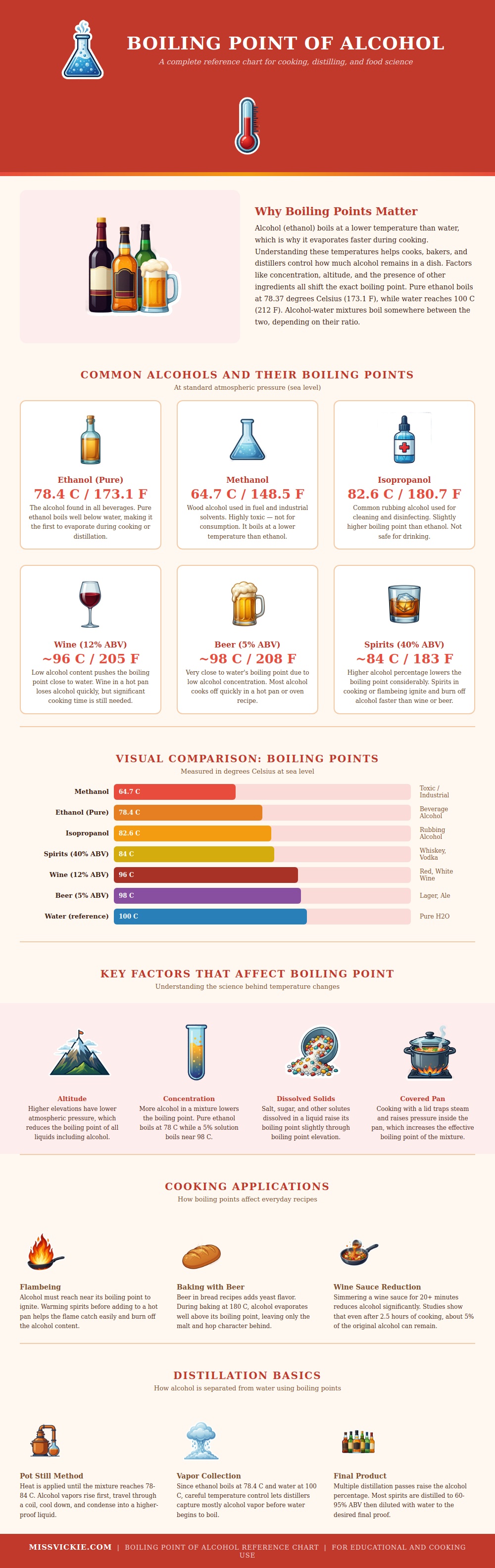
The boiling point of alcohol are the temperature at which alcohol will boils and turn into a gas. Every liquid have a specific boiling point. The boiling point of ethanol is more lower than the boiling point of water.
Because the boiling point of ethanol is lower than the boiling point of water, ethanol will evaporate at a lower temperature than water will. Thus, these difference in boiling points of these two liquid are essential for understanding both how alcohol behave in cooking processes as well as in processes of distillation. The concentration of alcohol in a liquid will change the boiling point of that liquid.
How Alcohol Boils and Affects Cooking
For instance, a liquid that contain a low concentration of alcohol, such as whine, will have a boiling point that is similar to the boiling point of water. However, a liquid that contain a high concentration of alcohol, such as whiskey, will have a boiling point that are closer to the boiling point of pure ethanol. Thus, a liquid that contains a low percentage of alcohol will cause the alcohol in that liquid to take more time to evaporate from a pan than a liquid that contains a high percentage of alcohol.
The altitude at which alcohol is boiling will change the boiling point of that alcohol. At higher altitudes, the air pressure are lower. Lower air pressure will cause the boiling point of alcohol and all other liquid to decrease.
Therefore, if cooking occur at high altitudes, the alcohol in a pan will evaporate more quick. Conversely, the use of a pressure cooker increase the air pressure within the cooker. Increased air pressure raise the boiling point of the liquids within the cooker.
Thus, if the boiling point of the liquid within the pressure cooker are higher, the alcohol will remain in that liquid for a longer period of time. The substances that are dissolve in a liquid will change the boiling point of that liquid. For instance, sugar, salt, and starch is dissolved into that liquid and it will make the boiling point of a liquid higher.
Thus, a liquid that contains alot of sugar or salt will hold onto its alcohol for longer than a liquid that do not contain any sugar or salt. While the impact that dissolved substance has upon the boiling point of a liquid is small, it is still one of the factor that must be considered in relation to the amount of alcohol that is contained within a prepared dish. Distillation take advantage of the difference in the boiling points of ethanol and water.
When a liquid that contains ethanol is heated during the distillation process, the ethanol will become a gas at a lower temperature than the water in that liquid will becomes a gas. The gas contain the ethanol, which can then be allowed to cool until it condense back into a liquid form. Distillers control the temperature at which they boil the liquid during the distillation process, as even small change in the temperature can impact the strength of the alcohol that is distilled.
The boiling point of alcohol can be utilized in cooking to control the flavor of the food prepared. In instances where you’re desired to keep the flavor of the alcohol in the food that is being cooked, the alcohol can be added later in the cooking process or the lid that covers the food will help to trap the alcohol vapor. In instances where it is desired to remove the alcohol from the food being cooked, the liquid can be simmermed for long periods of time or boiled in a pan with a large amount of surface area.
When simmering liquids, such as sauce, the alcohol will depart from the sauce, but it is difficult to remove all of the alcohol from the sauce during the simmering process. It should of been noted that the liquids’ temperature can affect results.