🍳 MissVickie boiled egg timing
Boiled Egg Time Calculator
Dial in yolk gradient, egg size, altitude, boil style, and ice-bath stop time for boiled eggs that land soft, medium, or hard on cue.
Each preset loads a realistic boil setup and recalculates the pull time, yolk band, and carryover stop instantly.
Use the controls below to model size, starting temperature, altitude boil offset, boil strength, and ice-bath carryover stop.
Your Boiled Egg Timing Plan
This plan balances yolk gradient, altitude, boil strength, batch size, and ice-bath stop time so you can pull the eggs at the right second.
Breakdown
The gradient runs from soft to hard. Use these bands as a visual check against the timer result before you chill the eggs.
Set whites, loose center, lowest carryover.
Creamy middle with a thin firm band.
A middle ground for salads and toast.
Best for chopping, filling, and travel.
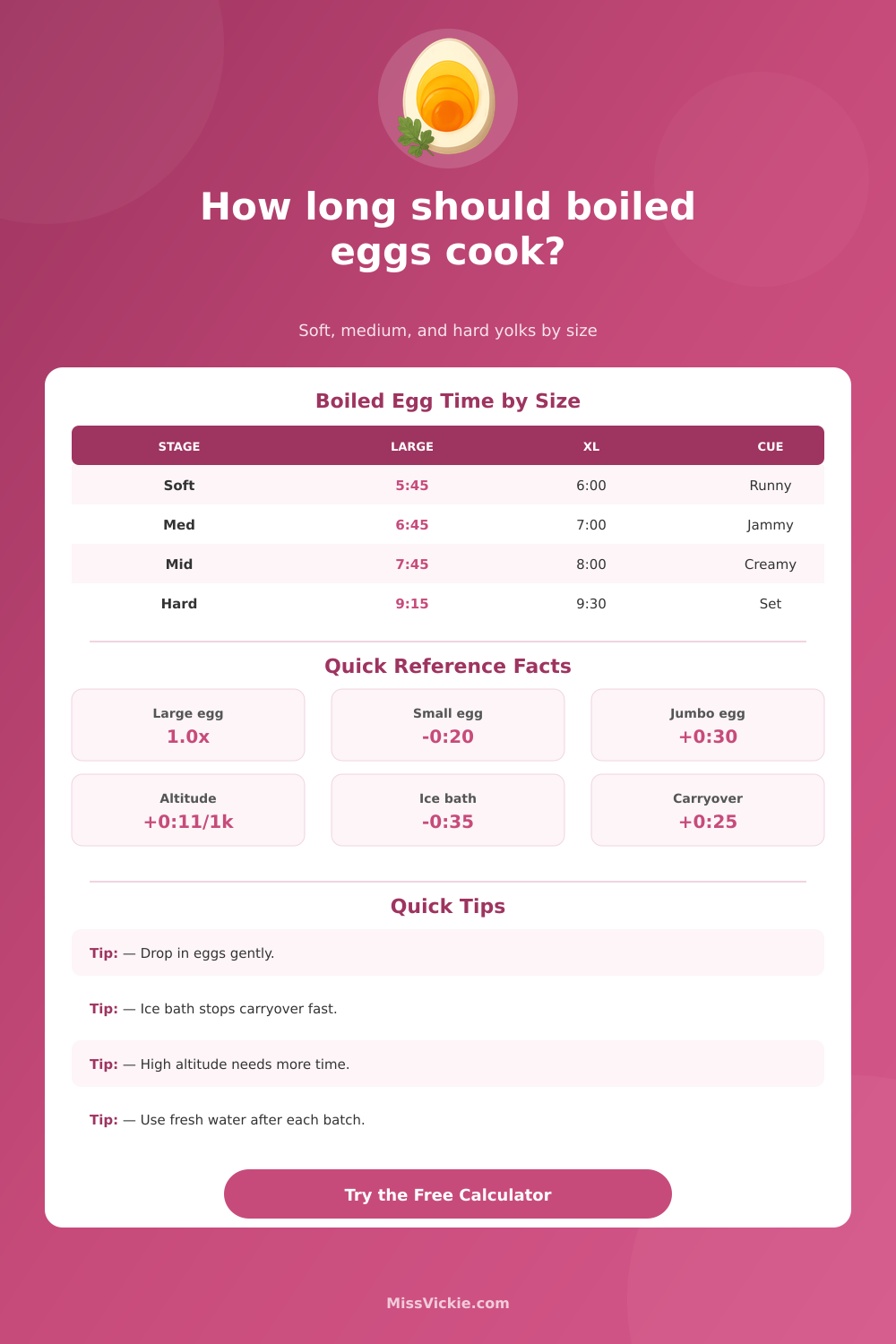
This table shows the baseline simmer window before altitude, egg size, and ice-bath adjustments.
| Stage | Large | Texture | Cue |
|---|---|---|---|
| Soft | 5:40 | Runny ring | bright yolk |
| Medium-soft | 6:35 | Jammy band | creamy edge |
| Medium | 7:30 | Custard set | even center |
| Hard | 9:10 | Fully set | dryest slice |
Size matters because the larger yolk center needs more time to reach the same doneness band.
| Size | Weight | Offset | Note |
|---|---|---|---|
| Small | 42 g | -0:22 | fastest set |
| Medium | 49 g | -0:10 | lighter core |
| Large | 56 g | 0:00 | default anchor |
| Extra large | 63 g | +0:16 | slightly longer |
| Jumbo | 70 g | +0:30 | slowest core |
As altitude climbs, the boil point drops and the simmer window stretches a little longer.
| Altitude | Boil | Offset | Cue |
|---|---|---|---|
| Sea level | 212 F | 0:00 | base boil |
| 1,000 ft | 210 F | +0:06 | tiny lift |
| 3,000 ft | 206 F | +0:18 | longer simmer |
| 6,000 ft | 200 F | +0:36 | noticeable |
This table shows how quickly the ice bath shuts down carryover heat after the eggs leave the pot.
| Mode | Stop | Cue | Use |
|---|---|---|---|
| Instant plunge | 0:16 | fast stop | best yolk lock |
| Quick chill | 0:28 | soft stop | good balance |
| Delayed chill | 0:44 | more carry | firmer center |
| No ice bath | 1:02 | longest set | least control |
Keep these tools close so the timing window stays clean from boil to chill.
Boiling an egg require managing several variables because teh internal temperature of an egg can change based on several factor. For many people, boiling an egg is a difficult task due to the small amount of time required to achieve a soft-boiled yolk versus a hard-boiled yolk. If the cooking time is too short, the yolk will be liquid; if the cooking time is too long, the yold will be hard and dry.
One of the variable to consider when boiling an egg is the size of the egg. A large egg will take longer to boil than a small egg because of the greater mass of the larger egg. The altitude at which you are boiling the eggs can also change the boiling time.
What Affects How Eggs Boil
At higher altitudes, the boiling temperature of water is lower, meaning it will take more time for the eggs to cook. You must account for the size of the eggs and the altitude at which they are boiled when preparing boiled eggs. The starting temperature of the eggs is one more variable to consider when boiling eggs.
If you take the eggs out of a refrigerator, they start at a lower temperature. That low starting temperature can make boiling the eggs take longer. If the eggs are left out at room temperature for a while, they will reach the necessary internal temperature faster.
People can use a calculator to determine the starting temperature of the eggs to prepare them for boiling. Furthermore, another variable to consider is the method in which the eggs are boiled. If you use a gentle simmer instead of a rolling boil, the cooking time will be longer because a rolling boil will heat the egg faster.
If the eggs are dropped into already-boiling water versus starting in cold water, the eggs will cook faster with the hot drop method versus the cold-start method. Carryover cooking for boiled eggs occur when the eggs are still hot from boiling, and the heat continues to cook the yolk even after the cook takes them out of the boiling water. If boiled eggs are left on a plate to cool, the eggs will continue to cook due to carryover cooking, potentialy turning a soft boiled egg into a hard-boiled egg.
To stop carryover cooking, an ice bath can be used. An ice bath will cool the eggs quickly and stop carryover cooking. Depending on the length of time that boiled eggs are cooked, they can come out with either a soft-boiled or a hard-boiled yolk.
Soft-boiled yolks will result in a liquid yolk, whereas medium yolks will result in a thick and jammy yolk. Hard-boiled yolks will result in a firm and pale yolk. You can use a table to determine how long to boil the eggs for a specific type of yolk texture.
Based off the variable for boiling eggs that can be managed, people have more control over the outcome of boiling eggs when they manage each of these variables to achieve the desired result.