Blueberry jam pectin, sugar, lemon juice, yield, jars, and set strength
How Much Pectin For Blueberry Jam Calculator
Estimate pectin for blueberry jam from crushed berry volume, fruit condition, pectin style, sugar plan, lemon juice, desired set, cook loss, jar size, and altitude.
Load a blueberry jam situation, then adjust the berry volume, ripeness, pectin type, sugar level, lemon juice, and jar plan.
Blueberry Jam Breakdown
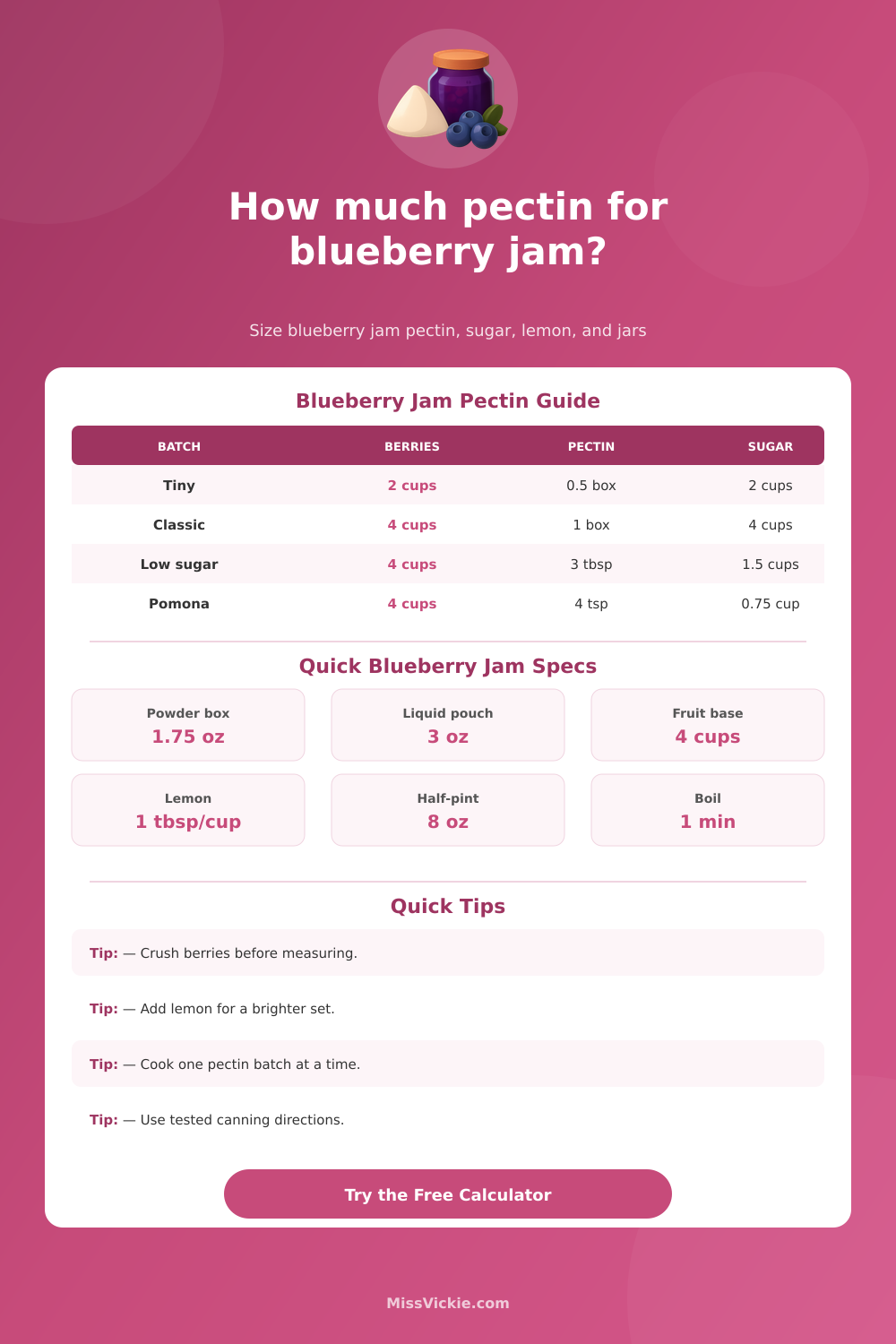
| Blueberry Batch | Crushed Fruit | Regular Powdered Pectin | Typical Sugar |
|---|---|---|---|
| Micro test pan | 1 cup | About 1/4 box or 1.6 tbsp | 3/4 to 1 cup |
| Small household batch | 2 cups | About 1/2 box or 3 tbsp | 1 1/2 to 2 cups |
| Classic cooked batch | 4 cups | 1 box, 1.75 oz | 3 1/2 to 4 cups |
| Wide pot batch | 6 cups | 1 1/2 boxes | 5 to 6 cups |
| Large canner planning | 8 cups | 2 boxes, split if needed | 7 to 8 cups |
| Pectin Type | Blueberry Use Case | Calculator Baseline | Watch Point |
|---|---|---|---|
| Regular powdered pectin | Classic cooked jam with enough sugar | 1 box per 4 cups crushed fruit | Mix into fruit before the full sugar addition. |
| Regular liquid pectin | Quick glossy cooked jam | 1 pouch per 4 cups crushed fruit | Usually added after sugar reaches a full boil. |
| Low or no sugar pectin | Reduced sugar blueberry jam | 3 tbsp per 4 cups fruit | Follow the low-sugar pectin package for sweetener limits. |
| Pomona-style pectin | Honey, maple, or very low sugar jam | 4 tsp pectin plus calcium water per 4 cups | Calcium water matters as much as pectin powder. |
| Freezer jam pectin | Fresh-tasting uncooked or lightly cooked jam | Use product-ratio estimate | Storage is freezer or refrigerator, not shelf-stable canning. |
| Berry Condition | Set Effect | Flavor Effect | Calculator Bias |
|---|---|---|---|
| Wild or small firm berries | Often sets a little tighter | Concentrated and tannic | Subtracts a small amount of pectin. |
| Cultivated fresh berries | Balanced baseline | Round blueberry flavor | No special correction. |
| Thawed frozen berries | Juicier base can set softer | Good flavor but more free liquid | Adds a small pectin cushion. |
| Very ripe soft berries | Lower natural pectin feel | Sweet, mellow, less bright | Adds pectin and benefits from lemon. |
| Thawed and drained berries | More concentrated than undrained frozen fruit | Less syrupy | Uses a lighter correction. |
| Jar Plan | Finished Volume | Best For | Headspace Reminder |
|---|---|---|---|
| Quarter-pint | 4 oz / 118 ml | Gift jars and tasting sets | Leave the tested recipe headspace. |
| Half-pint | 8 oz / 237 ml | Most blueberry jam batches | Common jelly jar size. |
| 12 oz jar | 12 oz / 355 ml | Family refrigerator jars | Check that your canning directions allow the jar size. |
| Pint | 16 oz / 473 ml | Large-use fridge jam | Many tested jam recipes prefer half-pints. |
Best when you want a familiar blueberry jam set from 4 cups crushed berries and full sugar.
Works when blueberry flavor matters more than a very sweet traditional jam profile.
Useful for honey, maple, or lower sugar batches because calcium helps form the gel.
Possible as a loose preserve, but yield drops and the set depends heavily on fruit and temperature.
Blueberry jam are a food product made from blueberries, sugar, pectin, and an lemon juice. The ingredient of blueberry jam must be balanced as the balance of the ingredients will determine the texture of the jam. If you use the right amount of pectin, sugar, and lemon juice, then the jam will set and form a gel.
However, if the ingredients are not balanced correct, the jam will not set correctly and may remain in a liquid form. Blueberries contains some pectin but not enough to produce a thick blueberry jam by itself. You must add an extra amount of pectin to ensure the jam set correctly.
How to Make Blueberry Jam Set
The condition of the blueberries may change the amount of pectin needing to set the jam. Jam made with fresh blueberries will contain different amount of pectin than jam made with frozen or very ripe blueberries. Frozen and very ripe blueberries will release extra liquid that could affect the setting of the jam and the amount of pectin that is needed.
Sugar is needed to make jam as the pectin will not set without the sugar. The amount of sugar must be correct as the pectin require sugar to produce the jam. If there is less sugar then what is required, the jam will not set proper and will be softer.
Using liquid sweeteners such as honey or maple syrup for the sugar will make the jam loose as these ingredient will introduce extra liquid to the jam. Lemon juice is added to the jam for flavor as well as to provide the acid that will allow the pectin to set. Pectin will not work correctly without the necessary amount of lemon juice.
If there is not enough lemon juice, the jam will not set proper. However, if there is too much lemon juice, the jam will contain to much acid and will taste too sharply for the jam. Yield is the amount of jam that will be produced.
As the jam simmers on the stove, the water in the jam will evaporate. This loss of volume of the jam during the simmering is referred to as cook-loss. Cook-loss will change the amount of jam that will be produced once it is set and pour into the jars.
Simmering the jam for a longer period will produce more cook-loss as more water will evaporate during the jam cooking process. Tables can be use to compare different blueberry jam recipes. One table can be used to compare recipes of different sizes.
Another can be used to compare regular pectin to low-sugar pectin. Furthermore, another table can be used to explain the effect of the condition of the blueberries on the jam setting. These tables provides extra information beyond what is required by the jam calculator to determine how much of each ingredient will be needed to make the jam.
Some of the most common mistake when making jam include incorrect measurements of the amount of fruit and incorrectly adding the jam ingredients in the order in which they should be added. The blueberries should be crushed before measuring them. Adding the sugar before dispersing the pectin will lead to the formation of lumps when boiling the jam.
Furthermore, if too many batch of jam are cooked in one large pot, the jam may not set correctly due to uneven heating of the jam in the one large pot. Altitude is an ingredient that can be accounted for in the jam calculator; however, the amount of pectin, sugar, and lemon juice do not change with the altitude where the jam is being prepared. The altitude will change the amount of time in which the jam should be canned to ensure proper shelf life of the jam.
Although the jam must be canned according to the altitude where it will be canned, the chemical component of the jam do not have to change according to the altitude. The jam calculator allow for the planning of the jam considering all of the variable. If the person making the jam prefers jams that are firm or soft, the jam calculator can make adjustment to the amount of ingredients based on the preference for texture of the jam.
Furthermore, using the jam calculator will ensure that the amount of pectin, sugar, and lemon juice required for setting is correct for the type of blueberries that will be used to make the jam.