Glucose mg/dL, mmol/L, sample timing, fasting ranges, post-meal ranges, and personal targets
Blood Sugar Unit Conversion Calculator
Convert a blood glucose reading between mg/dL and mmol/L, then compare it with common fasting, pre-meal, post-meal, bedtime, random, or CGM target notes.
Choose a common meter reading or sample scenario, then adjust the unit, timing, target profile, and personal target range.
Conversion Breakdown
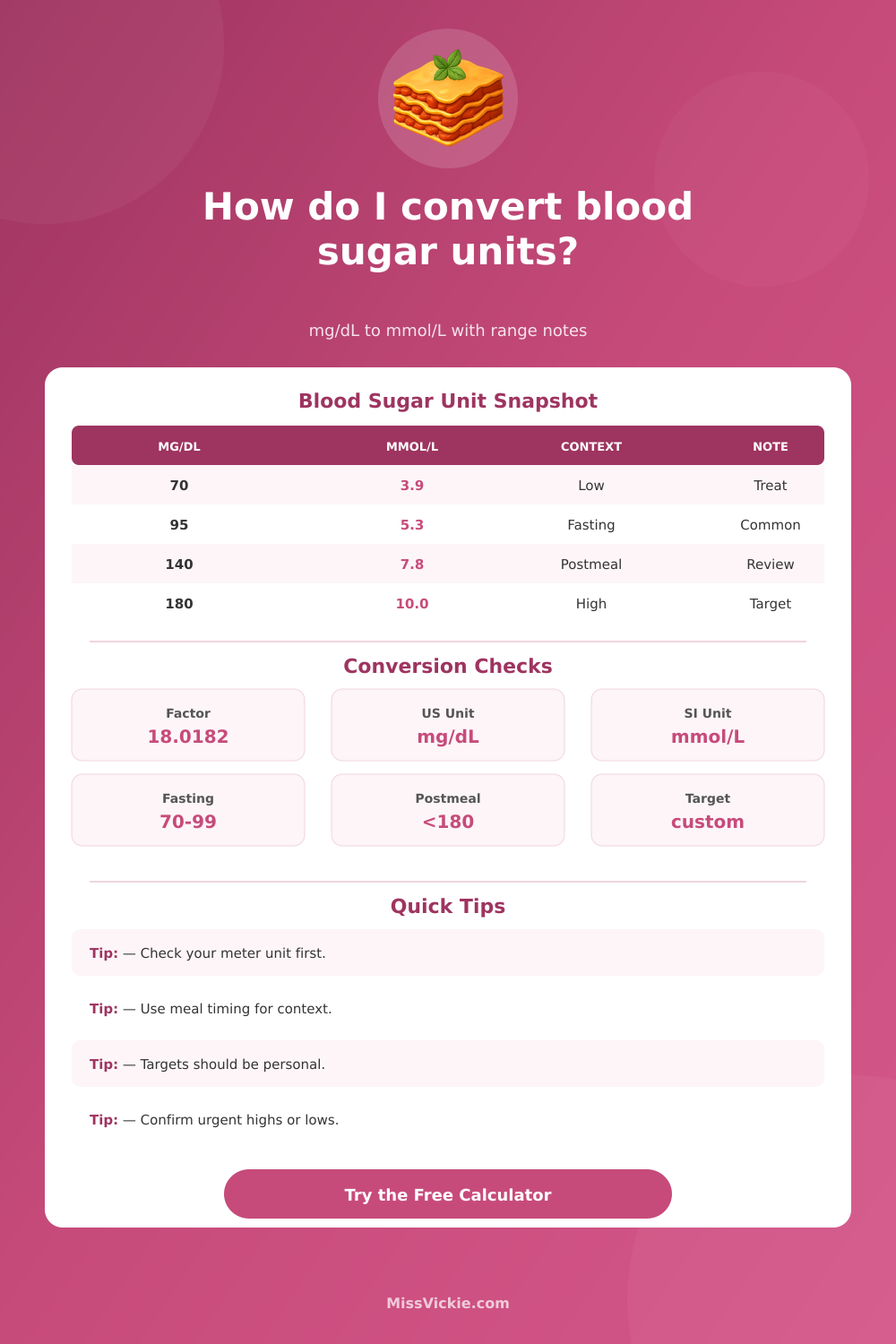
Divide mg/dL by the glucose molecular conversion factor.
Multiply mmol/L by the same factor for US-style readings.
Many US meters show whole-number mg/dL readings.
Many mmol/L meters show one decimal place.
| mg/dL | mmol/L | Common Context | Conversion Note |
|---|---|---|---|
| 54 | 3.0 | Clinically significant low | Needs prompt action based on care plan. |
| 70 | 3.9 | Low threshold | Often used as the lower alert boundary. |
| 95 | 5.3 | Common fasting value | Within many general fasting references. |
| 100 | 5.6 | Fasting boundary | Start of impaired fasting glucose range. |
| 126 | 7.0 | Fasting lab threshold | Needs appropriate lab confirmation. |
| 140 | 7.8 | Post-meal marker | Often used in 2-hour screening context. |
| 180 | 10.0 | Common after-meal goal | Frequently cited for many adults with diabetes. |
| 250 | 13.9 | High reading | Follow personal sick-day or ketone guidance. |
| Sample Context | mg/dL Reference | mmol/L Reference | Interpretation Note |
|---|---|---|---|
| Low glucose alert | Below 70 | Below 3.9 | Common threshold for hypoglycemia action plans. |
| General fasting reference | 70 to 99 | 3.9 to 5.5 | Often used as a common fasting comparison range. |
| Impaired fasting glucose | 100 to 125 | 5.6 to 6.9 | Discuss repeat testing and risk factors with a clinician. |
| Diabetes fasting threshold | 126 or higher | 7.0 or higher | Diagnosis usually requires proper lab confirmation. |
| Common adult diabetes pre-meal goal | 80 to 130 | 4.4 to 7.2 | Often individualized for nonpregnant adults. |
| Timing | mg/dL Reference | mmol/L Reference | Use In Calculator |
|---|---|---|---|
| 1 hour after meal in pregnancy plans | Often under 140 | Often under 7.8 | Pregnancy targets need clinician direction. |
| 2 hours after meal in pregnancy plans | Often under 120 | Often under 6.7 | Used only when pregnancy profile is selected. |
| 2 hours after meal screening | Under 140 | Under 7.8 | Common normal 2-hour comparison marker. |
| Many adults with diabetes after meal | Under 180 | Under 10.0 | Common individualized post-meal goal marker. |
| Random high with symptoms | 200 or higher | 11.1 or higher | Needs prompt clinical interpretation. |
| Profile | Typical Low | Typical High | Important Note |
|---|---|---|---|
| General fasting comparison | 70 mg/dL / 3.9 mmol/L | 99 mg/dL / 5.5 mmol/L | Screening comparison only, not a diagnosis. |
| Common adult diabetes pre-meal | 80 mg/dL / 4.4 mmol/L | 130 mg/dL / 7.2 mmol/L | Targets may be higher or lower by care plan. |
| Common adult diabetes post-meal | 80 mg/dL / 4.4 mmol/L | 180 mg/dL / 10.0 mmol/L | Often checked 1 to 2 hours after starting a meal. |
| Pregnancy fasting target | 60 mg/dL / 3.3 mmol/L | 95 mg/dL / 5.3 mmol/L | Use only clinician-directed pregnancy targets. |
| CGM time-in-range review | 70 mg/dL / 3.9 mmol/L | 180 mg/dL / 10.0 mmol/L | One reading is not the same as time in range. |
Blood sugar measurement exist on lab reports, glucose meters, and continuous glucose monitors, but each use one of two different measurement system. Each system use a different unit to display the blood sugar measurement. One unit use milligrams per deciliter, while the other use millimoles per liter.
To properly understand the blood sugar measurement, it is necessity to convert the blood sugar measurement from one unit to the other. While the glucose calculator can make this mathematical conversion for you by entering your blood sugar reading and selecting the unit that your glucose meter use, the blood sugar reading is still not useful until you complete the rest of the form. It is important to know when your blood sugar was measure.
How to Convert and Understand Blood Sugar Readings
A fasting blood sugar reading should be compared to a different target range then, for example, your bedtime blood sugar. Using the label selector allow you to compare your blood sugar measurement to the correct target range. It is common for a person to be confuse by the fact that their glucose meter display one number for blood sugar, while their lab report display a different number.
These two numbers is representing the same amount of sugar in the blood, but the glucose meter display the measurement in milligrams per deciliter while the lab reports the number in millimoles per liter. The difference between these two numbers is due to the molecular weight of glucose and the volume of liquid being measure. Once a person understand that both units indicate the same amount of sugar in the blood, they can focus on which reference range should be used to evaluate that blood sugar reading.
The reference range for blood sugar for each individual are not the same. The reference range for a person without diabetes is not the same as the reference range for a person with type 2 diabetes. Additionally, the reference range for a pregnant woman will be different from the reference range for a man or a woman who are not pregnant.
The profile selector allow a user to switch between the different blood sugar profile, and the changing target range will ensure that the comparison between blood sugar and target range is accurate. If the user chooses the incorrect profile, the comparison will be incorrect. Another factor in interpreting blood sugar reading is the timing of the blood sugar measurement.
A blood sugar reading taken two hours after meal will have a different target range then a blood sugar measurement taken before meal. The minutes since meal feature on the calculator allow for the selection of the timing of the blood sugar measurement. While the calculator will not judge the blood sugar measurement, it will place the blood sugar measurement into the correct category based on the number of minutes since the last meal.
The source from which the blood sugar measurement was taken is another factor that should be consider. The source of the blood sugar sample can be either fingerstick capillary blood, venous lab plasma, or estimate from a continuous glucose monitor. While each of these contain the same amount of sugar in the blood from the same individual at the same time, the source are not the same.
A glucose meter will read the blood from a fingertip, while a lab test will take blood from a vein. The blood glucose source selector will allow a user to select the source of the blood sample. In addition to the blood sugar reading itself, another focus area for a user is the trend of the blood sugar measurement.
A fasting blood sugar measurement of 95 mg/dL is not the same as a blood sugar measurement of 95 mg/dL that occur after the patient has experienced stress. The trend selector will allow a user to note these circumstance regarding the blood sugar measurement. While the trend selector will not change the mathematical conversion of the blood sugar reading, it will help to ensure that the context of the blood sugar reading is maintained.
Safety exist outside of the blood glucose calculator. If your blood sugar level are too low or too high, or if you are experiencing symptom that do not match your blood sugar levels, you should seek clinical attention. While the calculator have a disclaimer stating that it can only mathematically convert blood sugar measurement and compare them to target range, it cannot replace clinical attention that may be required.
The habit that should be develop is to check both the blood sugar reading and the context of the blood sugar reading. While the calculator remove the need for performing the mathematical calculation of blood glucose, it is still important to focus on the question of both the value and the context of the blood sugar reading.