Blood Alcohol to Breath Alcohol Calculator
Convert a blood alcohol concentration into estimated breath alcohol using BAC units, a blood-to-breath partition ratio, output breath unit, elapsed time, elimination rate, and uncertainty range.
Load a common reporting style, then adjust the units, ratio, time, uncertainty, and jurisdiction shown with the result.
Conversion Breakdown
Same numeric value as g/dL for common BAC reporting.
Common blood concentration wording in many laws.
Breath mass per liter from the selected partition ratio.
Grams per 210 liters of breath for comparison.
| BAC Reporting Unit | Meaning | Example at 0.080% | Convert to g/dL |
|---|---|---|---|
| % BAC | Grams ethanol per 100 mL blood | 0.080% | Use the same number as g/dL |
| g/dL | Grams per deciliter blood | 0.080 g/dL | Use directly |
| mg/dL or mg/100 mL | Milligrams per deciliter blood | 80 mg/dL | Divide by 1000 |
| g/L | Grams per liter blood | 0.80 g/L | Divide by 10 |
| mmol/L ethanol | Moles using ethanol molecular weight | 17.37 mmol/L | Multiply by 46.07 then divide by 10000 |
| Breath Unit | Formula from mg/L | Example at 0.080 BAC, 2100:1 | Where Seen |
|---|---|---|---|
| mg/L breath | Base BrAC value | 0.381 mg/L | Scientific and device-style reporting |
| ug/100 mL breath | mg/L x 100 | 38.1 ug/100 mL | UK-style breath reporting |
| g/210 L breath | mg/L x 0.21 | 0.080 g/210 L | US statutory breath equivalent |
| mg/100 mL breath | mg/L x 0.1 | 0.038 mg/100 mL | Alternate lab-style breath display |
| ug/L breath | mg/L x 1000 | 381 ug/L | Instrument and research conversion |
| Ratio | At 0.080 BAC | Effect on BrAC | Use in Calculator |
|---|---|---|---|
| 1700:1 | 0.471 mg/L | Higher estimated breath value | Lower-ratio sensitivity check |
| 1900:1 | 0.421 mg/L | Moderately higher than 2100 | Cautious comparison |
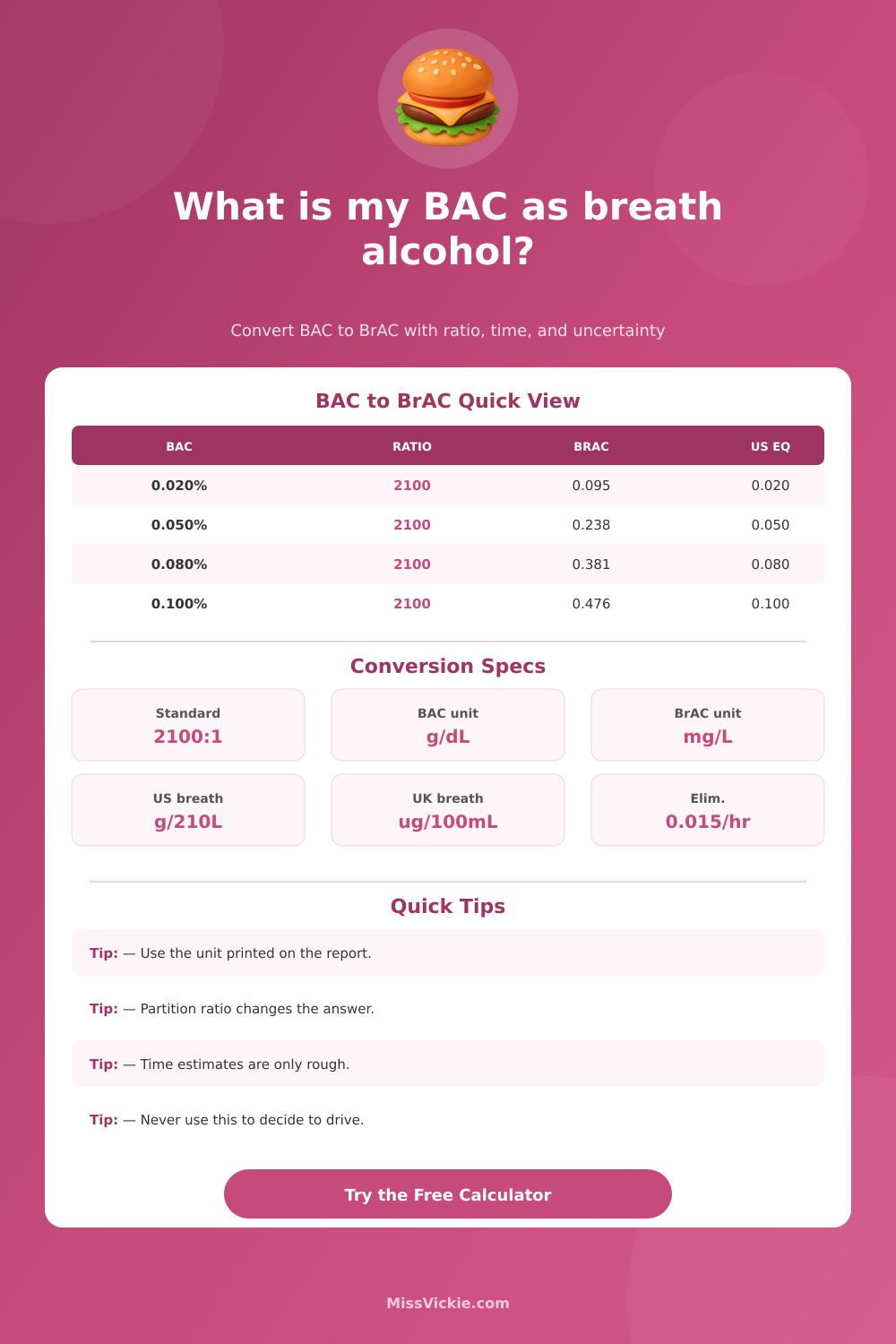
| 2100:1 | 0.381 mg/L | Common statutory equivalence | Default setting |
| 2300:1 | 0.348 mg/L | Lower estimated breath value | Higher-ratio sensitivity check |
| Display Option | BAC Limit Shown | Breath Limit Shown | Important Note |
|---|---|---|---|
| US most states and DC | 0.080 g/dL | 0.080 g/210 L | Lower limits may apply to commercial, young, or probationary drivers |
| Utah adult per se | 0.050 g/dL | 0.050 g/210 L | Utah uses a lower adult per se display than most US states |
| Canada display | 80 mg/100 mL | 0.080 g/210 L equivalent | Provincial roadside sanctions can start lower |
| England, Wales, NI | 80 mg/100 mL | 35 ug/100 mL | Breath and blood limits are not always exact 2100-ratio twins |
| Scotland | 50 mg/100 mL | 22 ug/100 mL | Lower UK limit display for Scotland |
| Australia full licence | 0.050% | 0.050 g/210 L equivalent | Zero or lower limits can apply by licence class |
The breath alcohol concentration value reflect the same as the blood alcohol concentration but measured on a different part of the body. A laboratory can measure the blood alcohol concentration through drawing blood and running the sample through a laboratory, while analyzing the exhaled air of an individual measures the breath alcohol concentration. The two measurements display different value due to the units in which they are measured and the way that alcohol move from the blood to the breath.
Because these two values dont always align, it is necessary to create a converter that allows individuals to input one of the measurements and recieve the other as an output of the calculation. The mathematical equation used to calculate the breath alcohol concentration from the blood alcohol concentration utilize the partition ratio. The partition ratio describe the amount of alcohol that moves from the blood to the lungs and is measured in air.
How to Convert Blood Alcohol to Breath Alcohol
Most legal system use a partition ratio of 2100 to 1 for alcohol content in the blood and breath. However, the ratio can differ from individual to individual due to factors like body temperature, breathing rate, and the chemistry of the lungs. An individual with a lower partition ratio will have a higher breath alcohol concentration reading than the blood alcohol concentration reading, while an individual with a higher partition ratio will have a lower breath alcohol concentration reading.
The calculator can help to test various partition ratio to determine how that changes the breath alcohol concentration reading. Time is another factor that plays into the calculation of alcohol concentration in the blood and breath. After the alcohol is consumed, the alcohol concentration in the blood decrease at a steady rate after the body absorbs the alcohol.
This hourly reduction rate allow for the estimation of the alcohol concentration in the blood at any given time prior to or after the time when the blood sample was taken. However, the hourly reduction is only an estimation of the actual rate at which the alcohol leave the blood of an individual. Factors like food intake prior to drinking or the amount of body weight can impact that rate.
The adjustment for hourly reduction allows individuals to determine if the blood alcohol concentration reading several hour prior to the blood sample is still relevant to the current situation. Uncertainty is present in all measurements. Whether the measurement is of blood or breath alcohol concentration, there is some error associated with that measurement.
Errors can occur due to the equipment used to measure the alcohol concentration, the way in which the samples are drawn, or the time at which the measurements are taken. The uncertainty setting for the calculator allow individuals to adjust for the potential for these errors to impact the alcohol concentration measurements, allowing them to view the measurement of alcohol concentration in both blood and breath with a certain range. A narrow range indicates that the measurement is likely close to the calculated value, but a wide range provide allowances for the true measurement to be higher or lower than the calculated value.
The settings relating to the various jurisdictions allow individuals to compare the calculated alcohol concentration in the blood and breath with the limit published by those various regions. Each jurisdiction has published different limit for alcohol concentration in the blood and breath. Additionally, the breath alcohol concentration limits vary in different region of the world.
These settings allow individuals to view the calculated alcohol concentration in the blood and breath in the context of the legal limits for that jurisdiction. However, this comparison is for informational purposes only. Errors are likely to occur in the measurement of alcohol concentration if individuals are not careful to use the appropriate units for those measurements.
For instance, values of alcohol concentration in the blood may be reported in relation to milligrams per deciliter (mg/dL) in one jurisdiction, but in grams per deciliter (g/dL) in another report. These measurements are the same, but if you dont enter the value correctly into the calculator, the result will be inaccurate by a factor of 1000. The breath alcohol concentration calculation displays the step in which the blood alcohol concentration was converted to the breath alcohol concentration so that individuals can review these step to ensure that the starting value was correctly entered into the calculator prior to calculating the breath alcohol concentration.
Breath alcohol concentration unit differ between regions of the world. For instance, breath alcohol concentration may be reported in milligrams per liter (mg/L) in one region of the world while it may be reported in micrograms per 100 milliliters (mcg/100mL) in another region of the world. These unit are the same, but the selection of the correct unit will make the breath alcohol concentration reading easier to compare to legal limits for breath alcohol concentration.
Some condition in the real world may not match the mathematical calculation of the breath and blood alcohol concentration. Factors like body temperature, amount of physical activity performed by the individual, and the time of the last drink of alcohol can all impact the partition ratio of an individual. Because the breath and blood alcohol concentration calculator cannot account for these variable, the only true calculation that the tool can perform is the calculation of the variable that are accounted for in the calculator.
However, it is important for individuals to recognize this limitation regarding the breath and blood alcohol concentration calculator. The table located on this page list the conversions of common blood alcohol concentration level to breath alcohol concentration level and the conversions of common breath alcohol concentration level to blood alcohol concentration level. Additionally, the tables also illustrate the change in breath alcohol concentration value with changes in the partition ratio of an individual.
These table provide individuals with an understanding of the relationship between blood and breath alcohol concentration level before they begin to calculate these value for themselves. Finally, while the breath and blood alcohol concentration calculator can provide individuals with the alcohol concentration level of an individual’s system, those level do not indicate levels of impairment. Individuals may have the same amount of alcohol in their blood and breath, but exhibit different level of impairment from that alcohol due to factors like body weight, health, level of fatigue, and other substance in their systems.
While the calculator can aid in the understanding of how alcohol concentration relate to each variable, the calculator does not indicate how an individual will function at specific level of alcohol concentration. Thus, the calculator can remove the confusion between the two variable, but individuals must use their own judgment to understand the implications of each calculated value.