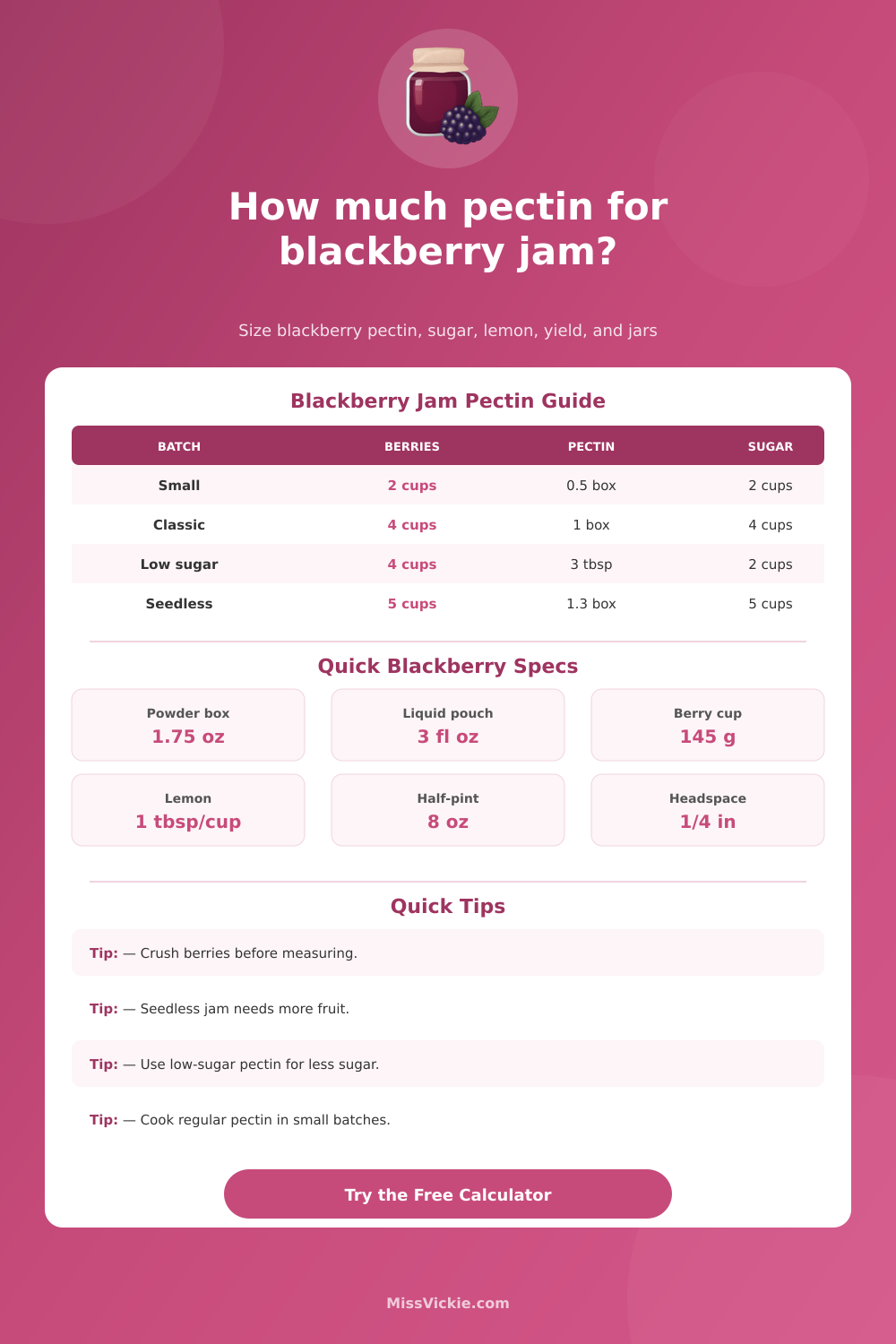
Blackberry pectin, sugar ratio, lemon, seed strain, berry condition, yield, and jars
How Much Pectin for Blackberry Jam Calculator
Estimate blackberry jam pectin from crushed berries, juice or puree, seed removal, pectin style, sugar plan, lemon juice, cook loss, jar size, and altitude.
Load a blackberry jam scenario, then adjust berry form, sugar level, pectin type, seed straining, lemon juice, jar size, and batch scale.
Blackberry Batch Breakdown
| Pectin type | Typical blackberry base | Calculator unit | Sugar behavior | Best use |
|---|---|---|---|---|
| Regular powdered pectin | 4 cups crushed blackberries | 1 box, 1.75 oz | Needs high sugar for a firm gel | Classic cooked blackberry jam |
| Regular liquid pectin | 4 cups fruit or juice | 1 pouch, 3 fl oz | Usually added after sugar boil | Glossy jam or jelly-style batches |
| Low or no-sugar pectin | 4 cups crushed berries | 3 tbsp powdered pectin | Works with reduced sugar | Fruit-forward spreads |
| Pomona-style calcium pectin | 4 cups fruit base | 4 tsp pectin plus calcium water | Can gel with little sugar or honey | Flexible sweetener recipes |
| Instant freezer pectin | 4 cups crushed berries | 5 tbsp or product packet | No-cook set varies by brand | Freezer or refrigerator jam |
| Bulk HM pectin | 1000 g fruit and sugar blend | 8 to 12 g pectin | Needs sugar and acid | Experienced large-batch scaling |
| Berry form | Density used | Seed strain factor | Pectin effect | Texture note |
|---|---|---|---|---|
| Crushed whole berries | 145 g per cup | Low loss | Baseline | Classic seeded blackberry jam |
| Partly strained pulp | 140 g per cup | Medium loss | Small increase | Fewer seeds, still jam-like |
| Fully seedless base | 135 g per cup | High loss | Moderate increase | Smoother, lower solids |
| Clear blackberry juice | 240 g per cup | Pulp removed | Jelly-style increase | Sets like jelly, not preserve |
| Thawed frozen berries | 150 g per cup | Juice released | Small increase | Loose, juicy fruit base |
| Wild tart berries | 142 g per cup | Low loss | Small decrease | More acid and natural set |
| Prepared blackberry base | Regular powder | Low-sugar pectin | Classic sugar | Half-pint yield |
|---|---|---|---|---|
| 2 cups crushed berries | 0.5 box | 1.5 tbsp | about 1.3 cups | 2 to 3 jars |
| 4 cups crushed berries | 1 box | 3 tbsp | about 2.9 cups | 5 to 6 jars |
| 5 cups seedless base | 1.3 boxes | 4 tbsp | about 3.6 cups | 6 to 7 jars |
| 6 cups crushed berries | 1.5 boxes | 4.5 tbsp | about 4.4 cups | 8 to 9 jars |
| 8 cups crushed berries | 2 boxes | 6 tbsp | about 5.8 cups | 10 to 12 jars |
| 12 cups crushed berries | 3 boxes | 9 tbsp | about 8.7 cups | 16 to 18 jars |
| Condition | What changes | Calculator response | Kitchen check | Processing reminder |
|---|---|---|---|---|
| 0 to 1000 ft | Standard boil behavior | Base processing note | Full rolling boil | Use tested recipe time |
| 1001 to 3000 ft | Lower boil temperature | Altitude reminder | Cold plate set test | Add time as directed |
| Rainy watery berries | Diluted solids | Raises pectin pressure | Watch sheet test | Avoid oversized pot |
| Very low sugar | Regular pectin weakens | Shows set warning | Use low-sugar pectin | Follow product insert |
| Seedless straining | Pulp and seeds removed | Adjusts fruit solids | Measure after straining | Use safe juice recipe |
This calculator estimates jam ingredients for planning. For shelf-stable canned blackberry jam, follow a tested recipe for acid, jar size, headspace, and water-bath processing.
Making blackberry jam require that you manage several differents variables. You must manage these variable because blackberries contain fewer natural pectin than other fruit, such as apples and currants. You must decide how much commercial pectin to add to the jam because too much or too little will result in the jam being either too thin (like syrup) or too thick (like candy).
You must also decide how much sugar to add to the jam, as the jam will not reach the right consistency without a correct amount of sugar. If the variable of pectin and sugar are balanced correct in the jam, the jam will hold its shape on a spoon. However, if the variables are not balanced correct, the jam could be too thin or too thick.
Things That Affect Blackberry Jam
The condition of the blackberries will also change the outcome of the jam. If the blackberries are not yet ripe, they will contain more natural pectin. However, they will also be more tart, so you will have to add more lemon juices.
If the blackberries are frozen, the ice crystals will break down the cell wall of the blackberries. This will cause the jam to release more liquid when you allow the frozen blackberries to thaw. Another variable is whether or not the cook will remove the seed from the blackberries.
While many people prefer seedless jam, the removal of the seeds will also remove the pulp from the jam. If the jam contains less solid than jam with the seeds intact, you will have to adjust the amount of pectin you use in the jam. Furthermore, if the seeds and the pulp is removed from the blackberries, there will be less liquid made into jam.
This will result in the production of less jars of blackberry jam if seedless jam is made. Sugar is another ingredient that is required for the make of blackberry jam. It will help the pectin to set and will also create a jam that is safe to make into jar for canning.
Most recipe use equal weights of blackberries and sugar. However, you can use different amounts of sugar to create jam with a different flavor or texture. Using less sugar will result in jam with a brighter flavor of blackberry.
However, a lower sugar content will require a specific type of pectin for the jam to set proper. The percentage of sugar can be used to determine how much sugar to add to the jam. The percentage of sugar will also affect the dose of pectin that must be used, as well as the yield of jam.
Adding lemon juice to jam will provide the acid that the pectin need to set. Blackberries can vary in they acidity. Therefore, adding lemon juice will ensure that the jam contains enough acid to allow the pectin to create a setting.
Jam without enough lemon juice will remain soft. Jam with too much lemon juice will have a sharp flavor. Knowing the yield of jam that will be produced is another variable that must be calculated before making jam.
The yield will be affected by how much liquid evaporate during the cooking process, how much liquid the sugar will add to the jam, and how much headspace will be allowed in the jars. This calculation will allow you to know how many jar will be needed to contain the jam. It will also allow you to know whether you will cook the jam in batch of different sizes.
Cooking jam in smaller batches will work better for jam made from blackberries than cooking large batches of jam at once. Jam cooked in large batches may be difficult to boil to the proper temperature for setting. The altitude where jam is being cooked will also affect the jam recipe.
Boiling temperatures decrease at higher altitude. Therefore, if you live in an area at a high altitude from sea level, you will have to adjust the processing time for jam. Following the guidelines for your local area will ensure that your jam is processed correct.
Pectin is not one ingredient but several with different requirement. Regular high methoxyl pectin will require both sugar and acid to set and will have to be added early in the jam making process. Low methoxyl pectin is formulated to work with jams that contain less sugar.
Calcium set pectin will work with jams that contain honey or very little sugar. Freezer pectin will only work with jams that do not have to be cooked and will be stored in the refrigerator or freezer. Another variable that must be considered is accurately measure the blackberries.
If measuring the whole blackberries as opposed to crushed blackberries, there will be more air in the jam. Therefore, if you measure the blackberries before being crushed, there will not be enough solids for jam made with that amount of blackberry. Crushing or straining the blackberries before measuring them will ensure that the jam will contain the amount of jam that was intended from the recipe.
Furthermore, if the jam is seedless, the resulting jam will behave more like jelly. Therefore, the jam will have a firmer set and less yield than jam that use whole blackberries with seeds intact. In making jam with blackberries, several variable will affect the outcome of the jam.
Each variable must be managed appropriately to ensure the jam set and tastes great.