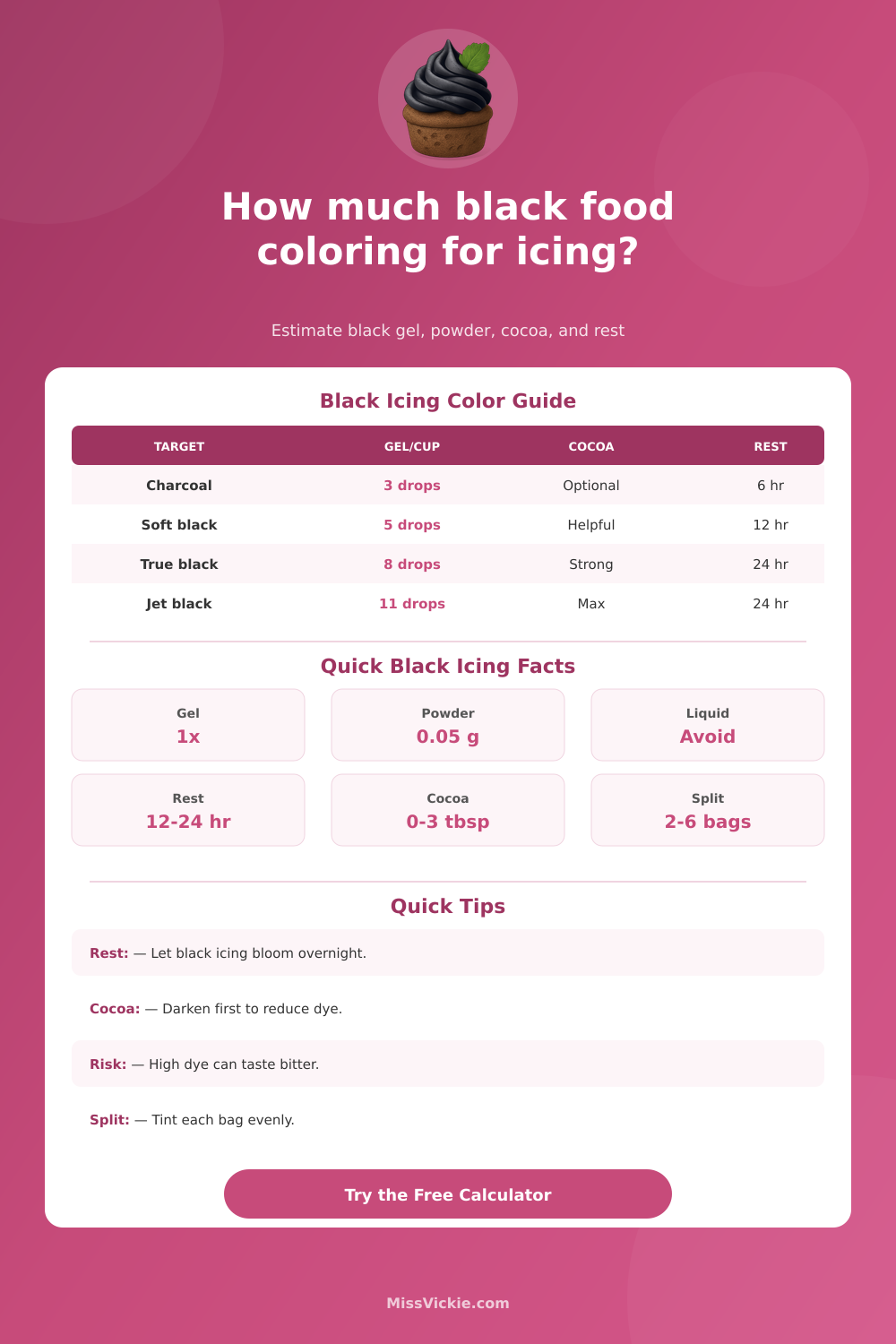
Black icing tint, cocoa support, bloom time, and batch split math
Black Food Coloring in Icing Calculator
Estimate how much black gel or powder food coloring to use in icing based on batch weight, icing type, cocoa pre-darkening, target charcoal or black shade, rest time, stain risk, and split batches.
Start with a familiar black icing job, then adjust the batch weight, cocoa support, colorant type, rest time, and number of piping bags.
Black Icing Breakdown
| Target shade | Gel estimate per cup | Best support | Practical use |
|---|---|---|---|
| Charcoal gray | 2 to 4 drops | Optional cocoa or gray starter | Cupcake swirls, marbled icing, pale spooky themes |
| Soft black | 4 to 6 drops | Regular or Dutch cocoa | Drips, borders, lettering, and medium details |
| True black | 7 to 9 drops | Dutch or black cocoa | Cake coverage, cookie icing, strong piping work |
| Jet black accents | 10 to 13 drops | Black cocoa plus overnight rest | Logos, outlines, small details, and high-contrast accents |
| Pre-darkening choice | Dye reduction | Flavor effect | Best use |
|---|---|---|---|
| No cocoa support | 0% | No chocolate note | Vanilla icing where color will be charcoal or detail-only |
| Regular cocoa | 12% | Mild chocolate | Soft black frosting, cupcakes, and darker vanilla bases |
| Dutch cocoa | 20% | Round chocolate | True black buttercream with lower bitterness risk |
| Black cocoa | 32% | Oreo-style dark cocoa | Deep black designs and overnight resting batches |
| Chocolate ganache support | 26% | Rich chocolate | Ganache buttercream, fillings, and black drip-style icing |
| Black colorant | Compared with gel | Calculator unit | Caution |
|---|---|---|---|
| Black gel paste | 1x | Drops | Good all-purpose choice; add gradually and var color bloom. |
| Extra-strength black gel | 0.72x amount | Drops | More concentrated; easier to overshoot small batches. |
| Black powdered food color | 0.05 g per gel drop | Grams | Sift or make a paste to avoid specks in smooth icing. |
| Airbrush black mixed in | 2.4x amount | Milliliters | Better for surface spray than mixed-in deep black icing. |
| Liquid black drops | 4x drops | Drops | Can loosen icing before it reaches a true black shade. |
| Plant charcoal style powder | 0.08 g per gel drop | Grams | Check food-use suitability and keep flavor expectations realistic. |
| Icing type | Black color behavior | Factor | Mixing note |
|---|---|---|---|
| American buttercream | Opaque and forgiving | 1.00x | Can handle cocoa support and gel better than delicate icings. |
| Swiss meringue buttercream | Fat-rich and slow to bloom | 1.15x | Rest before adding more because black deepens over time. |
| Italian meringue buttercream | Silky and slightly pale | 1.18x | Use black cocoa or powder if gel starts softening texture. |
| Royal icing | Dries darker than wet color | 0.86x | Stop a touch shy of black and test a dried sample. |
| Cream cheese icing | Ivory base mutes black | 1.22x | Keep cocoa support moderate so tangy flavor stays balanced. |
| Fondant | Pigment needs kneading | 1.30x | Use paste or powder and gloves, then rest wrapped fondant. |
| Split plan | Best workflow | Color matching risk | Calculator use |
|---|---|---|---|
| One bowl | Tint the full batch, rest, then bag | Lowest | Use the total result directly. |
| Two to three bags | Tint full batch first, then divide by weight | Low | Use per-bag amount for planning only. |
| Four to six bags | Make a black starter paste before splitting | Medium | Reserve extra to correct lighter bags. |
| Eight small bags | Weigh each bag and tint from one starter paste | High | Round carefully; tiny differences show in black icing. |
For the cleanest black, mix to dark gray first, cover the icing, rest it, then adjust after the color blooms.
Achieving a true black color with icing can be tricky. The color of the icing, the amount of cocoa powder used, and the resting period of the icing can all play a role in the outcome of the icings color. As such, adding black gel to white icing is one method for achieving black icing.
However, because white icing reflects the light, you must add more dye to white icing in order to achieve true black icing. Using excessive amount of dye, though, may lead to the icing having a bitter flavor, staining teeth or napkins. To avoid these outcomes, use the calculator included in this website to determine the amount of icing dye that is needed to achieve true black icing with your icing batch.
How to Make True Black Icing
Baking cocoa can also help to achieve true black icing. Cocoa powder will darken the icing from within. Using Dutch cocoa or black cocoa powder will allow for the icing to contain less gel or powder to achieve true black icing.
Using less gel and powder will ensure that the flavor of the icing are pleasant. Black cocoa will bloom to create true black icing, but it may not be appropriate for the recipe that you’re going to use. For instance, if cream cheese icing is to be made, the cocoa may not be desired in the recipe.
In this case, the tool can be utilized to determine the amount of dye that is required without the inclusion of cocoa powder. Another method of producing true black icing is to allow the icing to rest after it has been mixed. During the resting period, black icing will darken.
Icing will not appear as true black icing immediately after it is mixed. However, if you allow the icing to rest for several hours, the icing will even out to become true black icing. A resting period of six hours will allow for the icing to become true black icing, but a resting period of simply overnight will usually allow for true black icing to be achieved without the addition of icing dye.
In the case that icing rest is not possible, the tool can determine the amount of icing dye that will be necessary if the icing rests for a shorter period. When dividing icing into multiple bags, icing may not be true black icing within each bag. Some cooks will make a starter paste to add to the bags, while other cooks will tint all of the icing.
Because black icing is difficult to modify, if the icing within the bags isnt the same shade, the tool can be used to determine how much dye should go into each bag. This way, true black icing can be achieved throughout the batch. Another concern with the addition of icing dye is staining.
Icing that contains high amounts of dye may stain the lips, fingernails, and tablecloths. The risk score provided with the tool is a combination of the amount of dye, the amount of cocoa reduction, and the resting factor of the icing. The risk score will help in determining whether it is better to use less icing dye than is calculated so as to avoid staining.
To avoid adding too much icing dye, it is recommended to add the dye in stages. Start with adding two-thirds of the amount of icing dye that the tool calculates. Mix the icing until the color is even throughout the icing batch.
Cover the icing and allow it to rest before adding the remaining one-third of the icing dye. This method allows for the icing to be dyed without adding too much icing dye, avoiding the creation of a bitter icing flavor.