Biscuits and Gravy Per Person Calculator
Plan Southern-style biscuits and sausage gravy by guest count, biscuits per plate, ladle size, sausage load, meal role, appetite, leftover goals, and holding time so the biscuits and gravy stay balanced.
🍞 Biscuits and gravy presets
Choose a real breakfast or brunch setup, then fine-tune biscuit count, gravy ladles, sausage level, appetite, leftovers, and holding time.
⚖ Portion inputs
Your biscuits and gravy plan
Balanced biscuit count, gravy volume, sausage, and holding buffer.
Plate math
Kitchen prep
Serving notes
📌 Quick serving checkpoints
📊 Portion reference tables
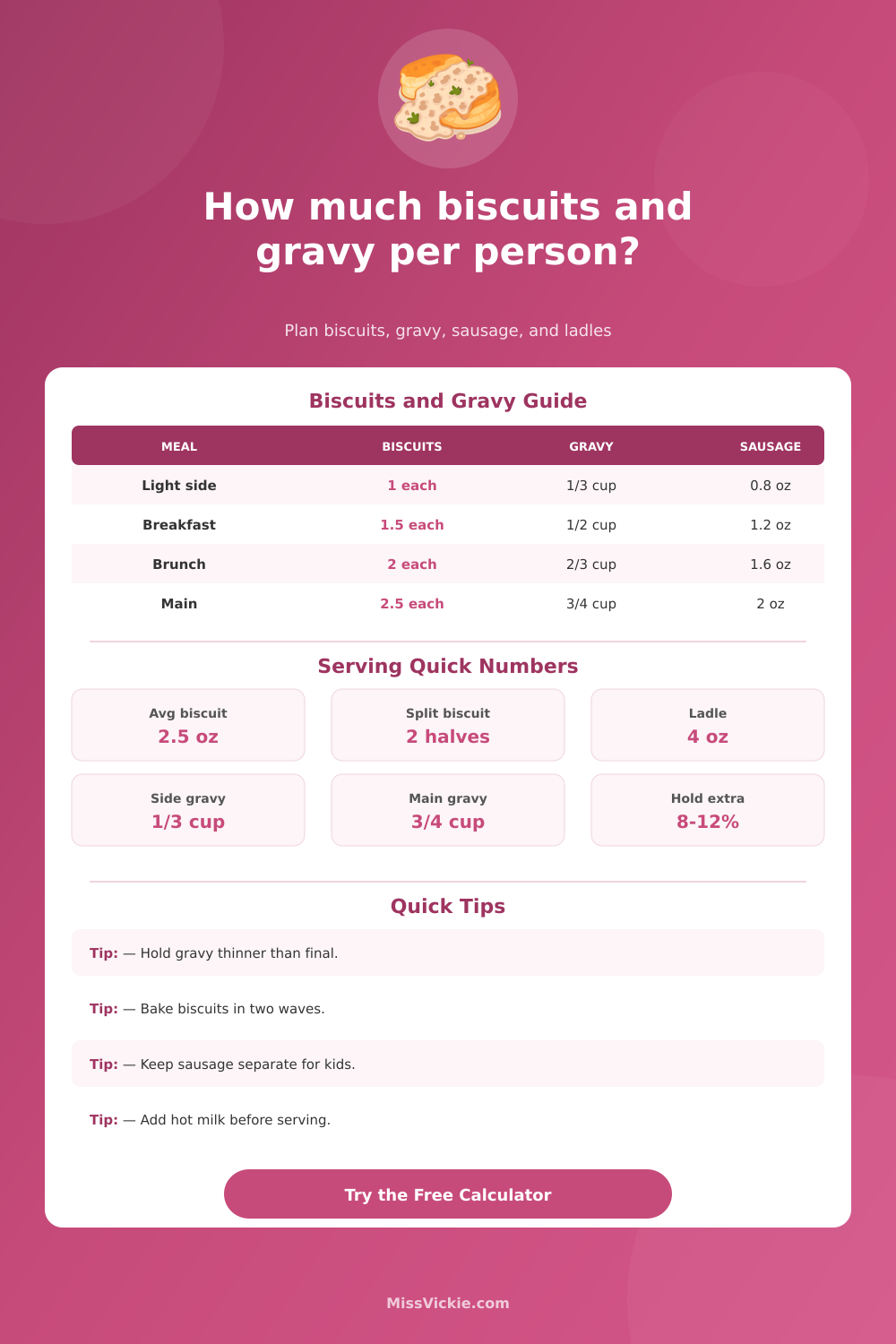
| Meal role | Biscuits per person | Gravy per person | Sausage per person | Best use |
|---|---|---|---|---|
| Tasting or small side | 0.75 to 1 biscuit | 3 to 4 fl oz | 0.5 to 0.8 oz | Brunch line with many hot sides |
| Side dish | 1 to 1.25 biscuits | 4 fl oz | 0.8 to 1.1 oz | Eggs, bacon, potatoes, or casserole alongside |
| Breakfast main | 1.5 to 2 biscuits | 5 to 6 fl oz | 1.2 to 1.6 oz | Typical biscuits and gravy breakfast plate |
| Brunch centerpiece | 2 biscuits | 6 to 7 fl oz | 1.5 to 1.8 oz | Guests build a full plate around the gravy |
| Hearty main | 2 to 2.5 biscuits | 7 to 8 fl oz | 1.8 to 2.4 oz | Hungry crowd, late breakfast, or no other entree |
| Buffet line | 1.25 to 1.75 biscuits | 4.5 to 6 fl oz | 1.1 to 1.6 oz | Self-serve pans where some guests take seconds |
| Biscuit size | Typical baked weight | Dough estimate | Gravy absorption | Portion note |
|---|---|---|---|---|
| Mini 2-inch biscuit | 1.2 oz / 34 g | 1.4 oz / 40 g each | Low | Use 2 to 3 minis for an adult plate |
| Standard 2.75-inch biscuit | 2.2 oz / 62 g | 2.6 oz / 74 g each | Medium | Best default for plated breakfasts |
| Large cathead biscuit | 3.8 oz / 108 g | 4.4 oz / 125 g each | High | One large biscuit often equals two standard halves |
| Split biscuit halves | 1.1 oz / 31 g per half | 2.6 oz / 74 g per biscuit | Medium high | Useful for buffets and portion control |
| Drop or square biscuit | 2.5 oz / 71 g | 2.9 oz / 82 g each | Medium | Irregular tops catch more gravy |
| Gravy style | Flour per cup | Fat per cup | Milk base per cup finished | Texture cue |
|---|---|---|---|---|
| Loose spoonable | 1 tbsp | 1 tbsp | 0.93 cup | Flows easily from a ladle |
| Classic creamy | 1.35 tbsp | 1.2 tbsp | 0.91 cup | Coats biscuit without standing stiff |
| Thick diner-style | 1.75 tbsp | 1.5 tbsp | 0.88 cup | Holds shape briefly on split biscuits |
| Pan pepper gravy | 1.25 tbsp | 1.1 tbsp | 0.92 cup | Skillet-style, pepper-forward, pourable |
| Group size | Light side | Breakfast main | Hearty main | Buffet buffer |
|---|---|---|---|---|
| 4 guests | 5 biscuits, 2 cups gravy | 8 biscuits, 3 cups gravy | 10 biscuits, 4 cups gravy | Add 1 biscuit and 1/2 cup gravy |
| 8 guests | 10 biscuits, 4 cups gravy | 15 biscuits, 6 cups gravy | 20 biscuits, 8 cups gravy | Add 2 biscuits and 1 cup gravy |
| 12 guests | 15 biscuits, 6 cups gravy | 23 biscuits, 9 cups gravy | 30 biscuits, 12 cups gravy | Add 3 biscuits and 1.5 cups gravy |
| 25 guests | 32 biscuits, 12.5 cups gravy | 48 biscuits, 19 cups gravy | 63 biscuits, 25 cups gravy | Add 6 biscuits and 3 cups gravy |
| 50 guests | 63 biscuits, 25 cups gravy | 95 biscuits, 38 cups gravy | 125 biscuits, 50 cups gravy | Add 12 biscuits and 6 cups gravy |
🍴 Comparison grid
High biscuit counts need more gravy than the meal role alone suggests, especially with large or split biscuits.
Large ladles can drown small biscuits, so the calculator caps very saucy plates unless appetite is high.
Extra sausage adds bulk without adding enough sauce, so milk volume rises slightly for meaty gravy.
Long holds need extra liquid and slightly fewer exposed biscuit halves until the final serving window.
💡 Biscuit and gravy tips
Reference amounts are planning estimates for standard buttermilk biscuits and milk-based sausage gravy. Adjust seasoning, thickness, and final consistency by taste before serving.
Breakfast is always more complicated then you expect. A plateful of fluffy biscuits with creamy sausage gravy sounds delicious, warm and fresh out of the skillet and oven. Reality tends to shatter when faced with a dozen plates. Will the gravy become separated from the fat? Will the biscuits be limp under foil by the time they reach the table? How much will you have left after serving everyone?
Balancing how long food stays hot, volume and varying appetite isn’t an easy task when planning this meal. Your brain needs to process multiple factors simultaneously. The calculator handle those factors so you can focus on keeping your coffee warm instead of doing the math in your head while it cools off.
How To Plan Breakfast For A Crowd
So how does it work? The very first question is what place this dish have within the overall meal. Is it meant to be the main event, or is it merely to accompany something else? If there’s more on offer for guests to eat, they’ll likely just have a single biscuit, maybe with a small amount of gravy poured over it. But if it’s the star of the show, then it will require larger servings.
You can toggle back and forth between these options here. It changes the ratios based off the starting point so that you’re not guessing at whether two biscuits feels like a feast, or more like an afterthought. That will inform every item on your preparation list.
Time matters. A lot. Most recipes are written with “as soon as it’s done” in mind. But real life isn’t so accommodating. If you’re feeding more than ten people, there’s nearly always going to be some waiting period between “ready” and “everyone seated.” As flour absorbs water, gravy becomes thicker (a little). If biscuits stays submerged in all that moisture for too long, they’ll soften quickly.
The longer your planned holding time, the more liquid the calculator suggest you use. It factors in a margin of error for texture changes. That way, the result doesn’t turn out to be soggy cardboard or gluey globs.
Another factor for making mistakes is density of sausages you are using. Sounds like a plus adding some more meat? No. Sausages soak up milk and release fats in ways you cannot predict. More hearty hunks will skew amount of solids vs. Sauce in the pan. This means more milk to adjust consistency, something many people overlook til they see all dry crumb-like gravy on their plate.
The tool allow you to differentiate between how much raw sausage weigh compared to how much liquid you have. It gives you a visual of exactly how much your roux must hold. Pick classic balance or get crazy meaty without worrying about having nothing left but the pork for sauce.
Size and shape of biscuit is also important: For example, a large cathead biscuit will have less surface area to soak up gravy than multiple smaller pieces cut in half (like a bunch of biscuit shapes). And if you’re serving big rounds, you’ll use more ladles to get each plate topped off than if you’ve served biscuit cut into pieces.
The page has tables that help with this… It’s a matter of breaking it down by typical dough amounts and weights. But what it really boils down to is controlling the texture: If you split biscuits right before serving, they maintains structure. Split too soon and they fall apart. Knowing how much to bake helps you figure out how much to make, but when to do it makes sure they hold together.
There’s an art and a science to cooking for a crowd. There are judgment calls: does this look like a nice plate? Or will it be messy? And there’s no way to totally automate that. But here’s what you can do: take the guesswork out of the supply chain. Locking in your holding constraints, appetites, and guest counts as soon as possible would of prevented panic during service.
The numbers settle down. Your shopping list gets precise. Then when the line forms, you pour with confidence. Not with anxiety. It comes down to having enough fuel for the fire but not so much that the fire burns itself out before everybody’s been fed.