Bouillon paste, broth equivalence, sodium, flavor strength, and water reduction planner
Better Than Bouillon Ratio Calculator
Convert Better Than Bouillon style paste into cups, quarts, grams, water, broth equivalents, recipe-strength adjustments, sodium intensity, reduced-water sauces, and jar yield estimates.
📌Bouillon Ratio Presets
Start with a common cooking use, then adjust flavor base, broth volume, teaspoon concentration, sodium style, water reduction, and recipe role.
⚖Paste, Water, Sodium, And Recipe Inputs
Better Than Bouillon Ratio Plan
Enter a broth amount to calculate paste, water, grams, sodium intensity, and broth equivalents.
Ratio Breakdown
Flavor, Sodium, And Equivalence
Kitchen Guidance
🧂Quick Paste And Broth Equivalence
Standard base ratio for prepared broth.
Good for soups, braises, rice, and gravy.
Use your kitchen scale for the neatest repeat batches.
Approximate yield for an 8 oz jar at 6 g per teaspoon.
🥣Broth Equivalence Table
| Finished Broth | Paste At 1 tsp Per Cup | Approx Paste Weight | Water To Add | Ready Broth Equivalent |
|---|---|---|---|---|
| 1 cup broth | 1 teaspoon | About 6 g | 1 cup hot water | 8 fl oz or 236 ml broth. |
| 2 cups broth | 2 teaspoons | About 12 g | 2 cups hot water | About one 16 oz recipe amount. |
| 3 cups broth | 1 tablespoon | About 18 g | 3 cups hot water | Useful for grains, stuffing, and small soups. |
| 1 quart broth | 4 teaspoons | About 24 g | 4 cups hot water | Matches a 32 fl oz carton. |
| 2 quarts broth | 8 teaspoons | About 48 g | 8 cups hot water | Medium soup pot or stew base. |
| 1 gallon broth | 16 teaspoons | About 96 g | 16 cups hot water | Large batch soup or event prep. |
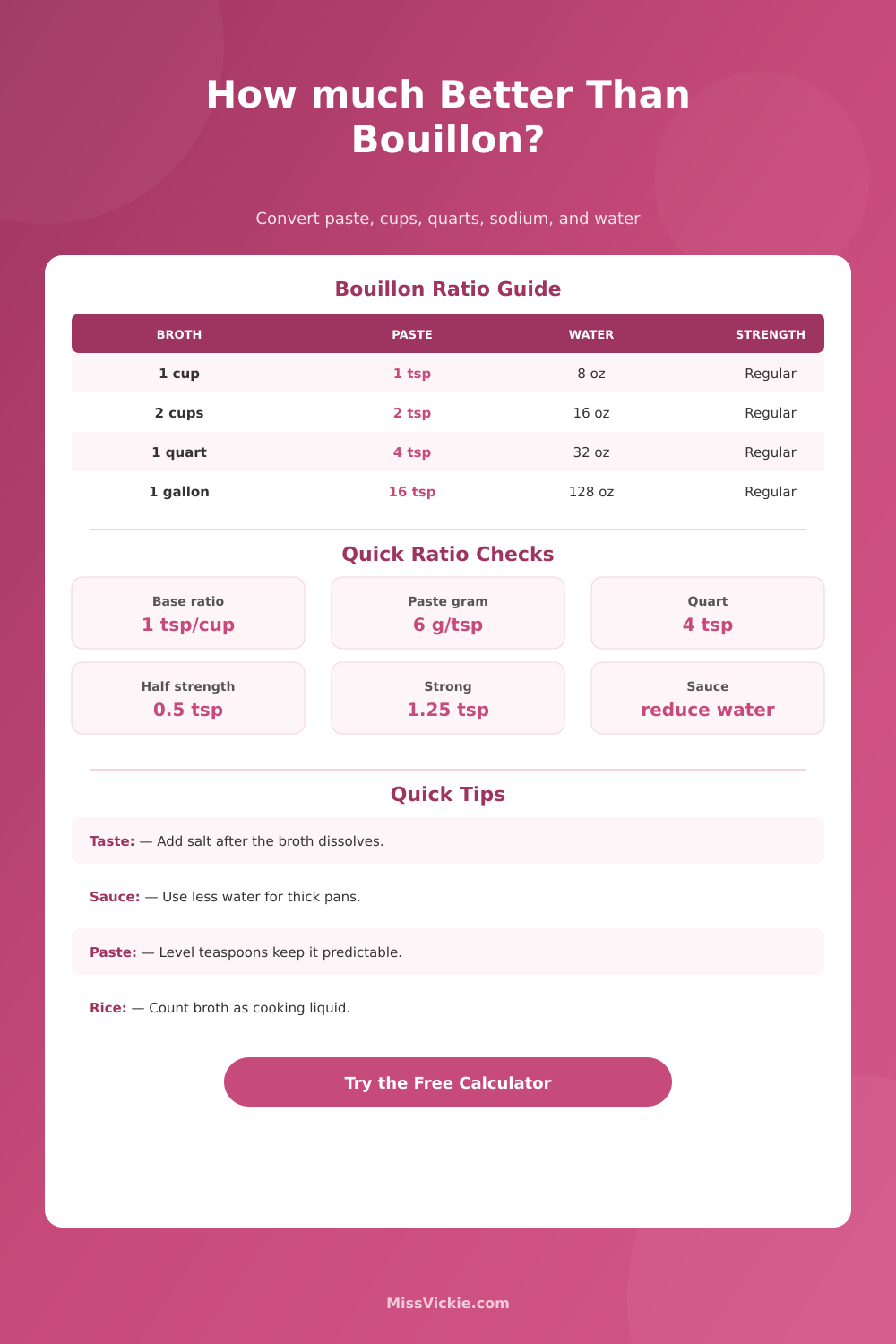
The common practical ratio is 1 level teaspoon paste stirred into 8 fluid ounces hot water for 1 cup prepared broth.
🍲Recipe Role And Water Reduction Guide
| Recipe Role | Paste Rate | Water Plan | Sodium Watch | Best Use |
|---|---|---|---|---|
| Prepared broth | 1 tsp per cup | Use full water volume | Salt after tasting | Soup, sipping broth, noodles, rice, and casseroles. |
| Rice or grains | 3/4 to 1 tsp per cup | Count as cooking liquid | Lower if using salted butter | Rice pilaf, quinoa, couscous, or pasta absorption. |
| Pan sauce | 1 to 1 1/2 tsp per cup | Reduce water 20% to 40% | Deglazed drippings add salt | Skillet sauces, mushroom sauce, and quick jus. |
| Gravy or stew | 1 tsp per cup | Use full water, reduce later | Use lower sodium base if simmering | Thickened gravy, pot roast liquid, and stew base. |
| Marinade boost | 1/2 to 1 tsp per cup | Do not treat as full broth | Balance with acid and oil | Chicken, beef, vegetables, or tofu before cooking. |
| Seasoning paste | 1/4 to 1 tsp total | Add only enough water to dissolve | Very easy to oversalt | Meat rubs, savory butter, sauces, and casseroles. |
🍚Base Flavor Reference
| Base Flavor | Common Pairings | Suggested Strength | Sodium Behavior | Kitchen Note |
|---|---|---|---|---|
| Chicken base | Rice, soup, gravy, noodles | Standard | Moderate to high | Most versatile; add herbs after the paste dissolves. |
| Beef base | Pot roast, onion soup, gravy | Standard to rich | Moderate to high | Works well with wine, mushrooms, and browned drippings. |
| Vegetable base | Beans, grains, vegetable soup | Light to standard | Moderate | Good when the dish needs savoriness without meat flavor. |
| Roasted garlic base | Sauces, mashed potatoes, vegetables | Light | Can taste salty quickly | Use as a seasoning layer rather than all the broth. |
| Mushroom base | Risotto, gravy, stew, noodles | Rich | Umami increases salt perception | Strong with soy sauce, parmesan, and reduced pans. |
| Turkey or ham base | Holiday gravy, beans, greens | Light to standard | Ham can be very salty | Reduce added salt until the dish is almost finished. |
📏Common Quantities And Jar Yield
| Kitchen Amount | Prepared Broth | Paste Needed | Approx 227 g Jar Share | Use Case |
|---|---|---|---|---|
| Small sauce | 1/2 cup | 1/2 tsp | About 1% | Deglaze a skillet or boost pan juices. |
| Side dish | 2 cups | 2 tsp | About 5% | Rice, couscous, quinoa, or stuffing moisture. |
| Quart batch | 4 cups | 4 tsp | About 11% | Soup starter, gravy, or braising liquid. |
| Soup pot | 8 cups | 8 tsp | About 21% | Family soup, stew, chili, or noodles. |
| Large batch | 16 cups | 16 tsp | About 42% | Event soup, meal prep, or party gravy. |
🧾Sodium Intensity Reference
Tastes like normal broth in most recipes.
Useful when cheese, soy sauce, cured meat, or salted butter are present.
Good for sauces, but taste before salting.
Simmering removes water, not sodium, so reduction concentrates salt.
💡Bouillon Measuring Tips
Sounds familiar? That’s because you probably know the drill. A recipe calls for a quart of chicken broth, but your pantry is empty except for that jar of paste that has been sitting in the back since last Thanksgiving.
That’s because you’re trying to make a recipe calling for a quart of chicken broth. Except you don’t have any on hand in fridge or pantry. You have some paste left over from last Thanksgiving, though. With nothing more than water, this jar gives you restaurant-quality results (and a savory taste).
How to Use Chicken Broth Paste
But again: It is not the product, it is the math. At best, most home cooks is guessing how much to use; they combine it with hot water, stir, cross their fingers, and hope for the best. Some end up with soups that taste like salt water. Others gets watery soups with little flavor. When the paste get the ratio right, it’s a useful improvement for your cooking.
Mixing instructions are simple: Eight ounces of water plus one level teaspoon of paste equals one cup of broth. That’s the default concentration. When you use form above, it figures the amount for you (so you don’t have to do it in your head as you’re mincing an onion).
But cooking isn’t simply dialing a number; you want control over things like saltiness, consistency, and other ways the broth will play in the dish. And those factors changes the mix a lot. How concentrated? Think about your dish. Do you want grains like quinoa and rice cooked so they soak up some liquid but don’t turn into mush? Use a lighter amount (about 3/4 teaspoon per cup). Or maybe you’ll add seasoned broth cubes or salted butter? It works great here. Use more for heavier things, such as a rich gravy or hearty beef stew. Use up to one and a quarter teaspoons.
With this tool, you can dial in how intense you’d like that concentration to be. And it considers that you’re going to reduce the water. When you simmer a pan sauce, for example, you evaporate away some of that water to thicken it. That means you need less at the beginning then what the recipe’s final volume implies, because the evaporation will concentrate the saltiness. The calculator take that into consideration so you won’t accidentally oversalt your sauce.
The other variable is sodium. Because paste is concentrated flavor, it’s also concentrated salt. If we go with six grams per spoon, there are about thirty-seven level teaspoons in a jar. That may seem like a lot, but remember that you’re using just a fraction of that amount per batch. The problem arises when you think that the only salt in your pot is coming from the paste. Add a couple cans of beans, some soy sauce, a sprinkle of parmesan cheese, and suddenly your sodium levels has spiked. Consider the paste more of a background flavor instead of the main seasoning. After it dissolves, taste the broth, and adjust with fresh herbs, a hit of acid, or even a pinch of table salt, if necessary. That final touch is what brings the dish together.
How big is a heaping teaspoon? How about a tablespoon? They’re different amounts, and getting exactly the same result again is pretty hard. A small kitchen scale, or even just a level spoon, would of allowed you to know that you’ve got one teaspoon, not two, or three, or whatever. A level teaspoon of paste weighs around six grams. That’s a good place to aim for with a teaspoon. If you are making really big batches, like for a party, it is easy to use weight when you scale up. This gives you much better accuracy than eyeballing out a quarter cup of furnitures.
There’s also a table at the bottom of the page that tells you how many teaspoons there are per gallon, or per quart, so you can see roughly what fraction of the whole jar you’ll be using. Odds are, unless you scoop it all onto an enormous plate, you’ll have a single jar last for months of normal cookery.
And there’s a final lesson: The paste is merely a means to an end. Yes, it will save you space in your pantry and time. But it won’t cook dinner for you. The ratio propels you to the starting gate, and then it’s up to you. Your palate, to take over. Adjust according to the dish at hand, start with the basic measure, and always taste first for added salt. That combination of control and convenience sets a quick fix apart from a truly good meal.