
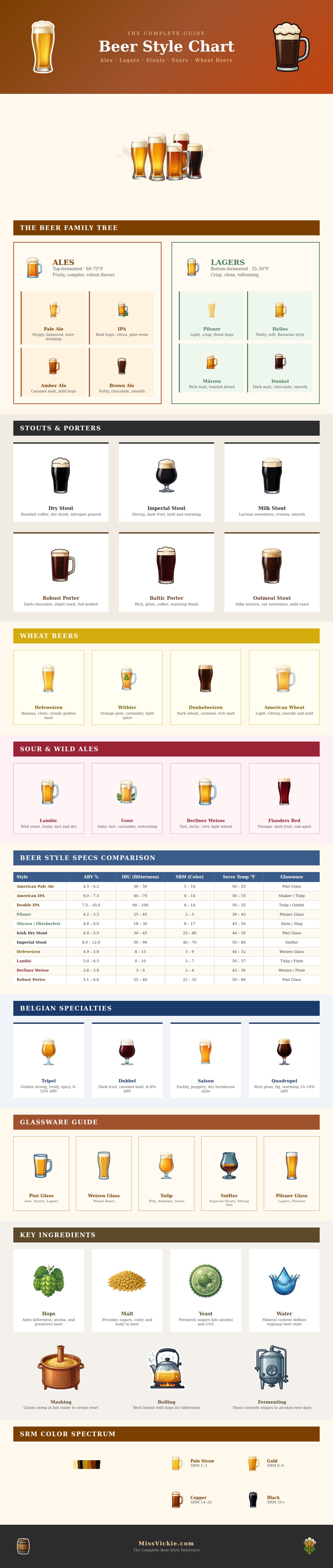
Beer shops are confusing mazes of choice. You grab something that appears appealing, only to find out you’ve chosen the wrong thing: too sweet or too bitter. A simple chart categorize the possibilities in easily understood groups. It transforms a confusing list of options into an orderable menu.
To begin, here’s lager versus ale. That’s determined by temperature and the way brewer interacts with yeast. Top-fermenting yeast ferments at a higher temperature, giving rise to complex and fruity ales. Lager yeast ferments at lower temperatures, producing clean and crisp beers that goes down easily. Understanding this difference can clue you into what you’ll experience when cracking open brew.
How to Choose Your Beer
Hop-happy IPA’s and Pale Ales feature big citrus flavor and bitter hops, which pair nicely with rich foods. If you just want to drink without thinking too much go with a lager. Helles lagers and pilsners is made for easy drinking. Drink it slow, sip it throughout a few hours. You won’t get sick of the taste of it.
Grouping the styles visually in the chart removes guesswork from making a decision, so you can choose based off mood. You might think dark = stronger, but guide explains how this isn’t necessarily true. Porters and Stouts is divided into categories where darker doesn’t equate to stronger. For instance, a Dry Stout is a beer with a roasted coffee aftertaste and a smooth creaminess due to being served through nitrogen. An Imperial Stout, on the other hand, can tastes strongly of dark fruits but still has high alcohol content! Knowing which style to order will save you from getting a dry porter instead of a thick stout. These sub-styles help clear up this confusion.
There is also another corner of the spectrum for wheat beers and sours. Hefeweizen wheat beer taste like banana and clove. That’s because of type of yeast strain used, not extra ingredients added. Sours use bacteria or wild yeast to give funky, tart flavor profiles. It cleanses your palate while giving you an acidic flavor that might shock your taste buds if you’re more accustomed to sweet malt flavors. Because of this, there’s a different way to drink these styles.
The pictorial chart separates wheat beers and sours from the other big branches of ale and lager. It shows that they play by just a little bit of diffrent rules.
Technical information such as SRM, IBU and ABV of beer is in the chart. Don’t worry about committing that info to memory. But knowing it will help shape your decision on which brew to order. SRM indicates color, running from pale straw to opaque black. The higher the IBU (International Bitterness Units), the hoppier-tasting the beer. And then there’s the serve temp factor: For delicate lagers, cool temps mute flavor and accentuate carbonation. For hearty stouts, warm temps allows the aromatic components to be released.
Useful tips you might not hear elsewhere: Glassware can be a game changer. The proper glass matters, pouring an aromatic IPA into the wrong glass can ruin its intended character. Belgian beers and other fragrant IPAs needs a tulip to trap their scents. Pilsner glasses highlight color and those little carbonation bubbles.
Most people don’t realize how important ingredients is. Regional style is defined by water’s mineral content. Malt imparts body; hops impart balance. Essentially, brewing is chemistry with a pretty face. Mashing release sugar. Boiling brings both flavor and preservation.
So learning about beer styles puts some sort of frame around what you like. What do you like? Dark or light beers? Bitter or sweet? Warm fermented or cold fermented? You should of learned this sooner. With that as a starting point, the chart is no longer a test, it’s a map. Next time you’re standing in front of that wall of bottles, you’ll know where to focus your attention. And when you discover a good pint, you’ll be able to not only enjoy it but also understand why you like it.