🍺 Brewing math for home batches
Beer Recipe Converter Calculator
Scale all-grain and extract recipes, shift target gravity, convert fermentable units, and estimate hops, yeast pitch, and priming sugar for cleaner brew-day planning.
The converter uses style-based base recipes, fermentable yield values, packaging loss, and brewhouse efficiency so the output reflects typical homebrewing math instead of simple kitchen scaling.
Session Batch
--
Half-size test batch scaling.
Standard Batch
--
Classic homebrew target volume.
Club Share
--
Mid-size split for bottles or kegs.
Big Brew Day
--
Large batch ingredient planning.
| Style | Base Batch | OG / FG | Base Grain | Base Hops | Base Priming |
|---|---|---|---|---|---|
| Hazy IPA | 5 gal | 1.066 / 1.014 | 12.5 lb | 10.0 oz | 4.8 oz |
| West Coast IPA | 5 gal | 1.064 / 1.012 | 12.2 lb | 8.6 oz | 4.7 oz |
| Dry Irish Stout | 5 gal | 1.052 / 1.012 | 9.6 lb | 3.0 oz | 4.2 oz |
| German Pilsner | 5 gal | 1.048 / 1.010 | 8.7 lb | 4.0 oz | 4.6 oz |
| Hefeweizen | 5 gal | 1.050 / 1.011 | 9.5 lb | 1.8 oz | 5.0 oz |
| Amber Ale | 5 gal | 1.054 / 1.013 | 10.3 lb | 3.5 oz | 4.5 oz |
| Robust Porter | 5 gal | 1.058 / 1.015 | 11.1 lb | 3.3 oz | 4.4 oz |
| Saison | 5 gal | 1.056 / 1.006 | 10.0 lb | 3.4 oz | 5.3 oz |
| Belgian Tripel | 5 gal | 1.078 / 1.010 | 15.2 lb | 3.7 oz | 5.2 oz |
| Light Lager | 5 gal | 1.042 / 1.008 | 7.6 lb | 2.1 oz | 4.4 oz |
| Fermentable | PPG | Lb per Cup | Kg per Liter | Color | Best Use |
|---|---|---|---|---|---|
| US 2-Row Pale Malt | 36 | 0.40 | 0.19 | 1.8 L | Base malt |
| Pilsner Malt | 37 | 0.39 | 0.18 | 1.5 L | Lagers |
| Maris Otter | 38 | 0.41 | 0.20 | 3.0 L | English ales |
| Wheat Malt | 38 | 0.38 | 0.18 | 2.0 L | Wheat beers |
| Munich Malt | 35 | 0.42 | 0.20 | 9.0 L | Malt depth |
| Light DME | 44 | 0.53 | 0.25 | 4.0 L | Extract boost |
| Pale LME | 36 | 0.74 | 0.35 | 8.0 L | Extract base |
| Corn Sugar | 46 | 0.50 | 0.24 | 0.0 L | Dry finish |
| Finished Batch | Base Grain | Strike Water | Total Hops | Yeast Cells | Kegs / Bottles |
|---|---|---|---|---|---|
| 2.5 gal | 6.3 lb | 2.1 gal | 5.0 oz | 105 B | 24 bottles |
| 5.0 gal | 12.5 lb | 4.2 gal | 10.0 oz | 210 B | 48 bottles |
| 7.5 gal | 18.8 lb | 6.3 gal | 15.0 oz | 315 B | 72 bottles |
| 10.0 gal | 25.0 lb | 8.4 gal | 20.0 oz | 420 B | 2 corny kegs |
| CO2 Vols | Corn Sugar 5 gal | Beer Styles | Bottle Feel | Keg Note |
|---|---|---|---|---|
| 2.0 | 3.8 oz | Stout, Porter | Soft | Low pressure |
| 2.3 | 4.3 oz | Amber, Lager | Balanced | House standard |
| 2.5 | 4.8 oz | IPA, Pilsner | Lively | Brisk pour |
| 2.8 | 5.4 oz | Saison, Wheat | Spritzy | Higher line balance |
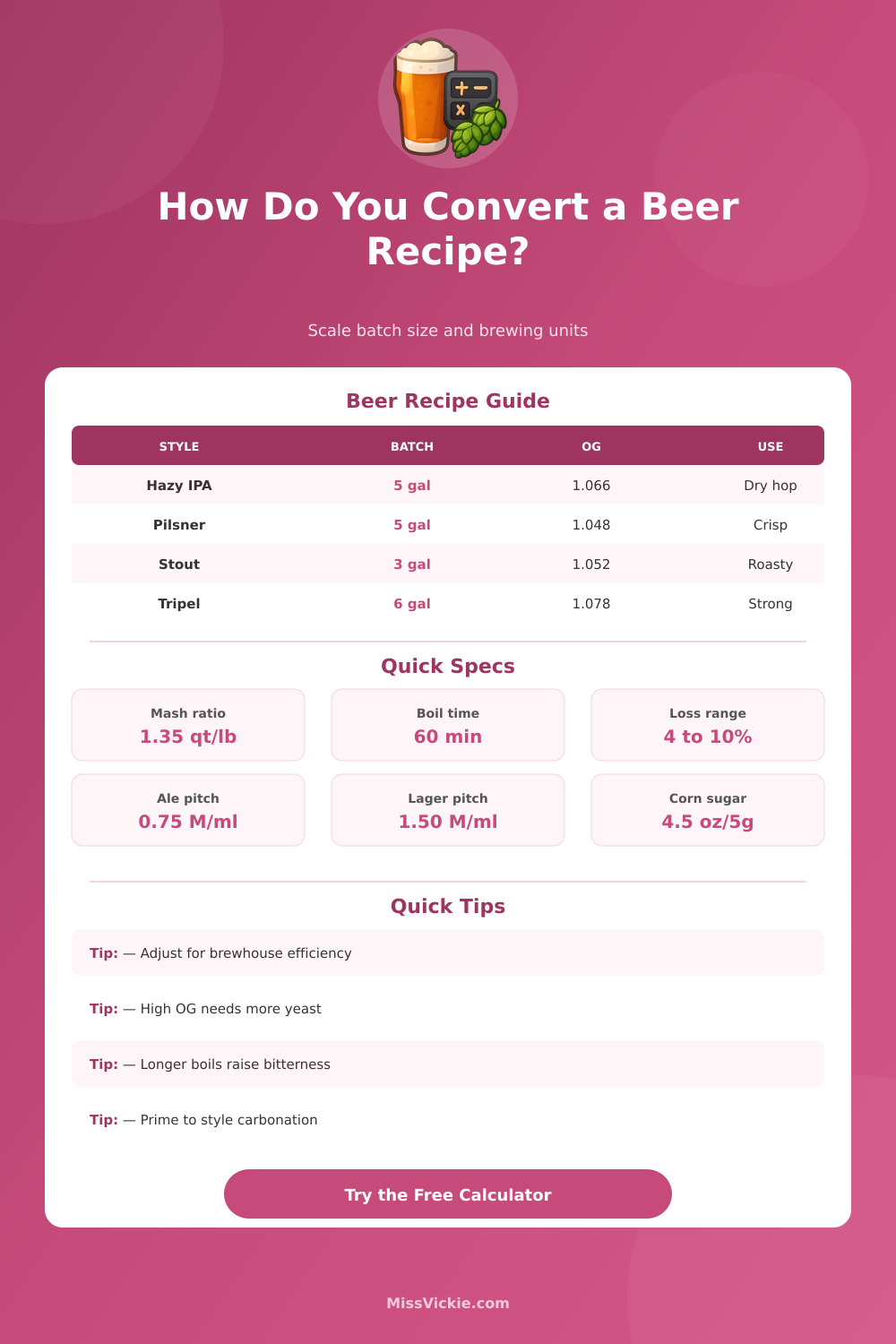
Recipe conversion are the process of changing a beer recipe from one batch size to another batch size. Recipe conversion is used if the recipe is written for five gallons of beer but only requires three gallon to be brewed, or if the recipe is written for five gallons but more beer is desire at ten gallons, for instance. Recipe conversion is required since changing the batch size change the way the ingredients interact with the brewing process.
If recipe conversion is not performed correctly, the beer may have the wrong amount of alcohol or the wrong amount of bitterness. Many people believes that recipe conversion involves simply multiplying each ingredient by a single number to arrive at the needed amount of that ingredient for the new batch size. However, recipe conversion is actualy more complex then this approach.
How to Change a Beer Recipe for a New Batch Size
The efficiency of the brewhouse determine how much sugar will be extracted from the grain. Loss of water during the boiling process determine how much of the beer will boil off during the boil. Furthermore, the loss of beer that remains in the fermenter as sediment and trub must also be considered; if you dont account for it, the batch size will not be correct after the beer is bottled or kegged.
Because fermentable ingredients like malt and sugar creates the gravity of the beer, the type of malt and sugar that are used can have an impact on the gravity of the beer. For instance, pale malt contain a certain amount of gravity points per pound of malt, but corn sugar contains a different amount of gravity per pound of sugar. These differences must be accounted for during recipe conversion.
The bitterness from the hops also change with the batch size of the beer. Bittering hops should be boiled for specific amount of time to provide the correct amount of bitterness to the beer, and aroma hops are added during different steps in the brewing process to provide the correct aroma to the finished beer. If recipe conversion does not create the hopping schedule correctly, the bitterness and aroma of the beer will be incorrect.
The number of yeast cells that is added to the beer are referred to as the pitch rate of the yeast. High-gravity beers require higher pitch rate of yeast because there is more sugar for the yeast to consume. For instance, ales requires a certain number of yeast cells to be pitched into the beer, but lagers require double that amount of yeast.
The brewer must calculate the pitch rate of the yeast based off the batch size and original gravity of the beer. Batch size refer to the total amount of beer that will be produced once the batch is complete. Furthermore, the batch size is a measurement of the amount of beer once losses have occurred during the brewing process.
Therefore, the first step in recipe conversion is to determine the target volume of the batch once complete. Furthermore, the losses of beer that occurs in the fermenter must also be accounted for; losses in the fermenter are typically between four and ten percent of the total batch. Thus, if the goal is to produce ten gallons of beer, the amount that should of been brewed will be more then ten gallons.
Efficiency is another factor that must be considered in recipe conversion. Efficiency rates determine how much sugar from the grain that is boiled will be moved into the liquid wort. Many homebrewers have efficiency rates that is lower than professional brewers.
Thus, if the efficiency rate of the beer is lower than the rate specified in the original recipe, more grain must be added to the batch size; otherwise, the gravity of the beer will be too low. The addition of priming sugar provides the carbonation of the beer, which create the carbon dioxide that carbonates the beer. Different styles of beer have different amount of carbon dioxide that is needed in the finished beer.
For instance, stout beer has less carbon dioxide than other types of beer. Thus, when recipe conversion is performed, the amount of priming sugar should be adjusted to ensure that the amount of carbon dioxide created in the batch will be correct for that style of beer. Overall, recipe conversion involves the calculation of the amount of grain, hops, yeast, and priming sugar for the new batch size.
Furthermore, efficiency, boil-off losses, and packaging losses must also be accounted for to ensure that the batch is accurate. Overall, the gravity, bitterness, and carbonation levels will remain the same, regardless of the batch size that is utilized. Its important to remember that even with moddern equipment, errors can happen.
Making alot of mistakes during the first few brews is naturaly part of the learning curve. Make sure you recieve teh right ingredients before you starts.