Beef Stew Simmer Time Calculator
Estimate beef stew simmer time from beef cut, cube size, batch volume, pot method, simmer temperature, vegetable timing, thickening method, tenderness target, and resting time.
🍲 Beef Stew Presets
Choose the closest stew plan, then adjust the cut, cube size, batch volume, simmer temperature, vegetables, thickener, tenderness target, and rest.
⚖ Stew Batch Details
Your Beef Stew Timing
A gentle simmer plan will appear here.
Model Inputs
Adjustments
Cooking Schedule
📌 Quick Stew Timing Benchmarks
Use the calculator as a timing plan, then confirm doneness with a fork. Beef stew is ready when the cubes yield easily but still hold their shape unless you chose a fall-apart target.
🥩 Beef Cut And Cube Size Table
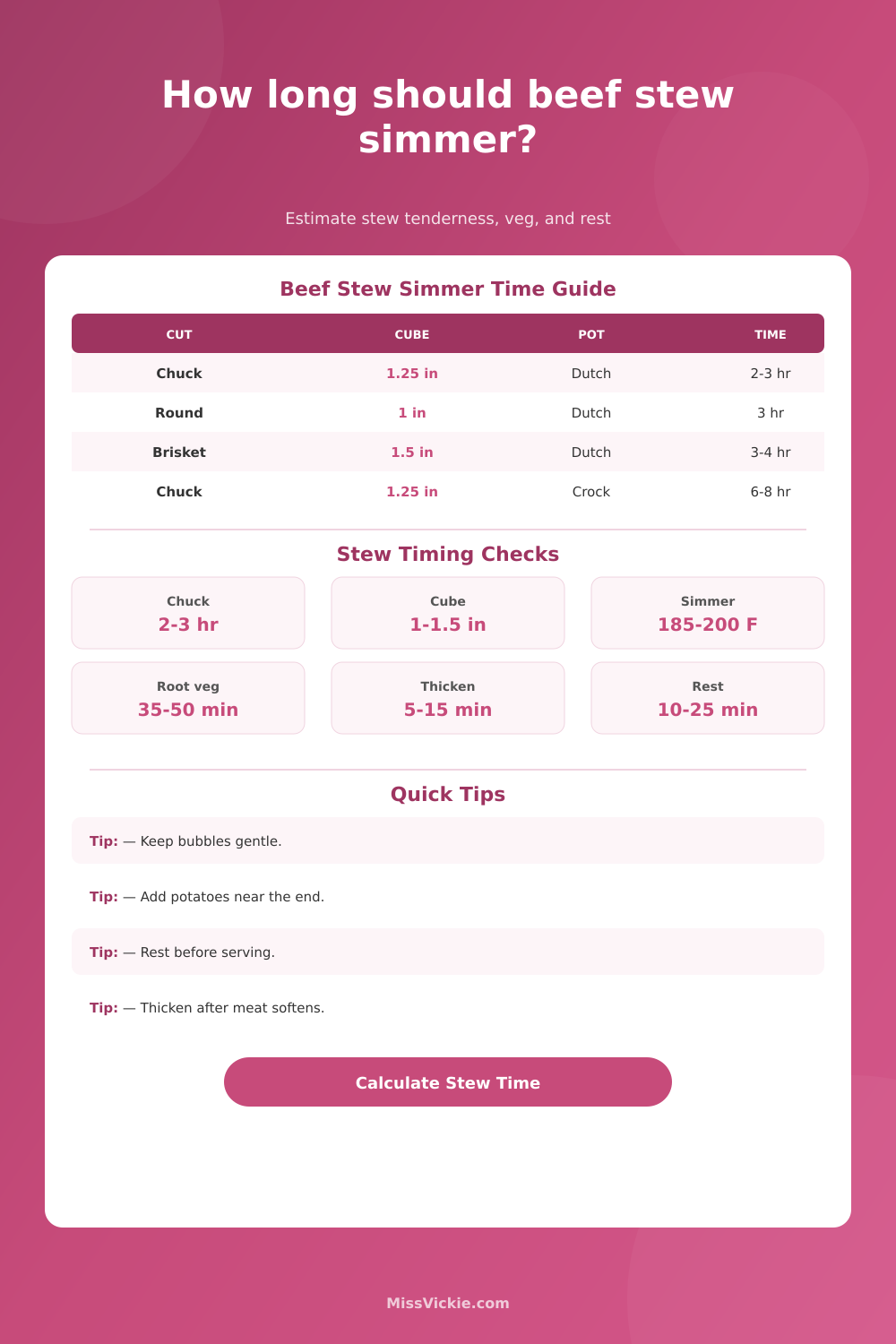
| Beef Cut | Best Cube Size | Dutch Oven Simmer | Texture Notes |
|---|---|---|---|
| Chuck roast or shoulder | 1 to 1.5 in | 2 to 3 hours | Most reliable balance of collagen, beef flavor, and stew texture. |
| Package labeled stew beef | 1 to 1.25 in | 2.5 to 3.5 hours | Often mixed cuts, so cook to the toughest cube in the pot. |
| Bottom round or top round | 0.75 to 1.25 in | 2.75 to 3.5 hours | Lean and slower to soften; keep the simmer gentle to avoid dryness. |
| Brisket cubes | 1.25 to 1.75 in | 3 to 4 hours | Needs patience, but the sauce gains deep beef flavor as collagen melts. |
| Boneless short rib | 1.25 to 1.75 in | 2.75 to 3.75 hours | Rich cut with visible seams; skim fat before thickening if needed. |
| Beef shank | 1 to 1.5 in | 3 to 4 hours | High gelatin; excellent for glossy sauce and spoon-tender stew. |
🔥 Pot Method Comparison Grid
Best default for steady stovetop simmering and easy sauce checks.
Very even heat; useful when the stovetop runs hot or uneven.
Good for unattended cooking, but vegetables usually need later timing.
Reduces faster, so watch liquid level and add stock as needed.
🌡 Pot Method And Heat Table
| Method | Typical Heat | Time Effect | Best Practice |
|---|---|---|---|
| Heavy Dutch oven, stovetop | 185 to 200 F | Baseline | Keep the lid slightly ajar if the stew is too thin. |
| Thin stockpot | Hot spots possible | Adds about 5 to 15% | Stir more often and use the lowest burner that keeps bubbles moving. |
| Wide braiser | Faster evaporation | Can shorten slightly | Check liquid halfway and cover tightly once sauce looks rich. |
| Covered oven | 300 to 325 F oven | Similar to Dutch oven | Use a tight lid and stir once or twice during the cook. |
| Slow cooker low | Low steady heat | Roughly 2.4x | Brown beef first, then add vegetables late if you want clean edges. |
| Slow cooker high | Higher steady heat | Roughly 1.6x | Useful for medium batches, but check lean cuts early. |
🥕 Vegetable Timing Table
| Vegetable Plan | Add Window | Best For | Texture Goal |
|---|---|---|---|
| Classic potatoes and carrots | About 40 to 50 minutes before the end | Standard beef stew | Tender pieces that still keep shape. |
| Firm vegetables added late | About 25 to 35 minutes before the end | Small potatoes, parsnips, celery | Clean edges and a fresher bite. |
| Large root vegetable batch | About 50 to 65 minutes before the end | Turnip, rutabaga, large carrot chunks | Fully tender without needing a hard boil. |
| Rustic vegetables from the start | At the start of simmering | Soft country-style stew | Vegetables melt slightly into the sauce. |
| Mushrooms and peas | Mushrooms early, peas last 5 minutes | Wine stew or lighter stew | Earthy broth with bright green finish. |
🥄 Thickening Method Table
| Thickener | When To Add | Extra Time | Result |
|---|---|---|---|
| Flour on beef before searing | Before simmering | 0 to 5 minutes | Classic stew body with browned flour flavor. |
| Separate roux | Last 15 to 20 minutes | 12 to 15 minutes | Stable, rounded sauce for large batches. |
| Cornstarch slurry | Last 5 to 8 minutes | 5 to 8 minutes | Quick glossy finish; can thin again if overcooked. |
| Beurre manie | Last 8 to 12 minutes | 8 to 12 minutes | Silky finish and good control in small pots. |
| Uncovered reduction | After beef is tender | 15 to 30 minutes | Concentrated flavor, but watch vegetable softness. |
💡 Stew Timing Tips
Beef Stew: It’s one of those dishes that most home cook learned early on; when you’ve got nowhere else to be, just chuck some chuck in a pot along with some veggies and broth and let time do its thing. But there’s a trap here. Throw everything in all at once and what you get could be tender chunks swimming in a sea of disintegrated mush. Stop too soon (because someone told you that two hours is enough) and what you get are rubbery cube that try your patience. Mastering two timelines at once will make all the difference between soup and proper stew.
Meat has one kind of timeline: It requires low and slow treatment to break down its connective tissue collagen into gelatin, which add body to the sauce. Vegetables have another: Just long enough to become tender but not disintegrate completeley. And unless you’re using a thin-bottomed pot that produces hot spots, a good old-fashioned stovetop is probably where you’ll achieve this Goldilocks balance; a heavy Dutch oven retains heat well and doesn’t boil ferociously. Toss it into a crockpot and you’re no longer adjusting for temperature, only time, so your veggies will have to wait far more long than they would on the stove.
How to Make Perfect Beef Stew
The calculator above figures out the numbers for you (once you enter your cooking method and cut) and saves you the guesswork about how these factors play off each other. Bigger isn’t always better. Your cubes don’t has to be bigger; in fact, smaller cubes tend to cook faster. This is because heat spreads deeper into a one inch cube than into a two inch chunk. Chunks of meat from the grocery store are usualy small and cut oddly. So, when cooking stew meat, take the biggest chunk as your guide; do not go by the average. People make this mistake all the time. They see a couple of nice, soft cubes and think they have succeeded, then they serve the food while the hidden toughness remains.
Remember chuck roast? Why’s everyone use that? It has just enough connective tissue to soften with long cooking yet not dry out like lean cuts of round steak. Brisket will also work, although you’ll have to wait another hour or so for that richness to set in. Then there are vegetables, where most plan go awry. Potatoes and carrots don’t cook up in exactly the same amount of time. Potatoes are starchy, while carrots contain more fiber and is less dense. What happens when you toss everything in together? One will be perfectly cooked; the rest, overdone.
Instead, plan to time things: Toss in your hardest-root ingredients (like parsnip, or maybe turnip) roughly 40 minutes before finishing the simmering period. Follow with more delicate items like peas or greens during the final five minutes. That way, not only does it look pretty, but also, each retains its own texture. You want to actualy see the carrot slice, not just taste its ghost in the broth.
One of the variables: Letting the stew rest allows the sauce to settle and cling to the meat. Sear the beef first with some flour coating it. It will continue to thickens during the simmering time. Or finish by adding a roux or cornstarch slurry; then simmer an additional five to ten minutes to remove any raw-starchy flavor from the stew. Otherwise, it’ll have a pasty, cloudy quality, which defeats the purpose of all your effort. Lastly, wait 15 minutes after turning off the heat before serving so that the sauce can settle and adhere to the beef instead of running off in a watery pool. Letting it sit will also cause the flavors to meld and come together.
There’s no need for precise measurements or careful attention. There’s a rhythm to the process, more like an improvisation. While you might think you’re missing notes, you’re actually getting the feel of things. That said, stage one involves building flavor from browned meat. Stage two involve maintaining a low temperature to soften connective tissue without turning the stew into mush. Stage three is letting veggies cook through as you add sauce finishing touches. All at once, it all adds up to good timing.
This sounds like it should of been easy, except once you get the parts in place, waiting doesn’t seem so much like waiting anymore. It becomes part of the process. Every hour that passes, the scent of the kitchen improves, and what was once just a simple pot becomes a luxurios satisfying thing by mealtime.