🥩 MissVickie beef roast math
Beef Roast Cooking Temperature Calculator
Dial in chuck, ribeye, and sirloin roasts with a carryover model that respects oven bands, sear-first plans, and the way heavier roasts hold heat.
Each preset loads a real roast scenario, sets the cut and finish goal, and updates the calculator in one tap.
Use the cut, goal, oven band, and sear plan together. The calculator converts metric or imperial inputs internally, then applies carryover to the finish temp.
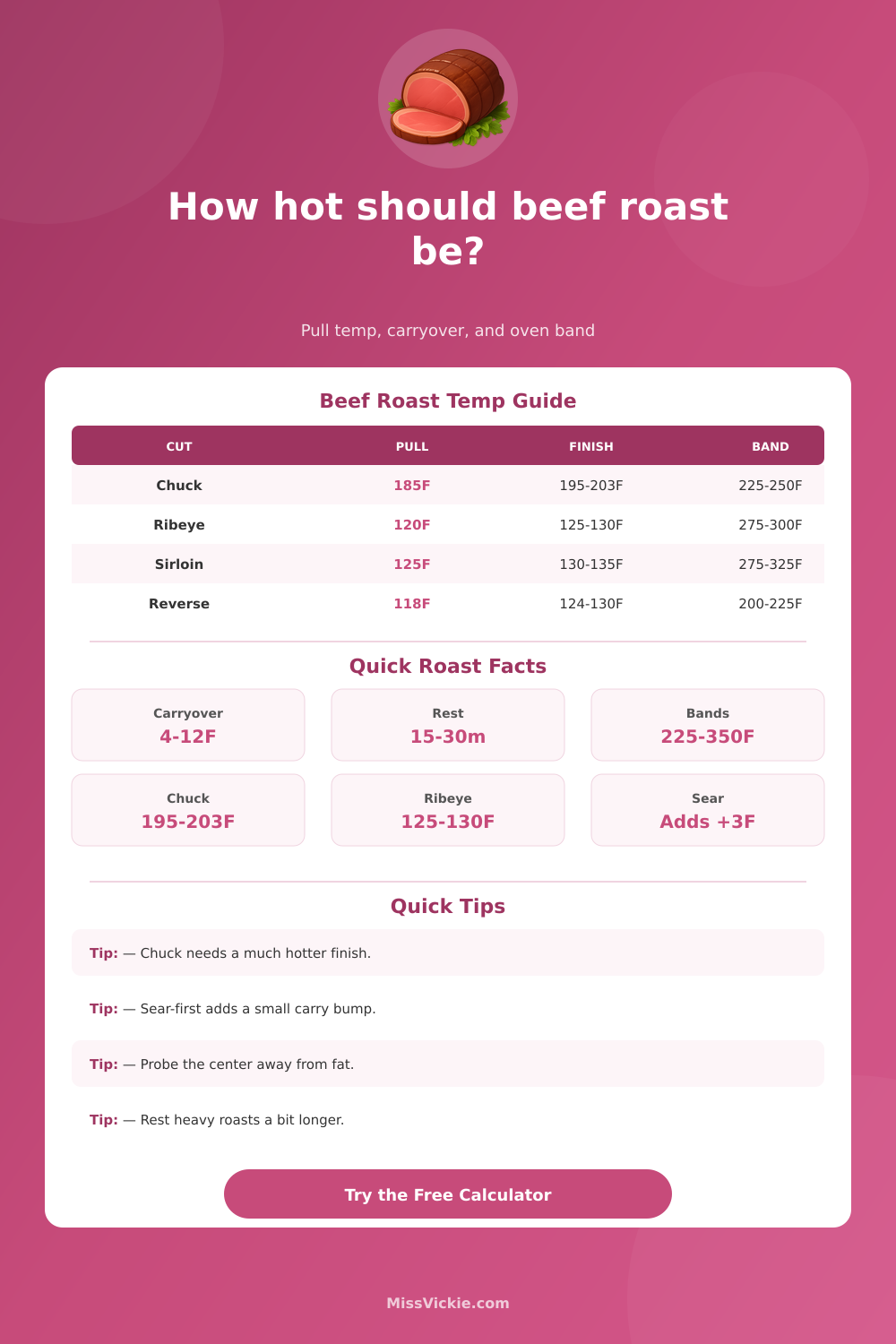
These are the core finish bands the calculator uses before it subtracts carryover from the pull temperature.
| Goal | Pull | Finish | Best fit |
|---|---|---|---|
| Rare | 118-120F | 120-125F | Lean roast slices |
| Medium-rare | 122-125F | 125-130F | Ribeye roast |
| Medium | 128-130F | 130-135F | Sirloin roast |
| Pull-apart | 185-190F | 195-203F | Chuck roast |
The band is the heat environment around the roast. Lower bands favor tenderness on tougher chuck cuts, while hotter bands speed crust and browning.
| Band | Range | Best use | Carry note |
|---|---|---|---|
| Reverse | 200-225F | Ribeye, sirloin | Soft rise |
| Low slow | 225-250F | Chuck roast | Deep carry |
| Steady | 275-300F | Most roasts | Balanced rise |
| Hot | 325-350F | Sear-first | Fast crust |
Use the comparison cards to see why different beef roasts need different pull temps and different carryover assumptions.
Best when held low and slow until the connective tissue relaxes and the finish climbs into shreddable territory.
Marbled and forgiving, so it likes a gentler pull and a clean rest before slicing.
Lean enough to watch carefully, but still roast-friendly when the pull buffer is honest.
Great for a deeper outside crust before the roast settles into the target oven band.
Each cut reacts differently to heat, so the calculator uses a cut-specific carryover model instead of one generic pull temp.
| Cut | Weight | Depth | Note |
|---|---|---|---|
| Chuck roast | 2-5 lb | 2-4 in | Tougher, needs carry |
| Ribeye roast | 3-6 lb | 3-5 in | Marbled and juicy |
| Sirloin roast | 2-4 lb | 2-3 in | Lean and roastable |
| Eye round roast | 2-4 lb | 2-3 in | Lean, slice thin |
This table shows the parts of the pull math that change the most as the roast gets bigger, hotter, or more aggressively seared.
| Factor | Effect | When it rises | Result |
|---|---|---|---|
| Weight | More rise | Heavier roast | Longer rest |
| Depth | More heat | Thicker center | Higher pull gap |
| Sear | Sharper edge | Hard crust | Bigger finish bump |
| Band | Heat load | Hotter oven | Faster cook time |
A quick way to compare the roast families before you commit to a finish target or cooking path.
Carryover cooking refer to the process whereby a roast continues to cook even after being removed from heat source. When a cook places a roast on a heat source, the outer layers of the roast begins to store thermal energy. As the roast rests, that stored thermal energy begin to move towards the center of the roast.
As a result, the internal temperature of the roast will continue to increase even after the cook has removed the roast from an oven. Such an increase in temperature is referred to as carryover cooking. If roasted meat are removed from the oven too soon due to not accounting for carryover cooking, the roast can become overcooked.
What Carryover Cooking Is and How to Avoid Overcooking
To manage carryover cooking, it is essential to understand the difference between the pull temperature and the finish temperature of the roast. The pull temperature is the temperature at which a roast is removed from the oven, while the finish temperature is the temperature that the roast reach after it has rested. If a cook allows a roast to rest to the desired temperature prior to being removed from the oven, carryover cooking will cause the roast to exceed that finish temperature.
As such, the roast should of been removed from the oven at a pull temperature that is lower than the desired finish temperature of the roast. Different type of beef will experience different amounts of carryover cooking. For instance, a cut of beef that is high in marbling, like a ribeye, will experience a different cooking process then a lean cut of beef, like an eye of round roast.
The marbling in the ribeye will act as an insulator in relation to the carrying of thermal energy towards the center of the roast. Additionally, another factor in the carryover cooking process is the size of the roast. For instance, a large bone in roast will have a different amount of carryover cooking than a small roast or a boneless roast.
The additional mass of the bone-in roast will cause its temperature to increase more gradual than a boneless roast. Another factor in carryover cooking is the cooking method for the roast. For instance, if a cook prepares a roast using high heat, the exterior of the roast will reach temperature that will create a surge of heat into the interior of the roast.
However, if the roast is cooked using low heat, such as a reverse sear method, the temperature increase that the roast will experience will be more gradual. Additionally, if the cook sears the roast prior to roasting, that sear will contribute additional heat to the roast, as well. It is essential that the thermometer that is used to monitor the temperature of the roast is accuracy.
The thermometer should be placed into the thickest part of the roast. If the thermometer is placed against a bone or a pocket of fat, it will read the incorrect temperature of the roast, causing for instance the roast to be removed from the oven at the wrong time. To allow the roast to rest after being cooked allow for the juices to redistribute within the roast.
If a roast is sliced while hot, the juice will leave the roast, causing the roast to become dry. Allowing the roast to rest allow the muscle within the roast to relax, as well as allows for the carryover cooking to occur. Overall, by calculating the appropriate temperature at which to remove the roast from the oven (the pull temperature) and allowing the roast to rest, the roast will reach the desired finish temperature.