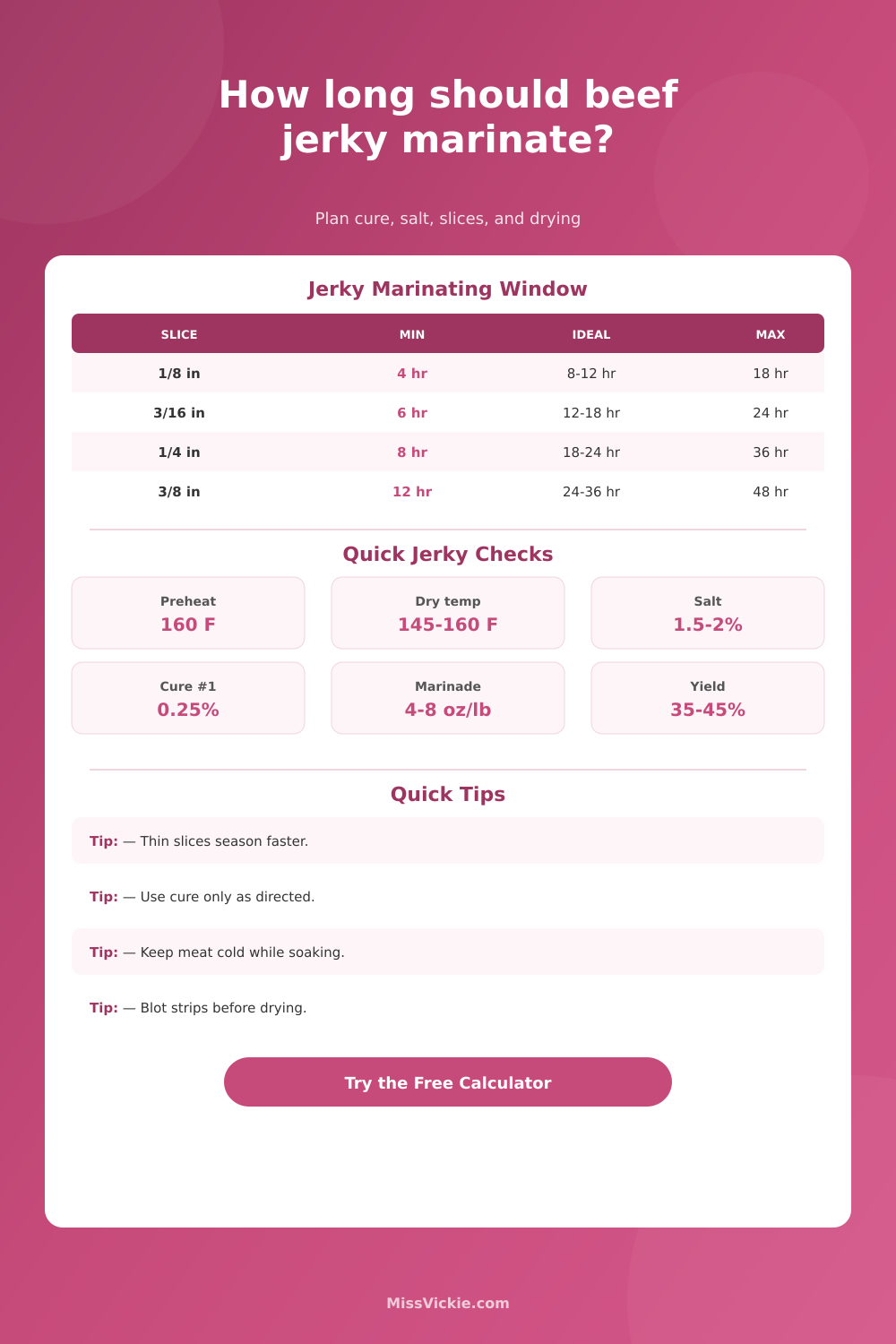
Slice thickness, cure, salt, marinade strength, absorption, refrigerator time, preheat safety, and dehydrator temperature
Beef Jerky Marinating Time Calculator
Estimate a practical marinating window for beef jerky strips, then size marinade volume, salt, optional cure, drying yield, and a safety preheat plan before dehydration.
Choose a real jerky scenario, then adjust meat weight, slice thickness, cure choice, salt target, marinade strength, cold holding temperature, safety preheat, dehydrator temperature, and desired dryness.
Jerky marinating plan
Results appear here after calculation.
Jerky Batch Breakdown
| Jerky Slice | Thickness | Minimum Soak | Best Window | Maximum Window | Drying Note |
|---|---|---|---|---|---|
| Very thin strips | 1/8 inch or 3 mm | 4 hours | 8 to 12 hours | 18 hours | Dries quickly; blot well |
| Standard jerky | 3/16 inch or 5 mm | 6 hours | 12 to 18 hours | 24 hours | Most balanced texture |
| Thick-cut jerky | 1/4 inch or 6 mm | 8 hours | 18 to 24 hours | 36 hours | Needs more rack time |
| Extra thick strips | 3/8 inch or 9 mm | 12 hours | 24 to 36 hours | 48 hours | Use cure and heat step |
| Ground jerky | 1/4 inch extruded | 2 hours | 4 to 8 hours | 12 hours | Mix evenly before piping |
| Method | Typical Amount | Time Effect | Safety Note | Best Use |
|---|---|---|---|---|
| No cure | 1.5 to 2 percent salt | Shorter cold window | Refrigerate and heat | Eat soon batches |
| Soy marinade | Use salt equivalent | Normal overnight soak | Watch total sodium | Classic jerky flavor |
| Measured salt | 1.7 to 2.2 percent | Predictable uptake | Weigh meat and salt | Low sugar recipes |
| Prague powder #1 | 0.25 percent meat weight | Needs full contact | Do not exceed label | Longer storage style |
| Cure packet | Per packet label | Follow label minimum | Do not double dose | Large repeat batches |
| Meat Weight | Lean Strips | Standard Marinade | Deep Flavor | Expected Uptake |
|---|---|---|---|---|
| 1 pound | 1/8 to 3/16 inch | 5 to 6 fl oz | 7 to 8 fl oz | 6 to 10 percent |
| 2 pounds | standard strips | 10 to 12 fl oz | 14 to 16 fl oz | 5 to 9 percent |
| 5 pounds | full dehydrator | 25 to 30 fl oz | 35 to 40 fl oz | 4 to 8 percent |
| 10 pounds | large rotation | 50 to 60 fl oz | 70 to 80 fl oz | 4 to 7 percent |
| Dry cure | any batch | 0 fl oz liquid | paste optional | salt driven |
Use only with a proper heat step and thin strips; drying window runs longer.
Common jerky setting with reliable drying for 3/16 inch strips.
Better for thicker strips and dehydrators that hold steady heat.
Most beef jerky finishes near this range after moisture loss.
This calculator estimates planning ranges for home jerky. Use fresh lean beef, clean equipment, reliable thermometer checks, and the food-safety instructions that came with your dehydrator or curing product.
Jerky’s also about patience: While your marinade might be perfect (a precise mix of brown sugar, soy sauce, and black pepper), without sufficient soaking time the ingredients won’t penetrate the fiber. Without that time, you’ll be eating nothing more than seasoned beef jerky. So yes, the marinating is the real work of making jerky; it is more than just waiting. Salt draws moisture from the meat while flavors flows into the fibers. And here’s the rub: Under-marinated jerky will taste flat; overdone strips becomes mush before making their way to the dehydrator.
Fortunately, the calculator above does the math for you once you input your cure type and slice thickness. You won’t need to guess whether eight hours will work or if it will take a full day.
Why Marinating Is Important for Jerky
The primary variable that you can control is thickness. Imagine that flavor has to get through a wall. A thin piece (around an eighth of an inch) will allow the liquid to seep all the way through in just a few hours. A really thick one (closer to a quarter inch or even thicker) take much longer since the inside of the strip won’t touch any of the liquid. When the slices are inconsistent and some parts are thinner than others, the thin ones will be ready while the thick ones barely begin to absorb at all. Consistent slices is very important.
That’s why I created a tool where the recommended window adjusts depending on what thickness you cut. You’ll need almost twice as long for a half-inch strip compared with a thin slice, which makes a huge difference when you’re planning out your schedule.
Salt has two conflicting roles that confuse beginners. It carries the flavorings in your mixture, but it can also be used to draw water out of meat to preserve it. Insufficient salt results in the spices just sitting on top of the meat and washing away once the meat dries. Excess salt will make the meat inedible long before it gets to drying time. Common ranges for most homemade recipes are around 1.5, 2% salt by weight.
The calculator takes this into account so you don’t overdo the sodium on your batch. Weighing your meat and determining the salt percentage ensures consistent batches. Using a teaspoon is easy to guess at, but your hand-measured teaspoon could vary widely from batch to batch. A scale eliminates that variable.
That’s just part of the problem. There is also a curing agent, so you don’t eyeball Prague powder number one. It’s strong stuff. Measure carefully, or you defeat the safety aspect. If you have too little or too much, your jerky will taste salty and like nitrites. That’s why the calculator takes that into account. When you choose a cured option, it adjusts the minimum marinating time accordingly. This gives the cure enough time to spread throughout the meat, evenly. Depending on what you’re planning to do with the jerky (make a big batch for trail food, maybe), the cure will help keep it from spoiling in storage. A quick snack for the weekend you can eat within a week? Maybe skip it altogether. Toggle the option on/off without altering your basic flavor plan based off the tool.
Another potential problem is marinade volume. Not too much, you need enough to cover all of the meat, but excess liquid simply won’t get absorbed. Yet not enough… and then you’ve got some soaked pieces of meat on the bottom, and mostly dry ones on the top. There’s a surprisingly high amount of flavor that gets absorbed into beef (it can be as much as 6-10% of the total weight), so you want enough marinade for this to happen. This calculator estimates how much marinade you’ll need based off your meat weight and absorption depth. That way, you don’t end up with a soggy piece of meat, and also avoid drowning your beef in more sauce than necessary. Periodically shaking the bag around helps, but isn’t a substitute for proper volume.
The marinate stage temperature must be observed. The meat should always stay in the refrigerator, not on the counter. The cold slows down bacteria growth. It also allows flavors to soak in and other chemical reactions associated with curing to happen. The calculator will adjust the suggested time if you have a warm fridge, which is an important safety net. You don’t want to mess around with food safety. A quick thermometer reading of your fridge can prevent an entire batch from being ruined before it even gets dry.
Then, you get a window into what you’ll get. It tells you how long it takes to be safe and how much longer it can sit before it starts getting bad. What’s best texturally (the range around there) and how long you’re looking at in total. And how many jerkies you’ll have in the end.
Beef dries down A LOT, so when you start with 3 lbs., you won’t end up with 3lbs. Of jerky. Knowing your yield helps you buy the right amount of meat for your goals.
Don’t rush the marinade step. Let it do the thing. You’ll end up with a piece of beef that’s salty but still tasty. Every bite should of been worth the wait.