Bean Soaking Time Calculator
Estimate dry bean soak hours, soaking water, salt level, cooked yield, and cooking window from bean type, bean age, dry weight, soak method, room temperature, altitude, and cooking plan.
🫘 Bean Soaking Presets
Choose a real kitchen scenario, then adjust bean type, batch size, soaking style, water ratio, brine, room temperature, altitude, and cooking plan.
⚖ Soak And Cook Inputs
Your Bean Soaking Plan
Adjust the inputs to build a soaking schedule.
Batch Details
Timing Adjustments
Suggested Kitchen Flow
- Rinse and sort beans.
- Soak with measured water.
- Drain, cover with fresh water, and cook.
📊 Bean Soaking Snapshot
📘 Dry Bean Soak Reference
| Bean Type | Cool Soak | Quick Hot Soak | After-Soak Simmer | Best Use |
|---|---|---|---|---|
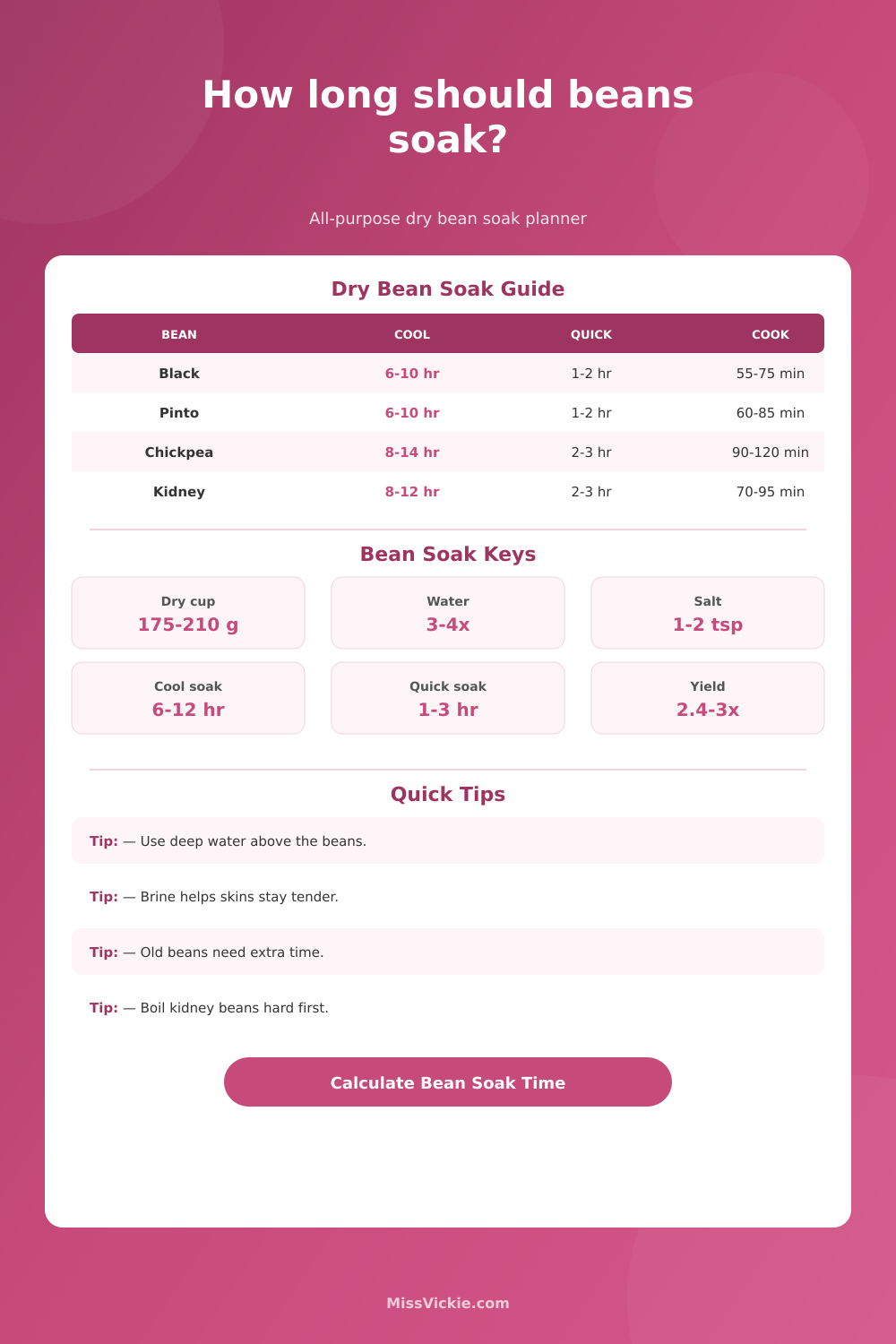
| Black beans | 6 to 10 hours | 1 to 2 hours | 55 to 75 minutes | Bowls, soups, sides |
| Pinto beans | 6 to 10 hours | 1 to 2 hours | 60 to 85 minutes | Refried beans, chili |
| Red kidney beans | 8 to 12 hours | 2 to 3 hours | 70 to 95 minutes | Chili and stews |
| Navy beans | 6 to 10 hours | 1 to 2 hours | 60 to 80 minutes | Soups, baked beans |
| Great Northern beans | 6 to 10 hours | 1 to 2 hours | 60 to 85 minutes | Soup and casseroles |
| Cannellini beans | 8 to 12 hours | 2 to 3 hours | 70 to 95 minutes | Salads and stews |
| Chickpeas | 8 to 14 hours | 2 to 3 hours | 90 to 120 minutes | Hummus, salads, curry |
| Large lima beans | 8 to 14 hours | 2 to 3 hours | 75 to 105 minutes | Succotash and soups |
| Adzuki beans | 4 to 8 hours | 45 to 90 minutes | 35 to 55 minutes | Grain bowls, fillings |
🧪 Water, Salt, And Yield Table
| Dry Amount | Approx Dry Cups | 3x Soak Water | Light Brine | Cooked Yield |
|---|---|---|---|---|
| 8 oz or 225 g | 1 to 1.25 cups | 3 to 4 cups | 1/2 tsp salt | 2.5 to 3 cups |
| 1 lb or 454 g | 2 to 2.5 cups | 6 to 8 cups | 1 tsp salt | 5 to 6.5 cups |
| 2 lb or 908 g | 4 to 5 cups | 12 to 15 cups | 2 tsp salt | 10 to 13 cups |
| 5 lb or 2.27 kg | 10 to 12 cups | 30 to 36 cups | 5 tsp salt | 25 to 32 cups |
⏲ Method Comparison Grid
Best default for even hydration and predictable cooking.
Best when cooking the same day and time is tight.
Best for warm kitchens or when plans move to tomorrow.
Works for many beans, but cook time becomes less predictable.
🌡 Temperature And Altitude Adjustments
| Condition | Soak Change | Cook Change | Practical Adjustment |
|---|---|---|---|
| Cool room under 65°F | Add 10 to 15% | No major change | Use the upper end of the soak window. |
| Warm room over 78°F | Shorten counter soak | No major change | Use fridge soaking for long windows. |
| Altitude 3,000 to 5,999 ft | No major change | Add 10 to 18% | Plan extra simmer time and water. |
| Altitude 6,000 ft or higher | No major change | Add 20 to 35% | Pressure cooking is often more consistent. |
🍴 Cook Plan Reference
| Cook Plan | Soak Goal | Texture Target | Kitchen Note |
|---|---|---|---|
| Stovetop simmer | Even hydration | Creamy center | Simmer gently and salt cooking water to taste. |
| Pressure cooker | Shorter soak is fine | Soft center | Use natural release for fewer split skins. |
| Slow cooker | Full soak preferred | Very tender | Kidney beans need a hard boil before slow cooking. |
| Soup or chili | Medium to full soak | Holds shape | Acidic tomato bases can slow softening. |
| Salads | Moderate soak | Firm bite | Start checking early and cool in cooking liquid. |
💡 Bean Soaking Tips
Calculator outputs are estimates for dried, whole beans. Split peas, lentils, canned beans, and heavily cracked beans use different timing.
There’s a bag of dried black beans sitting on your countertop. You look down at them, look up at clock, and think: How am I going to get this together in time for 7 p.m. What about dinner? The packaging tells you to soak them overnight. Uh-oh; only an hour left ’til you need to be out the door for work. This is when the math gets real, in the kitchen.
Dry beans is seeds, which have been dehydrated, and their tough outer coverings won’t soften till they’re good and ready to take on water. Knowing this means you know how long that’s going to take. It transforms what might feel like a mad rush at dinnertime into something you can plan for as part of your regular routine. Choose your batch size and bean type below, and the calculator will crunch numbers for you, but understanding why you put those inputs in there will help you cook better, even without computer screen.
How to Soak Beans Correctly
Other variables include age of your beans. If they’re fresh, from a bag less than three months out of the package, their skins will be pliable and porous, so they’ll soak rapidly. If they’ve been sitting in your pantry for more than a year, their outer layers have toughened up, resisting moisture uptake. Even after you soak for the usual ten hours, those older beans may not be thoroughly done inside. The tool include a question about bean age for that reason. It does not assume everyone starts with the same average situation. Instead, it accounts for that change in structure and adjusts the window to match. Freshness is inexpensive insurance to avoid either underdone or gloppy results.
The beans will really increase in volume as they soak: double or even triple their original size. The water level must be high enough to cover all seeds; otherwise the upper ones will cook unevenly because they’re drying out from above. I use the simple three-to-one water-to-dry-bean ratio as my baseline (meaning that for each cup of dried beans, there are 3 cups of water). That’s sufficient to cover everything, with no wasteful gallons of unused water. Plenty of water means all the seeds has enough access to it. Soaking also leaches some of the substances that can make digestion uncomfortabley. Discard this soaking water later. You can use extra water just to be safe without any harm.
Forget what you heard about salt: It’s not as bad as we used to think. Common wisdom said that salting the soaking water would toughen bean skins, but scientific tests have confirmed otherwise. A mild brine actualy helps penetrate the seed coat, which makes them cook evenly and adds seasoning to the inside. To accommodate this, the calculator allows you to select either plain water or one of several levels of salt (a teaspoon per pound is more than sufficient for all but the most serious purposes). The slight change in approach yields better results, texturally speaking without increasing your work load.
The final dish is slightly (but really) influenced by environment. Cold kitchen air slows down hydration, sometimes requiring another hour or two on a chilly winter night. A warmer room accelerates everything but will encourage fermentation unless promptly removed from that warm spot. Boiling point depends on elevation, affecting how long beans require to cook once rehydrated. Soaking doesn’t matter; water boils lower at higher elevations. Regardless!. So you’ll need to adjust for altitude whatever your elevation. This tool accounts for those ambient conditions. It helps prevent being mad at yourself when you follow a recipe written for a different elevation than yours.
The decision to soak quickly versus overnight has less to do with science then with how you like to schedule your time. The overnight soak is easy and low-impact: Dump beans into a pot of water, and come morning, they’re soaked. The quick-soak approach is fast, active, and high-energy: Bring to a boil then let stand, covered, for an hour or so. Either way will be fine. When you’re meal-planning at the last minute, some cooks want to keep the option of changing plans, so they like having control over their beans through quick soaking. With overnight soaking, other cooks swear by the gentle hydrating power of a longer period. Use the one that fits your rhythm.
Red kidney beans are the only beans that should be treated different because they contain natural toxins that must be made harmless through heat. Soak them and then always boil vigorously for 20+ min before slow cooking or simmering. Even if you soak them longer, failure to do so will make you ill. Contrary to all other soaking instructions, this is an exception where the potential for danger outweighs the soaking wisdom. Take this little precaution to ensure a safe bowl of chili.
The key to successfully cooking beans is knowing how to respect the structure of the seed itself. Provide adequate heat, provide adequate time, and provide adequate water. And let the math be done by the calculator while you attend to the taste adjustment and enjoyment. Well-hydrated beans go into your pot and come out flavorful and tender. They hold their own on the plate, whether in a hearty stew or a hummus.