How Much Cornstarch to Thicken Banana Pudding
Calculate cornstarch for cooked banana pudding by pudding volume, banana moisture, wafer layers, dairy fat, yolks, chill time, serving style, and slurry ratio.
Choose a common pudding build, then adjust the bananas, wafers, dairy, and chill window to match your dish.
Full Banana Pudding Breakdown
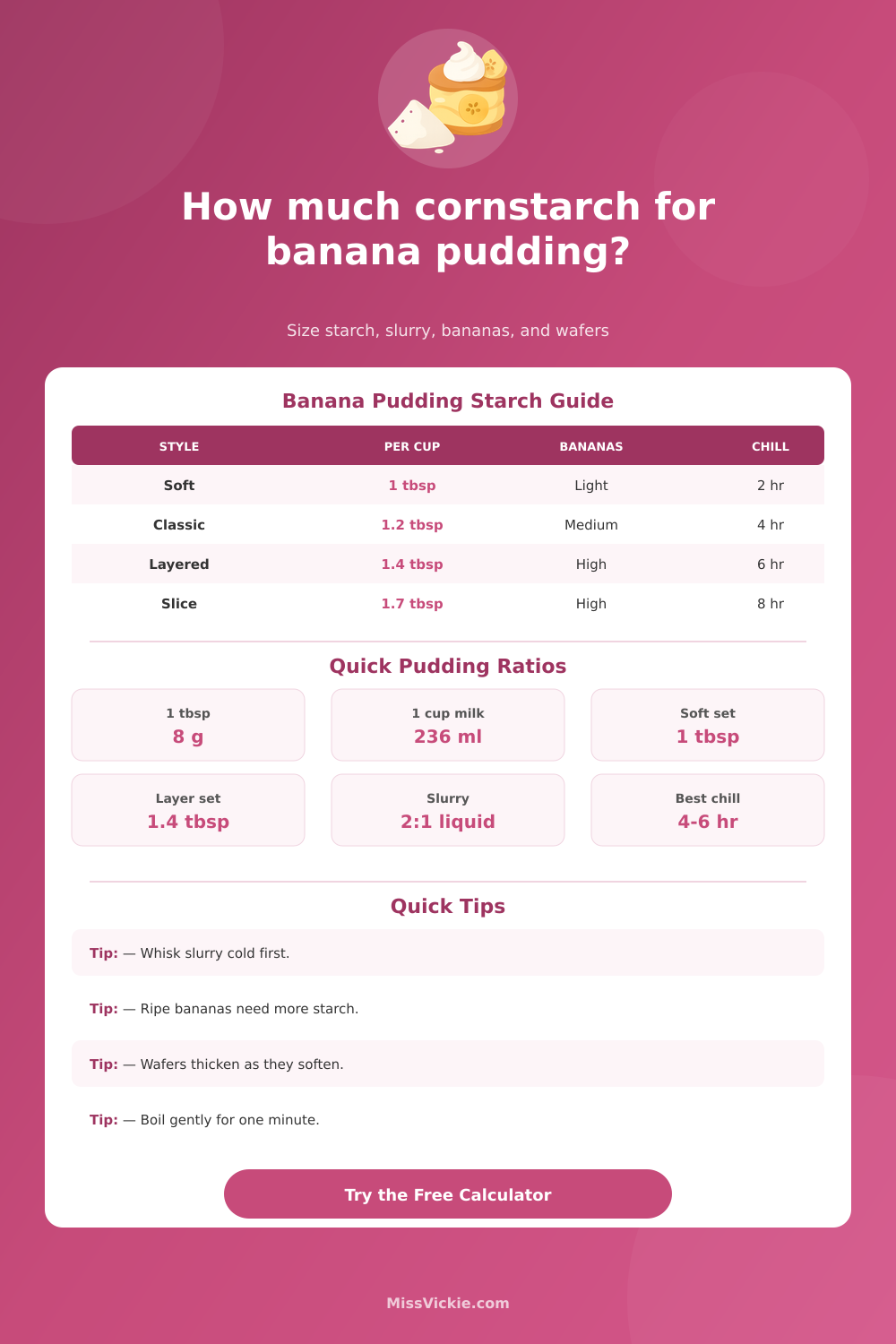
| Pudding Goal | Base Cornstarch | Best Use | Texture Cue |
|---|---|---|---|
| Soft spoon pudding | 1 tbsp per cup | Cups or bowls | Falls slowly from spoon |
| Classic layered scoop | 1.2 tbsp per cup | Bananas and wafers | Mounds softly |
| Tall trifle bowl | 1.35 tbsp per cup | Deep layered desserts | Holds layers |
| Clean slice pan | 1.65 tbsp per cup | Square servings | Cut edge stands |
| Potluck travel set | 1.8 tbsp per cup | Warm rooms or transport | Firm scoop |
| Banana and Wafer Load | Moisture Effect | Absorption Effect | Adjustment Hint |
|---|---|---|---|
| Firm bananas, light wafers | Low | Low to medium | Use base ratio |
| Ripe bananas, classic wafers | Medium | Medium | Add small cushion |
| Spotty bananas, no wafers | High | None | Add more starch |
| Very soft bananas, heavy wafers | Very high | High | Balance both effects |
| Crumb base with overnight rest | Medium | Very high | Avoid over-thickening |
| Dairy Choice | Body | Starch Need | Cooking Note |
|---|---|---|---|
| Skim or low-fat milk | Light | Slightly higher | Whisk constantly |
| Whole milk | Classic | Standard | Best baseline |
| Half-and-half blend | Rich | Slightly lower | Use gentle heat |
| Cream-rich custard | Very rich | Lower | Avoid scorching |
| Thin nondairy milk | Variable | Higher | Check simmer thickness |
| Slurry Style | Liquid Ratio | When to Use | Risk |
|---|---|---|---|
| Thin slurry | 3 tbsp per tbsp starch | Large batches | Adds more liquid |
| Standard slurry | 2 tbsp per tbsp starch | Most pudding | Low lump risk |
| Thick slurry | 1.5 tbsp per tbsp starch | Small saucepans | Whisk fast |
| Minimal slurry | 1 tbsp per tbsp starch | Emergency repair | Higher lump risk |
Best for same-day chilled bowls with few layers.
Good for sliced bananas and two wafer layers.
Extra support for deep pudding stacks.
Firm enough for clean spatula servings.
Kitchen note: cornstarch must reach a gentle boil to fully thicken, but prolonged hard boiling can thin a starch gel.
When making banana pudding from scratch, you must decide how much cornstarch to use in a recipe. The amount of cornstarch you use will determine whether the pudding remains thick or becomes liquidy. If you use too little cornstarch, the fruit and cookies will make the pudding too liquid.
If you use the correct amount of cornstarch, the pudding will hold its shape. The amount of cornstarch you need will change based off several factor. These factors includes the amount of moisture in the bananas you use, the amount of wafers you use in the pudding, the type of dairy you use in the recipe, and how long you chill the pudding after you mix all of the ingredients.
How Much Cornstarch to Use in Banana Pudding
If you use bananas that are very ripe they will contain more moisture than bananas that are firm to the touch. If you use very ripe bananas you will need to use more cornstarch to ensure that the moisture from the bananas does not make the banana pudding too liquid. If you use firm bananas you can use less cornstarch than if you used bananas that were very ripe.
The amount of wafers you use also play a role in how much cornstarch you need. Wafers will absorb the liquid from the pudding, making the pudding thicker. Therefore, if you use alot of wafers you can use less cornstarch.
The calculator accounts for this by reducing the amount of cornstarch that you need if you use heavy wafer option for the pudding. The type of dairy you use will also play a role in the amount of cornstarch you need. If you use cream or half-and-half instead of milk, your recipe will contain more fat.
The fat in the cream and half-and-half will help the banana pudding hold its shape. For these reasons you can use less cornstarch if you use more cream or half-and-half in your recipe. If you use skim milk or nondairy milk alternative you will have to use more cornstarch to help the pudding maintain its shape.
The amount of egg yolks you use in your pudding will affect the amount of cornstarch you need. Egg yolks contains fat and protein that will help the custard thicken. If you use many egg yolks you can use less cornstarch in your recipe.
If you do not use any egg yolks you will need to use more cornstarch to help the pudding maintain its thickness. The amount of time you allow the pudding to chill will change the amount of cornstarch you need. If you allow the pudding to chill for a long time it will firm up.
If you want the banana pudding to sit for only a short time you will need to use more cornstarch to ensure it is thick enough to eat. If you allow the pudding to chill for longer period of time, such as while sleeping overnight you can use less cornstarch. The way in which you will serve the pudding will dictate the amount of cornstarch you need in your recipe.
If you are making banana pudding that you will serve in individual cups you can use less cornstarch. If you are making banana pudding that you will serve in the form of trifle or slices of pudding you will need to use more cornstarch. More cornstarch will be required for slices and trifles compared to serving the pudding in individual cups because these forms of banana pudding require the pudding to hold its shape.
Before adding the cornstarch to your hot liquid you will need to make a cornstarch slurry. To make a cornstarch slurry mix the cornstarch with cold liquid. Make sure that you have fully mixed the cornstarch into the cold liquid so that when the pudding is mixed with all of it’s other ingredients it will be smooth.
Use a ratio of two tablespoon of cold milk to one tablespoon of cornstarch. Making a cornstarch slurry will prevent the cornstarch from creating white speck in your pudding. Finally, taste the custard while it is still cooking on the stove.
If the custard coat the spoon the cornstarch is working correctly. Tasting the custard while it is hot will allow you to understand if the cornstarch has achieved the appropriate thickness before adding the bananas and wafers. Using the cornstarch calculator and tasting the hot custard will allow you to ensure that your pudding will be thick and your recipe will be succesful.