Banana Bread Cooling Time Calculator
Estimate when banana bread is ready for warm slices, clean slices, wrapping, refrigeration, or freezing using loaf size, pan material, fruit moisture, mix-ins, carryover heat, rack airflow, and kitchen temperature.
Choose a bake that sounds close, then tune the weight, pan, crumb, and storage plan to match your loaf.
Your Banana Bread Cooling Plan
Cooling estimate appears here after calculation.
Formula Breakdown
Slicing and Storage Details
Cooling Timeline
- --
- --
- --
- --
| Banana Bread Format | Typical Baked Weight | Warm Slice Range | Clean Slice Range | Wrap Range |
|---|---|---|---|---|
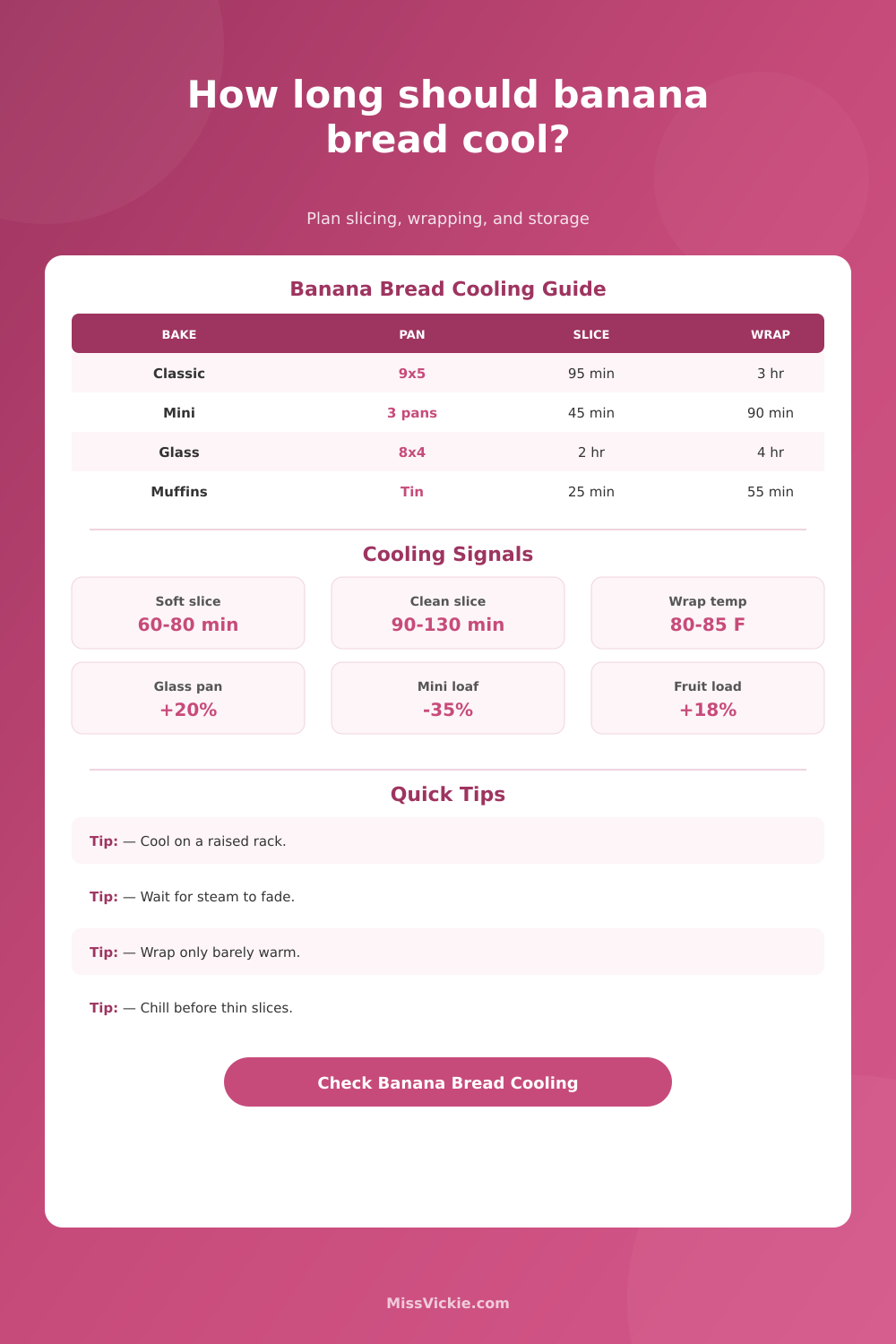
| 9x5 metal pan loaf | 1.45 to 1.85 lb | 55 to 80 min | 90 to 125 min | 2.5 to 3.5 hr |
| 8x4 dense loaf | 1.25 to 1.65 lb | 70 to 95 min | 110 to 145 min | 3 to 4 hr |
| Glass or ceramic loaf | 1.45 to 1.9 lb | 75 to 105 min | 125 to 165 min | 3.5 to 4.5 hr |
| Mini loaves | 0.35 to 0.65 lb each | 25 to 40 min | 40 to 65 min | 75 to 110 min |
| Banana muffins | 2.2 to 3.2 oz each | 12 to 20 min | 22 to 35 min | 45 to 65 min |
| Moisture or Batter Clue | Cooling Effect | Reason | Calculator Factor |
|---|---|---|---|
| Very ripe banana, dark crumb | Longer | More dissolved sugars and fruit water | 1.12x |
| Extra banana or applesauce | Much longer | Center stays custardy and steamy | 1.22x |
| Less banana, lighter crumb | Shorter | Lower moisture load | 0.92x |
| Chocolate chips | Longer | Melted pockets keep slices soft | 1.09x |
| Nuts | Slightly shorter | Dry inclusions interrupt heat pockets | 0.97x |
| Storage Plan | Best Center Feel | Condensation Risk | Added Wait |
|---|---|---|---|
| Counter wrap | Barely warm | Moderate if wrapped early | 15 min |
| Gift bag or tight wrap | Room temp | High in plastic or bag | 35 min |
| Refrigerate | Cool, no steam | Moderate inside container | 45 min |
| Freeze whole loaf | Fully cool | High under foil | 60 min |
| Freeze slices | Cool and firm | Low after slice rest | 80 min |
Open sides remove steam and reduce gummy edges.
Stored heat keeps the bottom and sides warm longer.
Trapped steam softens crust and encourages damp slices.
Extra firming helps thin slices and gift-ready ends.
Cooling times are estimates for home-baked banana bread. Very deep pans, underbaked centers, or humid kitchens can require more rest before slicing or wrapping.
No recipe goes wrong in the oven quite like banana bread. Except that it doesn’t go wrong in the oven; it goes wrong on the counter, when you’re trying to resist cutting yourself a slice until it cools enough to avoid mushy, collapsed texture. So you take it out, and then you wait 10 minutes (but then again maybe 20). The knife goes in, and there’s a mushy crater where the crumb has collapsed. The bread is letting out steam, ruining all the work you did to give it structure.
It feels like you baked something wrong, but really, what you’ve done is not waited long enough. You wanted warm, and now you have it, only with structural problems that come from having it be warm inside. That’s why a how-to for waiting time makes such a difference, helping home bakers prevent soggy bread or cold cake.
Why You Must Wait Before Cutting Banana Bread
This is where the calculator comes in. After you input your pan type and weigh your loaf, it does all of the math for you. You don’t need to do any conversions or guess at coefficients. It figures out how much heat is trapped by your equipment and ingredients.
Your metal pan doesn’t hold radiant heat as long as a glass pan. The bottom stay warm while the top might feel cool enough to touch. Is your loaf heavy with ripe bananas? Does it have lots of applesauce? More moisture mean it needs more time before steam inside escapes. Do you use a heavy batter or lean crumb? The tool will adjust the cooling time based off those factors. Why does a moist, moddern loaf act different than a quick-cooking loaf? It knows.
The outputs aren’t the only part of the equation; it’s equally critical that you understand what they’re telling you. If output says wait ninety minutes, that indicates that it take some time for the sugars and starches to set. Cutting into it before then messes up the process. The knife tears jaggedly at the sides and there’s nothing but crumbs where it should of cut through.
If your intention is to freeze (or give) the bread, you’ll have even more time once stored: steam builds up inside if it is wrapped while still hot. This moisture collects on the crust and makes it go soft, plus it encourage mold to form in a matter of days, or hours. Before you wrap it with anything plastic, let the inside be just warm, never hot, to the touch.
Season and ventilation will affect how hot your kitchen runs, so make use of other physical signs as well. For any kind of serious cooling, a raised wire rack is essential, air circulates beneath it. Never leave bread on a flat plate or in its baking pan, as this traps heat at the bottom of the bread and creates a wet ring that will not dry off correcty.
Also, try to test the tension of the crust itself, lightly pushing around the middle. Does it spring right back up, or sink? It is still too moist inside to be cleanly sliced. Finally, don’t cover your resting bread with a towel, or worse, some foil. You might do this to keep it fresh but you are actually trapping steam. This puts moisture back onto the surface you want to stay dry.
With warm or cold slices, the question becomes how to handle the wait time. If thick, warm slices sound good to you: Use a serrated knife, and don’t mind if they’re not totally crisp at the edges. Let them sit briefly, then cut. For thin, neat slice (for sandwiches): Cut when the loaf is completely cool and firm.
How do mini loaves compare with full-sized? The smaller volume has more surface area per volume of bread, so it loses its warmth sooner. It’s like this: A nine-by-five loaf will take hours to cool; a muffin tin cools within minutes.
A slightly short cool won’t hurt banana bread, but a slice cut a little too soon will. This isn’t a matter of degrees so much as change: a loaf left to sit for a while undergoes a structural metamorphosis, with its interior starches hardening. Water redistributes itself into an even crumb. And the longer you wait, the more likely you are to get a weepling. That’s because the weep centers from ignoring this step in the process.
Even though you’ll never see patience printed on any package, it’s the last ingredient in a perfect recipe, and letting the steam subside totally guarantees that each slice remains intact. Sweet and heavy as a pound.