
Baking require precision in the amount of time and the temperature used to cook the food. If the temperature of the cooking food is too high, it can result in dry food. If you use a temperature that is too low, the food wont fully set.
If you use a time that is too short, the food will be undercooked. If the time is too long, the food will become overcooked. To avoid these issue, bakers use temperature and time chart to ensure that they are using the correct amount of time and temperature to cook the food.
What Affects Baking Time and Temperature
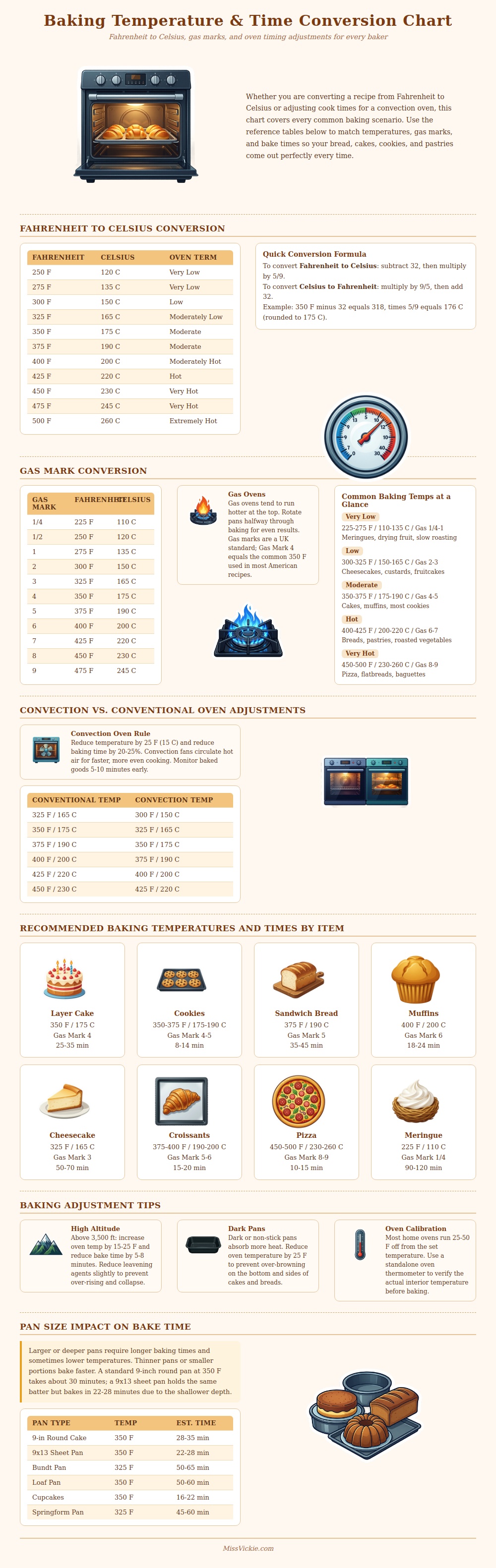
There is different temperature scale throughout the world and within cooking recipes. For instance, many cookbooks from the United States use Fahrenheit as the temperature scale. Other cookbooks from the United Kingdom may use gas marks to describe the temperature in which the food must be cooked.
Because gas marks and Fahrenheit is two different temperature scales, a conversion chart change the gas marks into Fahrenheit measurement. By understanding the relationship between gas marks and Fahrenheit measurements by using a conversion chart, cooks can follow any recipe, regardless of the mathematics that may be associated with the recipe. The type of oven that is used can alter the amount of time and temperature that is required to cook the food.
Conventional oven dont contain fan to circulate the hot air within the oven. Convection ovens contain a fan that circulates the hot air around the food. Because of the circulation of hot air around the food, convection ovens cook the food faster and allow for the browning of the foods surface to be more even.
To cook with a convection oven, reduce the cooking temperature by 25 degrees and reduce the cooking time. If you cook with a convection oven without adjusting the cooking temperature and time, the outside of the food will cook and brown before the inside are cooked. The altitude at which you cook can change the time and the temperature that is required to cook the food.
At high altitudes, the air pressure is lower. This cause the moisture within the food to evaporate at a faster rate, and the air bubble in the food expand at a faster rate. To cook food at higher altitudes, the cook should slightly increase the temperature.
Additionally, the amount of time should be reduced. Furthermore, the amount of leavening agent in the recipe can be reduced. If you do not adjust the cooking temperature and time for the altitude at which the food is to be cooked, the structure of the food may collapse prior to when it has set.
The type of material out of which the baking pan is made and the size of the pan can affect the time and the temperature at which the food is cooked. If the pan is made out of dark metal, it will heat the food more faster than a pan made out of shiny aluminum metal. Because of this, food will brown too quickly on the edges of the food.
Therefore, the cook should reduce the cooking temperature if using a dark metal pan. If the pan is shallow in comparison to the depth of the food, the food will heat to the desired temperature in less time than deeper pans. Therefore, pan size and depth can affect cooking time and temperature.
Within an oven, the temperature of the food will not always maintain the same temperature that is set on the oven’s dial. An oven can become as much as fifty degrees hotter or fifty degrees colder than the temperature that is set on the oven’s dial. To adjust for these inconsistency in cooking temperatures, cooks can use an oven thermometer within the oven.
When using an oven thermometer, cooks will always know the actual temperature of the oven. By knowing the actual temperature of the oven, cooks can follow the recipe for best result. Cooking recipes do not always include the time and the temperature for the specific oven, baking pan, or altitude at which the recipe is to be cooked.
While the recipe may ask for information regarding the type of pans in which the food is to be cooked, or the temperature of the oven, the recipe does not always include these detail. By using a conversion chart and an oven thermometer, cooks can adjust the time and the temperature accordingly. By understanding the relationship between temperature, time, altitude, and pan material, cooks can control the baking process.