Baking Soda to Baking Powder Converter
Convert baking soda to baking powder with recipe acid, baking powder type, category, salt impact, batch size, and lift target all kept in the math.
Load a common recipe situation, then adjust the soda amount, acidic ingredient, powder style, salt sensitivity, and lift goal for your batter or dough.
Conversion Breakdown
Needs recipe acid, browns well, and can taste soapy when excess remains.
Gives batter and oven lift, but adds acid salts and sodium to the recipe.
Reacts quickly once wet, so mix gently and bake without a long rest.
Cream of tartar blends are useful when you need a clear acid source.
| Original baking soda | Regular baking powder | Homemade powder | Best use |
|---|---|---|---|
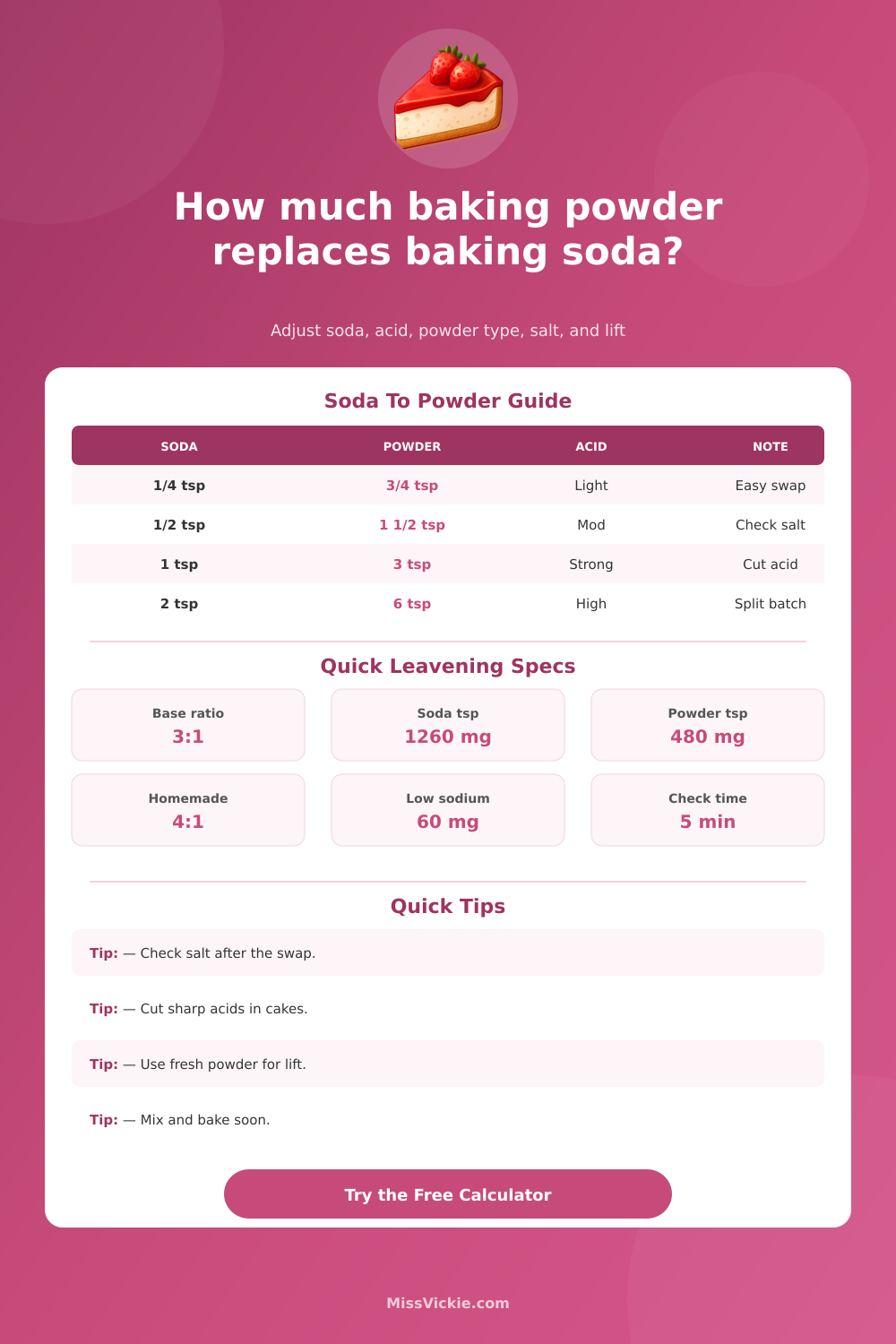
| 1/8 tsp soda | 3/8 tsp powder | 1/2 tsp homemade | Small cookie or mug cake batches |
| 1/4 tsp soda | 3/4 tsp powder | 1 tsp homemade | Pancakes, light muffins, thin batters |
| 1/2 tsp soda | 1 1/2 tsp powder | 2 tsp homemade | Most quick breads and 8-inch cakes |
| 1 tsp soda | 1 tbsp powder | 4 tsp homemade | Large loaf cakes or double muffin batches |
| 2 tsp soda | 2 tbsp powder | 8 tsp homemade | Large batches; watch bitterness and salt |
| Powder type | Ratio per 1 tsp soda | Sodium estimate | Kitchen note |
|---|---|---|---|
| Double-acting regular | 3 tsp powder | About 480 mg per tsp | Most reliable all-purpose replacement |
| Aluminum-free double-acting | 3.1 tsp powder | About 450 mg per tsp | Good for cakes with delicate flavor |
| Single-acting | 3.25 tsp powder | About 420 mg per tsp | Use when batter goes straight to the oven |
| Low-sodium powder | 3.3 tsp powder | About 60 mg per tsp | Useful when added sodium is the main concern |
| Homemade powder | 4 tsp powder | About 315 mg per tsp | Usually 1 part soda, 2 parts cream of tartar, 1 part starch |
| Acid level | Examples | Powder adjustment | Flavor watch |
|---|---|---|---|
| No clear acid | Milk, white sugar, Dutch cocoa | Add slightly more powder | May taste cleaner but less browned |
| Light acid | Brown sugar, fruit puree | Use near the base ratio | Usually no acid reduction needed |
| Moderate acid | Buttermilk, yogurt, sour cream | Use a small acid-aware reduction | Replace a little acid if tangy |
| Strong acid | Lemon juice, vinegar, molasses | Reduce powder or keep a pinch of soda | Too much unneutralized acid can taste sharp |
| Recipe category | Factor | Why it changes | Best target |
|---|---|---|---|
| Cakes and cupcakes | 1.00 | Even crumb needs balanced gas release | Standard or tall lift |
| Muffins and quick breads | 1.05 | Heavier batters need a small boost | Standard lift |
| Pancakes and waffles | 1.10 | Short cooking time benefits from extra early lift | Tall lift |
| Cookies and bars | 0.85 | Too much powder can make cookies cakey | Gentle lift |
| Biscuits and scones | 1.15 | Dense doughs need more vertical push | Tall lift |
A baking soda to baking powder converter is a tool that allows you to replace baking soda with baking powder in your recipe. Baking soda is a form of sodium bicarbonate that require an acidic ingredient in the recipe. Baking powder is a mixture that contain an acid, so it dont need to react with an additional acidic ingredient.
For these reasons, baking powder and baking soda are not interchangeable in recipes; baking powder and baking soda have different recipes for the amount of baking powder relative to the amount of baking soda that should be used in recipes, as well as recipes for the other ingredients that should be used within those recipes to provide balance to the recipe. To use a baking soda to baking powder converter, you must first enter the original amount of baking soda that the recipe requires. The original amount of baking soda will inform the remainder of the baking soda to baking powder conversion.
How to Convert Baking Soda to Baking Powder
After entering the amount of baking soda that the recipe requires, you must also select the type of baking powder that you will use in your recipe. Many baking powders contain different types of acid, and contain different amounts of sodium than other baking powders. Therefore, the amount of each ingredient in the recipe will differ based off the type of baking powder that you use in your recipe.
Another factor in the baking soda to baking powder conversion is the type of acidic ingredients that is present in the recipe. Ingredients like buttermilk, yogurt, lemon juice, molasses, and natural cocoa powder are acidic ingredients. Baking soda reacts with acidic ingredients.
Therefore, if you are using baking powder instead of baking soda, you no longer need these acidic ingredients. The baking soda to baking powder converter will let you know whether or not you need to change the amount of acidic ingredients in your recipe. You would only need to reduce the amount of acidic ingredients in the recipe if the baking soda to baking powder converter indicates that the recipe will otherwise taste too sour without the baking soda to neutralize the acid in the recipe.
Another factor that you should consider when using a baking soda to baking powder converter is the category of the recipe. For instance, pancakes have a different type of recipe for the batter than cookies have for their recipe for dough. In each of these recipe categories, baking soda to baking powder converters allow you to select the desired level of lift that the recipe should create.
If the recipe is for items like muffins, you may select a lift target that indicates that the baked good should be tall and airy. If, however, the recipe is for items like cookies, you may use a gentler lift target so that the cookie will be tender to the touch after baking. Each of these settings within the baking soda to baking powder converter will adjust the recipe as necessary to provide the type of baked good that you select.
Because baking powder contains sodium, using baking powder instead of baking soda will increase the amount of sodium in the recipe. The baking soda to baking powder converter will alert you to the increase in sodium that will result from converting baking soda to baking powder. The baking soda to baking powder converter may also allow you to adjust the amount of salt that you are to use in the recipe so that the total amount of sodium in the recipe does not become too high.
Baking soda to baking powder converters are helpful tools for those that would like to scale their recipes. Whether you would like to double or halve the amount of a recipe, the baking soda to baking powder converter will provide new measurements for each ingredient so that the proportions of the leavening agents (baking soda or baking powder) is maintained. Another consideration for baking powder conversions is the effect that the conversion will have upon the appearance of the baked good.
Baking soda raises the pH level of the batter for baked goods. A higher pH level will cause the crust of the baked good to brown. Baking powder does not raise the pH level of the batter to the same extent as baking soda.
Therefore, baked goods that use baking powder will not brown to the same extent as they would if baking soda was used. This effect is typically not noticeable in baked goods like muffins, but may be noticeable in delicate baked goods like vanilla cake. Baking soda to baking powder converters will warn you of these potential difference in browning.
Finally, baking powder should of been fresh before you begin using the baking soda to baking powder converter. Baking powder loses its effectiveness with time. If the baking powder is too old, the baking soda to baking powder converter will not provide accurate measurements for the amount of baking powder that should be used in your recipe.
To test whether your baking powder is fresh, simply mix the baking powder with warm water. If the baking powder creates foam when mixed with the warm water, the baking powder is fresh and can be used in recipes. If the baking powder does not foam when mixed with the water, the baking powder is old and should not be used in the recipe.
Using a baking soda to baking powder converter allows you to account for all of these variables at once. Otherwise, you would have to manually adjust the amount of acidic ingredients, sodium, and lift targets.