How Much Baking Soda to Tenderize Meat?
Estimate the baking soda, water, contact time, and rinse plan for sliced beef, chicken, pork, lamb, turkey, seafood, or ground meat without making the surface soapy.
Choose a real kitchen scenario to load meat type, thickness, weight, method, time target, and sodium sensitivity, then adjust the details for your cut.
Detailed Tenderizing Breakdown
| Protein | Starting Baking Soda | Best Method | Typical Time | Rinse Guidance |
|---|---|---|---|---|
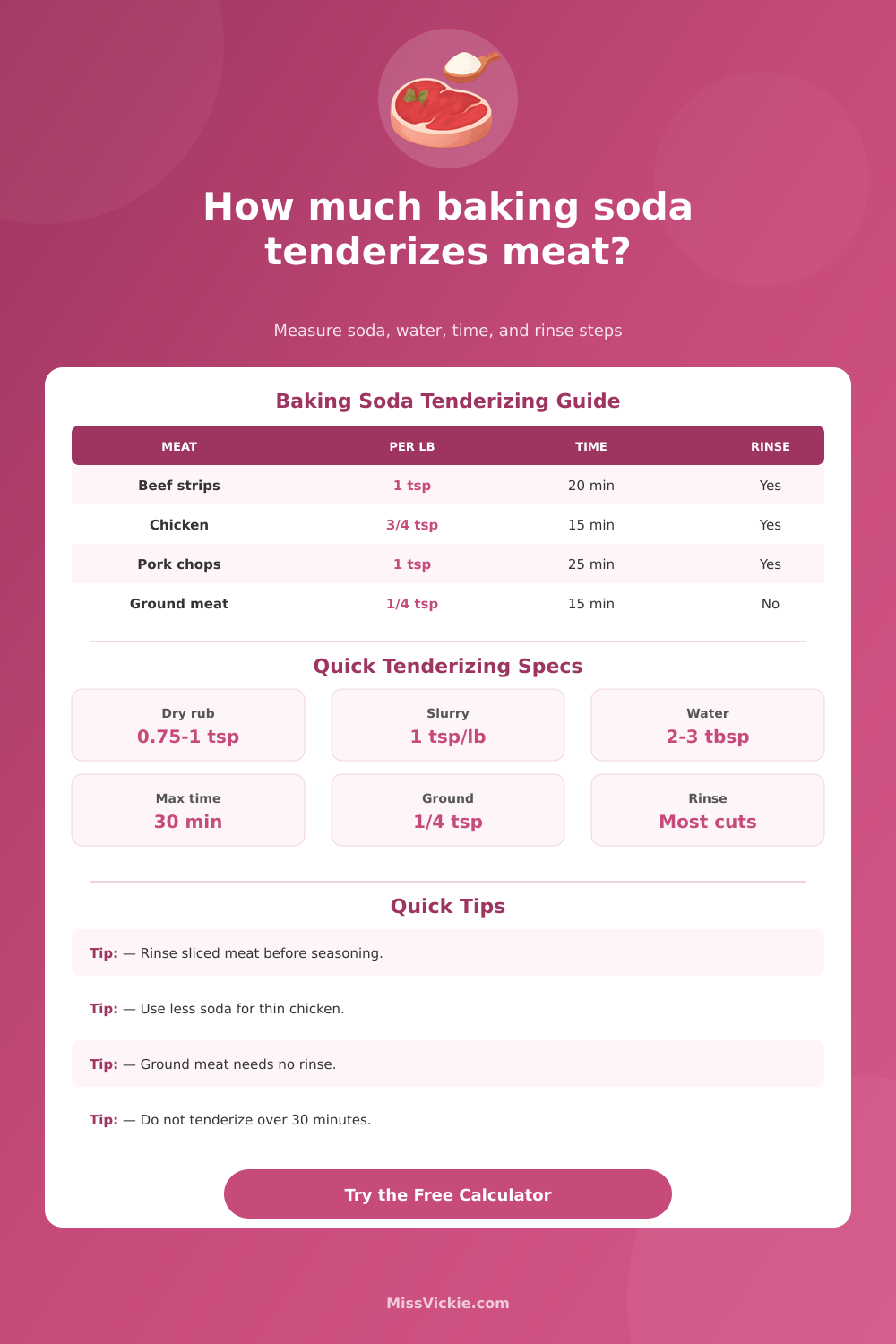
| Beef strips for stir-fry | 1 teaspoon per pound / 5.5 g per 454 g | Wet slurry or dry sprinkle | 18 to 25 minutes | Rinse well, drain, and pat dry before sauce |
| Chicken breast pieces | 3/4 teaspoon per pound / 4.1 g per 454 g | Velveting slurry | 12 to 18 minutes | Rinse unless baking soda is extremely low |
| Pork chops or slices | 1 teaspoon per pound / 5.5 g per 454 g | Wet slurry for even contact | 20 to 30 minutes | Rinse and dry thoroughly for browning |
| Lamb cubes | 3/4 teaspoon per pound / 4.1 g per 454 g | Slurry with light oil after rinse | 18 to 25 minutes | Rinse to prevent mineral flavor |
| Ground beef or pork | 1/4 teaspoon per pound / 1.4 g per 454 g | Mix directly with a spoon of water | 10 to 15 minutes | Do not rinse; cook as mixed |
| Shrimp or firm seafood | 1/2 teaspoon per pound / 2.8 g per 454 g | Loose cold slurry | 8 to 12 minutes | Rinse quickly and dry before heat |
| Cut Thickness | Surface Style | Light Goal | Standard Goal | Strong Goal |
|---|---|---|---|---|
| Under 1/4 inch / 6 mm | Shaved beef, thin chicken | 8 to 12 min | 12 to 18 min | 18 to 20 min |
| 1/4 to 1/2 inch / 6 to 12 mm | Stir-fry strips, fajita strips | 12 to 16 min | 18 to 24 min | 24 to 28 min |
| 1/2 to 3/4 inch / 12 to 19 mm | Pork slices, kabob cubes | 16 to 20 min | 22 to 30 min | 30 min max |
| 3/4 to 1 inch / 19 to 25 mm | Whole chop or thin steak | 18 to 22 min | 25 to 30 min | Score or slice first |
| Ground or minced | Loose crumbles or patties | 8 to 10 min | 10 to 15 min | 15 min max |
| Method | Liquid Range | When to Use | Rinse Step | Seasoning Note |
|---|---|---|---|---|
| Wet slurry | 2 to 3 tbsp per lb / 30 to 45 ml | Best all-purpose approach for strips and cubes | Rinse, drain, pat dry | Salt after rinse so seasoning stays balanced |
| Dry sprinkle | 0 to 1 tbsp per lb / 0 to 15 ml | Good for very thin slices with surface moisture | Rinse carefully | Rub evenly to avoid bitter spots |
| Velveting base | 1 to 2 tbsp per lb / 15 to 30 ml | Chicken, pork, or beef before stir-frying | Often rinse, then add starch and oil | Add soy sauce after soda is removed |
| Ground meat mix | 1 tbsp per lb / 15 ml | Browning ground beef, pork, or turkey | No rinse | Reduce added salt slightly |
Raises surface pH so proteins hold moisture and brown well after rinsing.
Seasons deeply and improves juiciness, but needs more time than soda.
Adds flavor, but too much acid can make thin meat mealy or chalky.
Papaya or pineapple can tenderize aggressively and needs close timing.
| Raw Meat Amount | Sliced Beef or Pork | Chicken Pieces | Ground Meat | Standard Slurry Water |
|---|---|---|---|---|
| 1/2 lb / 227 g | 1/2 tsp / 2.8 g | 3/8 tsp / 2.1 g | 1/8 tsp / 0.7 g | 1 to 1 1/2 tbsp / 15 to 22 ml |
| 1 lb / 454 g | 1 tsp / 5.5 g | 3/4 tsp / 4.1 g | 1/4 tsp / 1.4 g | 2 to 3 tbsp / 30 to 45 ml |
| 2 lb / 907 g | 2 tsp / 11 g | 1 1/2 tsp / 8.3 g | 1/2 tsp / 2.8 g | 1/4 to 3/8 cup / 60 to 90 ml |
| 3 lb / 1.36 kg | 1 tbsp / 16.5 g | 2 1/4 tsp / 12.4 g | 3/4 tsp / 4.1 g | 6 to 9 tbsp / 90 to 135 ml |
| 5 lb / 2.27 kg | 1 tbsp + 2 tsp / 27.5 g | 1 tbsp + 3/4 tsp / 20.6 g | 1 1/4 tsp / 6.9 g | 10 to 15 tbsp / 150 to 225 ml |
Baking soda can be used to tenderize meats. Additionally, baking soda can be used to change the texture of the meat. When baking soda are applied to the meat, the baking soda raises the pH level of the meat.
This raised pH level allow the meat to hold more moisture during the cooking of the meat. Consequently, the meat will be more tenderer if its cooked. However, you should take care with the amount of baking soda that is used, as well as with the length of times that the baking soda remains in contact with the meat.
How to Tenderize Meat with Baking Soda
Using too much baking soda can impart a soapy flavor to the meat. Additionally, leaving the baking soda in contact with the meat for too long can result in the meat developing a mushy texture. The thickness of the meat will determine the amount of baking soda to be used, as well as the length of time that the baking soda should be in contact with the meat.
Thin meats will absorb the effect of the baking soda more quickly than thicker cut of meat. Thicker cuts of meat will require more time for the baking soda to effectively tenderize the meat, but the length of time should be limited to the point where the outer layer of the thick cut of meat does not become too soft. Ground meats will require a different application of baking soda than sliced meats.
With ground meats, the baking soda can be mixed with the ground meat. After mixing the baking soda with the ground meat, there is no need for rinse the ground meat. Less baking soda should be used for ground meats than for sliced meats, however, or the ground meat may have a chalky texture.
Baking soda can be applied to the meat in two difference ways. One method is to apply the baking soda in the form of a wet slurry. In this method, baking soda is mixed with a small amount of water.
The advantage of this method is that the baking soda will spread more even over the meat. An alternative method of applying baking soda is as a dry sprinkle of baking soda powder. The disadvantage of this method is that the baking soda may clump together on the meat.
A calculator that determine the amount of baking soda to use will account for these different methods. Rinsing the meat treated with baking soda is a necessary step. This step removes the alkaline substance of the baking soda from the meat.
If the meat is not rinsed with water, the baking soda may impart a metallic taste to the meat. However, you should not aggressively scrub the meat with a brush to remove the baking soda from the meat. Aggressive scrubbing may remove the moisture from the meat.
After rinsing the meat with water, the meat should be patted dry with paper towel. Patting the meat dry will allow the meat to brown properly during the cooking process. The amount of salt to be used in the meat will impact the amount of baking soda to be used.
If alot of salt is to be used in the meat, less baking soda should be used so as to not make the meat too salty. If little or no salt is to be used in the meat, the standard dose of baking soda should be used. The amount of salt to be used in the meat can be indicated on the baking soda calculator so that the amount of baking soda that is calculated will account for the amount of salt that will be used.
The length of time that the baking soda remains in contact with the meat is another critical element of the process. If the baking soda is in contact with the meat for too long, the texture of the meat will be ruined. If the baking soda is in contact with the meat for more than thirty minutes, the texture of the meat may become mushy.
This is especially true for seafood. To avoid ruining the texture of seafood, a timer will have to be used to ensure that the baking soda is not in contact with the meat for more than the recommended length of time for that type of meat. If large amounts of meat are to be treated with baking soda, the yield of the raw meat will need to be account for.
When meat is rinsed with water and patted dry, some of the moisture will be removed from the meat. If a certain weight of cooked meat is to be prepared, more raw meat will need to be purchased to account for the loss of moisture. The baking soda calculator will account for this “yield loss” so that the total amount of raw meat to be purchased can be calculated.
Baking soda tenderizing is a different step from salt brining, as well as from acid marinating. Salt brining takes place over a longer period of time because the salt must penetrate deep into the meat, but the salt brining method seasons the meat. Acid marinating is a fast process, but too much time with acidic marinades may result in the meat becoming mealy.
Baking soda tenderizing can be performed quickly to change the texture of the meat without adding much flavor to the meat (which is removed by rinsing the meat with water). Thus, baking soda tenderizing is an effective method of tenderizing meat without changing the flavor of the meat.