How Much Baking Soda for Hard Boiled Eggs?
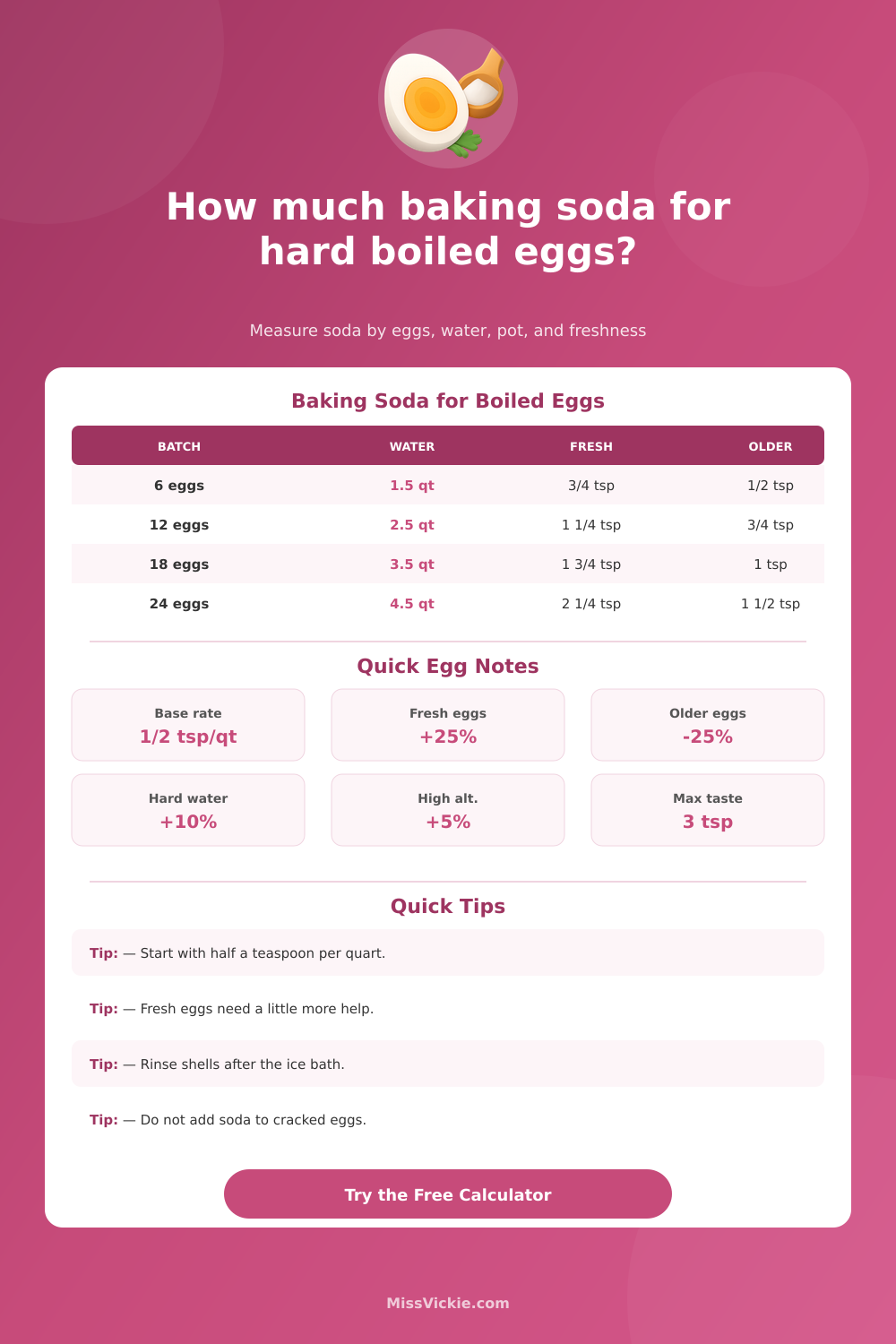
Calculate the right baking soda amount for hard boiled eggs using egg count, water volume, freshness, pot size, altitude, and peeling goal.
Choose a common kitchen batch and the calculator will load egg count, water coverage, freshness, and peeling target before running the estimate.
Detailed Baking Soda Breakdown
| Egg Batch | Typical Water | Fresh Egg Soda | Older Egg Soda | Best Use |
|---|---|---|---|---|
| 4 to 6 large eggs | 1 to 1.5 qt | 1/2 to 3/4 tsp | 1/4 to 1/2 tsp | Breakfast, snack boxes |
| 10 to 12 large eggs | 2 to 2.75 qt | 1 to 1 1/2 tsp | 3/4 to 1 tsp | Meal prep or lunch salads |
| 18 large eggs | 3 to 3.75 qt | 1 1/2 to 2 tsp | 1 to 1 1/2 tsp | Deviled egg trays |
| 24 to 30 large eggs | 4.5 to 6 qt | 2 1/4 to 3 tsp | 1 1/2 to 2 1/2 tsp | Party platters and catering |
| Condition | Adjustment | Why It Matters | Calculator Treatment |
|---|---|---|---|
| Very fresh eggs | Add 25% | Low air cell and tighter membrane make peeling harder. | Raises the teaspoon rate but keeps the taste cap. |
| Week-old eggs | Use base rate | Moderate pH and air-cell growth usually peel better. | Leaves the soda rate close to standard. |
| Older eggs | Reduce 25% | They already peel more easily, so less alkalinity is needed. | Lowers soda to avoid a soapy edge. |
| Very hard water | Add 18% | Minerals can dull the alkalinity effect. | Adds a small compensation factor. |
| Method | Water Contact | Soda Strategy | Notes |
|---|---|---|---|
| Covered boil | Full pot water | Measure by total quarts. | Best match for the classic baking soda rule. |
| Gentle simmer | Full pot water | Use the same amount as boiling. | Lower movement protects shells from cracking. |
| Steam basket | Shallow lower water | Use less soda, based on water below basket. | Peeling comes more from steam shock than soda. |
| Pressure cooker | Usually 1 cup water | Use a small pinch to 1/8 tsp. | Too much soda is unnecessary in low water. |
| Egg Size | Approx Weight | Water Displacement | Batch Note |
|---|---|---|---|
| Medium | 50 g each | About 50 ml | Needs slightly less pot space than large eggs. |
| Large | 57 g each | About 57 ml | Standard size used for most kitchen charts. |
| Extra large | 64 g each | About 64 ml | Allow a wider pot for single-layer cooking. |
| Jumbo | 71 g each | About 71 ml | Use a larger pot to avoid stacked shells. |
For pressure cooker cups, very small batches, or older eggs.
Good when eggs are already a week or two old.
The usual starting point for covered hard boiled eggs.
Useful for very fresh eggs, hard water, or clean halves.
Adding baking soda to the water when boiling eggs make the eggshells more easy to peel. Baking soda loosen the membrane that is between the eggshell and the egg white. If the membrane are not loosened, then the shell may stick to the egg white, or the shell may tear when the person try to peel the eggshell.
The alkaline property of baking soda alter the pH level of the water. The alkalinity of the water weaken the bond between the eggshell and membrane. Another variable that determine the amount of baking soda that should be used when boiling eggs are the freshness of the eggs.
Make Boiled Eggs Easy to Peel with Baking Soda
Fresh eggs contain more of an air cell and have a tighter membrane than older eggs. Because of this, fresh eggs needs more baking soda to loosen the membrane. On the other hand, older eggs contains a larger air cell and have a higher natural pH level, so they requires less baking soda to loosen the membrane.
The minerals that is contained in hard water can affect the effectiveness of the baking soda. If you lives in an area where the water is hard, the cook would need more baking soda to loosen the membrane of the eggshell. The altitude at which you live and the methods in which you cook the eggs can also affect the amount of baking soda that should be added to the water.
If you live in a high altitude where the boiling point of water are lower, you may need to adjust the amount baking soda that is added to the water. If you use methods like a steam method or a pressure cooker, there will be less water in the cooking method. In these instances, fewer baking soda should be used, or the eggs will taste like soap due to the high amount of baking soda relative to the amount of water in which the eggs is cooking.
Another factor to consider is the volume of water and the number of eggs in the pot. If there is too many eggs in the pot, the water cannot circulate evenly between the eggs. Additionally, if the eggs is not fully submersed in the water, the baking soda will not be able to work evenly on each eggshell.
Make sure the eggs is covered in water so that the baking soda can work on each eggshell. Using baking soda is similar to most recipes in that a standard measurement of baking soda are used. However, the standard measurement may not be accurate in each situation.
For instance, half a teaspoon of baking soda per quart of water may work in one situation but not in another. A baking soda calculator allow the person to input the volume of water, the number of eggs, and the freshness of the eggs to calculate the proper amount of baking soda to add to the water. Using the correct amount of baking soda will allow the eggshells to easily peel without tearing the egg whites.
In order to achieve the best result after boiling the eggs, an ice bath must be used. Adding baking soda to the water loosen the membrane that holds the shell to the egg. However, using an ice bath will contract the egg inside the shell, which will make the shell more easy to remove from the egg.
Rinse the eggs under cool running water after using the ice bath to remove the baking soda film from the eggshell. These two steps will make it easier to peel the cooked eggs.