Baking Soda per Cup of Flour Calculator
Estimate baking soda from flour cups or grams, recipe style, acidic ingredients, cocoa or molasses strength, baking powder already included, altitude, pan size, rise target, spread target, and batch scale.
Pick a common bake, then adjust the flour, acid, pan, powder, altitude, and scale to match your recipe.
Full Baking Soda Breakdown
Useful when baking powder supplies most lift or the recipe has only mild acidity.
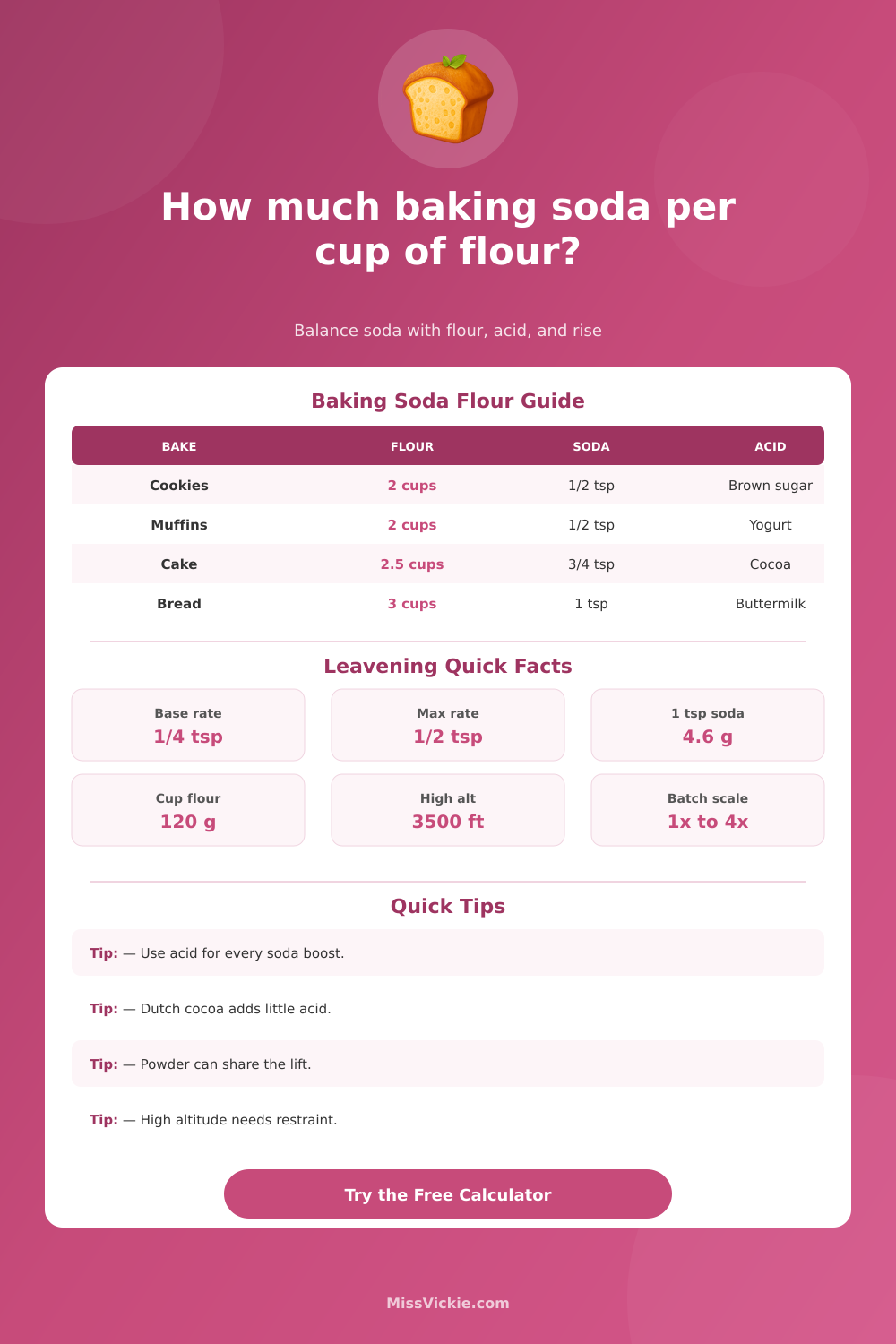
Common per cup flour for cookies, muffins, cakes, pancakes, and quick breads.
Works when buttermilk, yogurt, natural cocoa, molasses, or lemon carries the reaction.
Reserve for strongly acidic batters; too much soda tastes soapy and browns fast.
| Recipe Type | Starting Soda per Cup | Typical Acid Partner | Leavening Goal |
|---|---|---|---|
| Cookies and cookie bars | 1/8 to 1/4 tsp | Brown sugar, molasses, cocoa | Spread, browning, and light chew |
| Muffins and cupcakes | 1/4 tsp | Yogurt, buttermilk, fruit puree | Even lift without tunneling |
| Quick breads and loaf cakes | 1/4 to 1/3 tsp | Banana, buttermilk, sour cream | Steady rise through a deeper pan |
| Layer cakes and sheet cakes | 1/4 tsp | Natural cocoa, sour cream, vinegar | Tender crumb with controlled browning |
| Pancakes and waffles | 1/8 to 1/4 tsp | Buttermilk, kefir, yogurt | Quick griddle lift and browning |
| Brownies and dense bars | 0 to 1/4 tsp | Cocoa, molasses, brown sugar | Gentle puff without cakiness |
| Scones and biscuits | 1/8 to 1/4 tsp | Buttermilk or sour cream | Lift without harsh soda taste |
| Gingerbread and spice loaves | 1/3 to 1/2 tsp | Molasses and sour dairy | Strong reaction with dark acidic syrup |
| Acid Ingredient | Calculator Unit | Soda Support | Kitchen Note |
|---|---|---|---|
| Buttermilk or kefir | Cups | Strong | Reliable partner for soda in pancakes, muffins, and cakes. |
| Plain yogurt or Greek yogurt | Cups | Strong | Thicker yogurt may need enough liquid for even mixing. |
| Sour cream | Cups | Strong | Good for cakes and quick breads that need tenderness. |
| Molasses or treacle | Tablespoons | Strong | Supports higher soda in gingerbread and dark cookies. |
| Natural cocoa powder | Tablespoons | Medium | Acidic enough to help soda lift chocolate batters. |
| Dutch-process cocoa | Tablespoons | Weak | Often alkalized, so baking powder may be the safer lift. |
| Lemon juice or vinegar | Tablespoons | Strong | Reacts quickly; mix and bake without a long delay. |
| Banana or applesauce | Cups | Mild | Adds some acidity but should not carry all the soda alone. |
| Flour Amount | Approx. Grams | 1/4 tsp Rate | 1/3 tsp Rate |
|---|---|---|---|
| 1 cup | 120 g | 1/4 tsp soda | 1/3 tsp soda |
| 1 1/2 cups | 180 g | 3/8 tsp soda | 1/2 tsp soda |
| 2 cups | 240 g | 1/2 tsp soda | 2/3 tsp soda |
| 2 1/2 cups | 300 g | 5/8 tsp soda | 3/4 to 7/8 tsp soda |
| 3 cups | 360 g | 3/4 tsp soda | 1 tsp soda |
| 4 cups | 480 g | 1 tsp soda | 1 1/3 tsp soda |
| Factor | When It Matters | Soda Move | Reason |
|---|---|---|---|
| Baking powder already included | Recipe has 1 tsp or more per 2 cups flour | Lower soda slightly | Powder supplies some gas and its own acid balance. |
| High altitude | Above 3,500 ft | Reduce leavening | Gas expands faster, so too much soda can collapse structure. |
| Deep loaf pan | Banana bread, gingerbread, quick bread | Small boost only with acid | Deep batter needs lift over a longer bake. |
| Cookie sheet | Drop cookies or thin bars | Control for spread | Soda increases browning and can encourage spread. |
| Natural cocoa | Chocolate cake or muffins | Can support soda | Natural cocoa is acidic enough to react. |
| Dutch cocoa | Brownies or dark chocolate cake | Do not rely on it | Alkalized cocoa usually needs baking powder support. |
| Preset | Flour | Acid Source | Starting Soda |
|---|---|---|---|
| Natural cocoa cake | 2.5 cups / 300 g | Natural cocoa plus yogurt | 3/4 tsp total |
| Yogurt muffins | 2 cups / 240 g | Plain yogurt | 1/2 tsp total |
| Molasses cookies | 2.25 cups / 270 g | Molasses and brown sugar | 1/2 tsp total |
| Banana quick bread | 2 cups / 240 g | Banana and sour dairy | 1/2 to 2/3 tsp total |
| Buttermilk pancakes | 1.5 cups / 180 g | Buttermilk | 3/8 tsp total |
| Gingerbread loaf | 2.75 cups / 330 g | Molasses and yogurt | 1 tsp total |
| Dutch cocoa brownies | 1 cup / 120 g | Dutch cocoa, weak acid | 0 to 1/8 tsp total |
| Sour cream cake | 3 cups / 360 g | Sour cream | 3/4 tsp total |
| Lower-spread cookies | 2 cups / 240 g | Brown sugar | 1/4 to 1/2 tsp total |
This is easy to miss, but also simple. How much baking soda goes into a recipe rely on a few factors. If those aren’t properly accounted for, the resulting bake may taste soapy, rise improperly, or become over-browned on the outsides before it’s done in the middle. It all comes down to amount of flour being used (more on that soon), the type of acid being introduced to batter, and how that acid react with the other ingredients in the mix.
First, input the amount of flour, then plug those other things into the calculator above. The math is handled for you so you won’t have to guess how to change the measurement for each variable.
How Much Baking Soda You Need
In order for baking soda to work, it requires an acid, but not too little, since otherwise there wouldn’t be enough to trigger the reaction. Instead, you’d be left with unreacted baking soda (which will give your cake a bitter/metallic taste) along with unreacted acid. To counteract that, most recipes contains some kind of acid… Whether that’s brown sugar, molasses, natural cocoa, yogurt, buttermilk, etc.
How much baking soda a recipe need depends on strength of the acid. For example, if a recipe is heavy on molasses or natural cocoa, it can takes a bit more. However, something based off milder fruit purees or Dutch-process cocoa require less. That’s why the calculator allow you to specify not just the primary source of acid but also any additional ones; it will then adjust the suggested amount according to those choices.
Another factor that changes the equation are elevation. Gases expand faster the higher you are. This means you don’t want a muffin or cake to rise too far and too fast and collapse. For this reason, it lowers the rate if you choose a higher altitude range on the tool.
If your recipe contain baking powder already, this works on the same principle (powder has its own gas and acid), so it will reduce amount of soda to not over-leaven. The pan size and the depth of your batter make a difference too. A little more lift for a deep loaf pan carry the batter up higher during a longer bake. You want slightly less lift for shallow cookie sheet where you want spread and browning, not just rise. It’s the same with rise and spread: Want taller, domed muffins? The rate goes in that direction, and vice versa, want controlled spread on those cookies? Then the opposite. Little adjustments that maintains the look and feel of what you’re after.
This includes quick check of the reference tables on the page, which lay out typical rates by recipe type and show how various acids stack up different than each other in terms of strength. That same logic carries over to the preset buttons on the calculator. You load common combinations there to see what happens when you replace buttermilk with yogurt or add molasses to your chocolate batter.
This tool is valuable because it shows how different factors work together as a system, rather than just being a single number. It helps you see how things like an extra thousand feet of altitude or one more tablespoon of molasses will affects how much flour the recipe can handle. And then the rest of the recipe begin to fall into place.