How Much Baking Soda in Beans to Prevent Gas
Estimate a small soaking-water dose for dry beans, then balance gas-reducing rinses, sodium exposure, bean tenderness, and cooking time before the pot goes on.
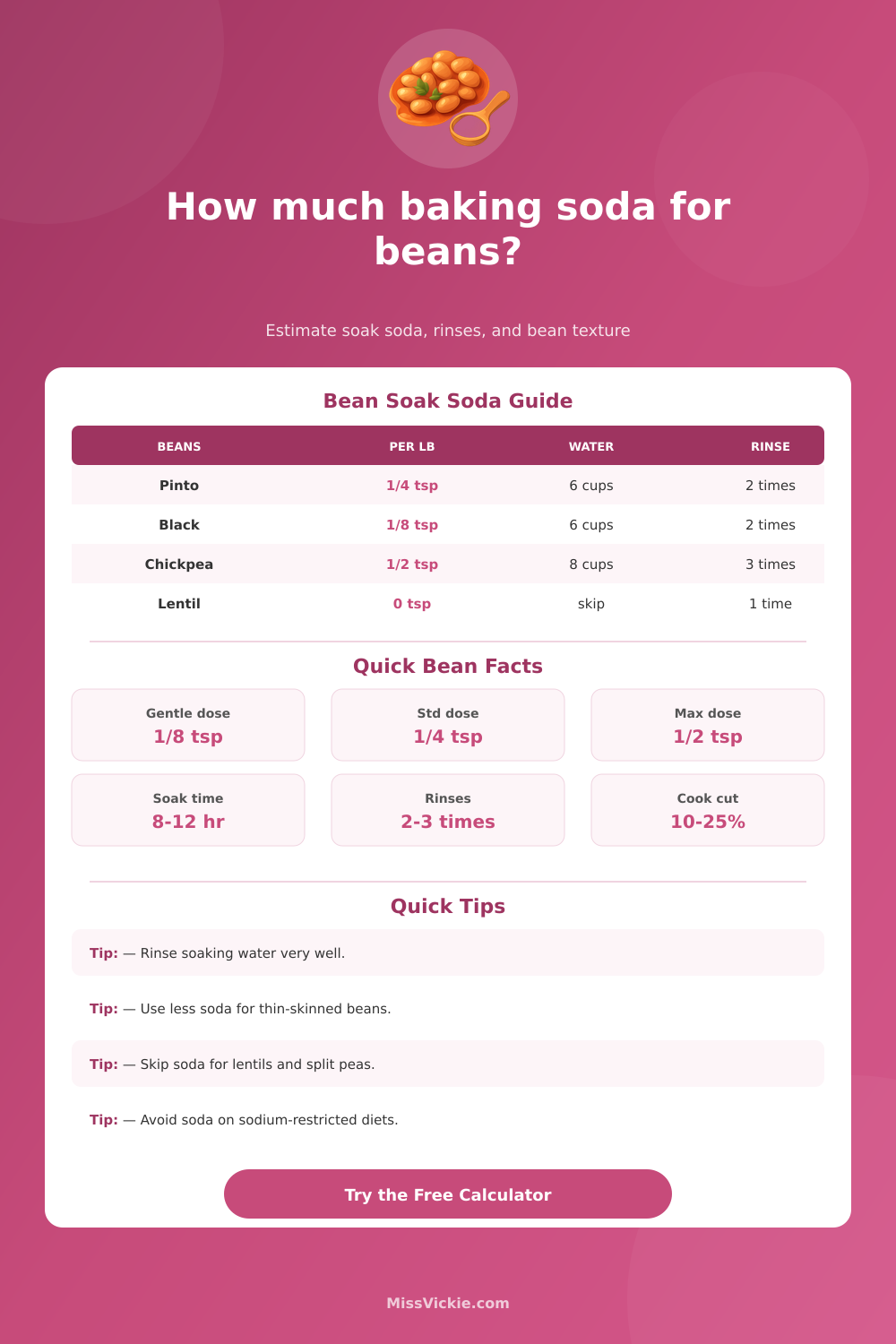
Choose a starting point for common bean batches. Baking soda can soften beans and support oligosaccharide removal during soaking, but draining and rinsing are still the main gas-reduction steps.
Full Baking Soda Breakdown
| Bean Type | Best Soda Range Per Pound | Water Target | Texture Warning |
|---|---|---|---|
| Pinto beans | 1/8 to 1/4 tsp | 6 to 8 cups | Good all-purpose bean for a balanced dose. |
| Black beans | 1/16 to 1/8 tsp | 6 cups | Too much soda can dull color and soften skins quickly. |
| Kidney beans | 1/8 to 1/4 tsp | 6 to 8 cups | Boil properly after soaking; do not slow-cook from raw. |
| Chickpeas | 1/4 to 1/2 tsp | 8 cups | Useful for hummus, but rinse especially well. |
| Navy or white beans | 1/8 to 1/4 tsp | 6 cups | Older beans benefit most, thin skins may split. |
| Lentils or split peas | 0 tsp | No long soak needed | Skip soda because they cook quickly and can turn mushy. |
| Method | Baking Soda Fit | Gas-Reduction Support | Cooking Note |
|---|---|---|---|
| Overnight soak | Best for gentle measured soda | Strong, because soak water is discarded | Start checking beans about 15 percent earlier. |
| Hot soak | Works with a small dose | Strong, especially with a full drain and rinse | Often gives softer, more even texture. |
| Quick soak | Use a lower dose | Moderate, because contact time is shorter | Helpful when time is tight, but rinse well. |
| No soak | Skip soda in this calculator | Lower, unless cooking water is changed | Cook longer and season after beans begin softening. |
| Soda Amount | Approx Soda Weight | Approx Sodium Before Rinse | Rinse Advice |
|---|---|---|---|
| 1/16 tsp | 0.3 g | 80 mg | Good for small or thin-skinned beans. |
| 1/8 tsp | 0.6 g | 160 mg | Drain and rinse at least twice. |
| 1/4 tsp | 1.2 g | 315 mg | Use for a full pound with enough water. |
| 1/2 tsp | 2.3 g | 630 mg | Reserve for chickpeas or very old beans. |
| Batch | Dry Beans | Soak Water | Balanced Soda Range |
|---|---|---|---|
| Side dish for 4 | 1/2 lb | 3 to 4 cups | Pinch to 1/8 tsp |
| Dinner pot for 6 | 1 lb | 6 to 8 cups | 1/8 to 1/4 tsp |
| Meal prep for 10 | 1 1/2 lb | 9 to 12 cups | 1/4 to 3/8 tsp |
| Party pot for 20 | 3 lb | 18 to 24 cups | 1/2 to 3/4 tsp |
Best for sodium-restricted cooking; rely on soaking, draining, rinsing, and gradual serving portions.
A gentle per-pound starting point for pinto, navy, kidney, and great northern beans.
Softens older beans faster, but can push delicate beans toward split skins or a flat taste.
Better suited to chickpeas, hummus texture, or very old beans than everyday pots.
Baking soda can be added to the water that beans is soaked in to reduce the amount of gas that the beans will produce in the body. Baking soda work in that baking soda raises the pH level of the soaking water. The more higher the pH level of the soaking water is, the more the cell wall of the beans will break down.
When the cell walls of the beans break down, the complex sugar that are inside of the beans can exit the beans and enter the soaking water. These complex sugars are the substances that causes gas in the human body when human enzymes break them down. However, you must discard the soaking water (that contained the baking soda and complex sugars) and the beans rinse.
How to Soak Beans with Baking Soda
If the soaking water isnt discarded and the beans are not rinsed, the beans may taste bad or cause discomfort. The amount of baking soda that should be used in the soaking water can vary depending upon the type of bean that are being prepared. For instance, beans like pinto beans and kidney beans can contain baking soda but the beans will fall apart if too many baking soda is used in the soaking water.
Black beans can also contain baking soda but excesive amount of baking soda may cause the black beans to lose their color. Chickpeas have thicker skins than most beans so they can contain more baking soda to help soften them to create creamier chickpeas. Finally, beans like lentils and split peas does not need to be soaked in baking soda because they cook quickly and would turn to mush if baking soda were add to those beans.
The age of the beans may also impact the amount of baking soda that is require. Beans that are fresh will even hydrate but if the beans are old the skins of the beans will be tougher and more resistant so more baking soda will be need. If the beans have sat in the pantry for a long time both baking soda and soak time can be increased.
Additionally, the volume of water that is use for soaking the beans will also impact the amount of baking soda that is needed. Using too little water may lead to an alkaline aftertaste of the beans while using too much water will lead to baking soda that is too diluted to be efective. Rinsing the soaked beans remove the sodium and the sugars from the beans.
Rinsing should be done at least twice but may need to be done three times if a large dose of baking soda were used or if the goal is to reduce the sodium in the meal. Sodium reduction is important because rinsing will remove sodium but not all of the sodium from baking soda can be rinsed away. For individuals who require reducing the sodium in their diets baking soda should be avoid and a longer soak with extra rinse used instead.
Finally, the way that the beans will be cooked will change based off the amount of baking soda used. Since baking soda will soften the skins of the beans, the beans will cook more quicker. Additionally, since the skins will be softer than beans soaked in no baking soda the beans should be check in ten to fifteen minutes of the cooking time to ensure they are not overcooked.
If the beans will be use in a salad softer skins are desired so baking soda should be used in a lower dose. If the beans will be mashed the skins should be softer so more baking soda should be used. Thus, using the proper amount of baking soda will ensure that the beans end up with the desired texture when cooked.