MissVickie crispy wing math
Baking Powder for Wings Calculator
Scale baking powder for crispy wings by raw wing weight, wing count, powder percent, salt blend, dry-brine hours, oven or air fryer heat, skin moisture, rack spacing, and coating loss.
🍗Start With a Crispy Wing Scenario
Choose a starting point: each preset loads wing weight and count, baking powder percent, salt blend, dry-brine time, appliance temperature, skin moisture, rack spacing, and coating loss.
⚖Units and Wing Batch
🧂Powder, Salt, Moisture, and Heat Inputs
Wing Coating Breakdown
📌Current Batch Benchmarks
📊Baking Powder Targets for Wings
| Crispness Goal | Baking Powder % | Teaspoon Shortcut | Best Use | Flavor Risk |
|---|---|---|---|---|
| Lightly crisp | 0.55% to 0.75% | About 3/4 tsp per lb | Small wings, sauced after cooking | Very low |
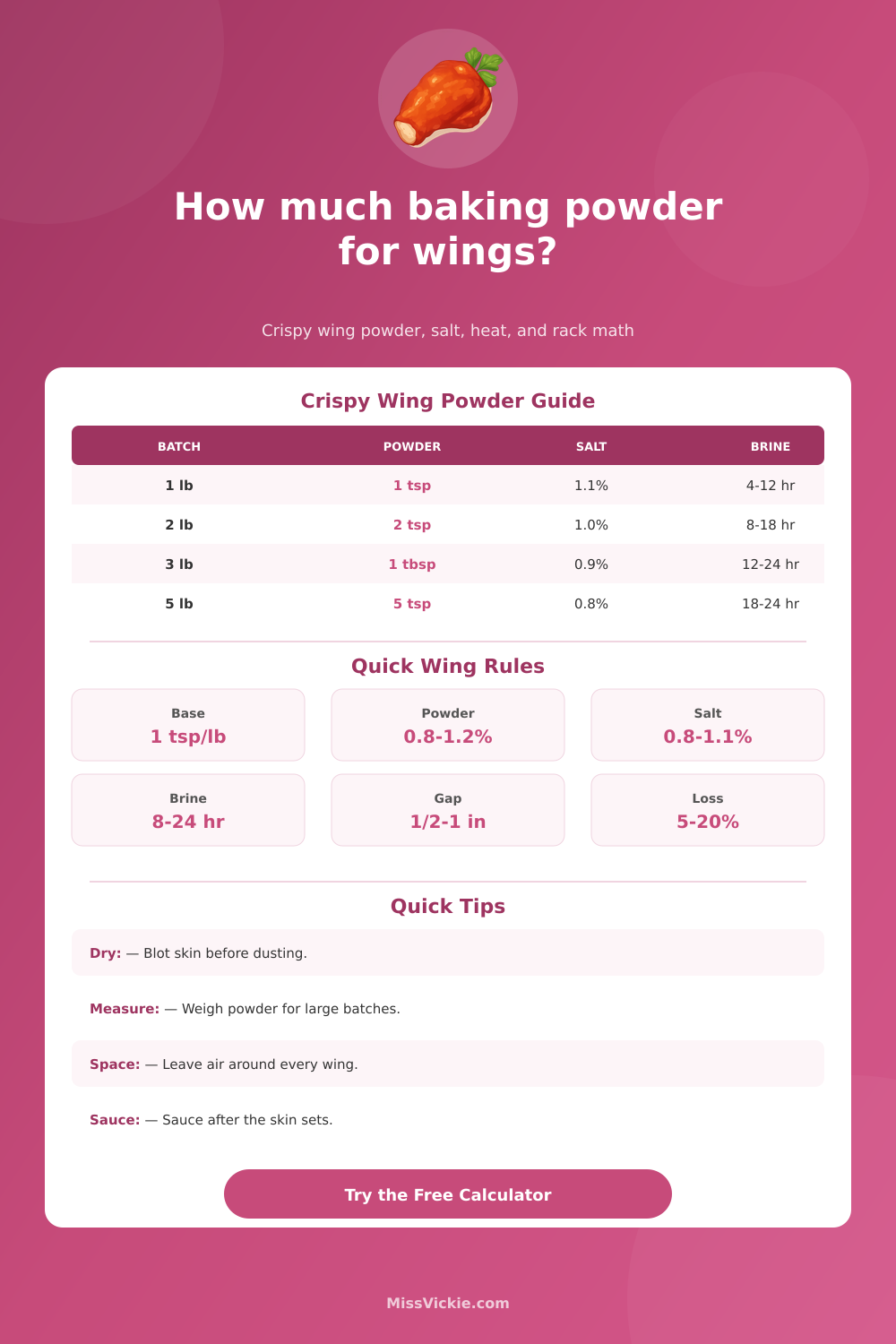
| Classic crispy | 0.8% to 1.05% | About 1 tsp per lb | Most oven and air fryer wings | Low if skin is dry |
| Extra crisp | 1.1% to 1.3% | About 1 1/4 tsp per lb | Wire rack, dry brine, high heat | Watch for powdery taste |
| Maximum crunch | 1.35% to 1.6% | About 1 1/2 tsp per lb | Very dry skin and dry rub finish | Use aluminum-free powder |
| Boneless bites | 0.4% to 0.8% | About 1/2 to 3/4 tsp per lb | Less skin, more meat surface | Too much tastes flat |
🔥Oven and Air Fryer Heat Reference
| Setup | Target Heat | Batch Loading | Typical Time | Crispness Note |
|---|---|---|---|---|
| Air fryer basket | 390 F to 410 F | Single loose layer | 18 to 26 min | Shake or turn halfway |
| Oven wire rack | 425 F to 450 F | 1/2 to 1 inch gap | 38 to 50 min | Best all-around dry skin plan |
| Convection oven | 400 F to 425 F | Rotate racks once | 34 to 46 min | Fan helps powder finish dry |
| Sheet pan no rack | 425 F to 450 F | Do not crowd | 40 to 55 min | Flip well; underside steams |
| Two-stage oven | 250 F then 450 F | Wire rack preferred | 60 to 80 min | Slow drying, crisp finish |
🧂Salt Blend and Dry-Brine Guide
| Salt Blend | Target Salt % | Teaspoon Feel | Best Brine Window | Use When |
|---|---|---|---|---|
| Kosher salt balanced | 0.95% | Moderate crystals | 8 to 18 hr | Reliable savory wing batch |
| Diamond Crystal light | 1.05% | Fluffy and forgiving | 12 to 24 hr | You season by volume often |
| Morton kosher strong | 0.82% | Dense flakes | 6 to 18 hr | Avoid oversalting overnight wings |
| Fine sea salt | 0.78% | Dense fine grains | 4 to 12 hr | Even coating, stronger by spoon |
| Low-salt seasoning | 0.55% | Gentler blend | 4 to 18 hr | Sauce or rub adds more sodium |
💡Crispy Wing Troubleshooting
Marinade or thaw water turns the powder into paste before heat can dry it.
Touching wings trap steam, especially on a sheet pan without a wire rack.
Below the setup target, skin renders slowly and browns before it crisps.
Sticky sauce before the skin sets softens the powder crust.
The calculator uses practical kitchen ratios for crispy baked or air-fried wings. Always cook poultry to a safe internal temperature and adjust timing for your appliance.
Baking powder can be use on chicken wings in order to change the texture of the skin of those chicken wings. When you place baking powder upon the chicken wings, the baking powder raise the pH level of the skin of the wings. As a result of the raising of the pH level, the baking powder will speed the loss of moisture that occurs during the cooking of the chicken wings.
As a result of the loss of moisture from the skin of the chicken wings, the skin will become thin and crispy rather than thick and rubbery. Thus, baking powder help to create a drier and more crisp crust upon the chicken wings. The amount of baking powder that is use upon the chicken skin must be correct, as the amount of baking powder will impact the flavors of the wings.
How to Use Baking Powder for Crispy Chicken Wings
Using too little baking powder will prevent the skin from becoming crispy. Using too much baking powder can lead to the development of a dusty or metallic flavor in the finished chicken wings. The amount of baking powder that is required may depend upon factors like the moisture content of the skin of the wings, as well as the amount of space that is provide between the chicken wings that are being cooked.
Thus, a calculator may be utilized to determine the amount of baking powder that should be used upon the chicken wings. The calculator will determine the amount of baking powder that are required by considering the weight of the wings, the cut of the chicken wing, the type of baking powder to be used, the salt blend, the dry brine time, the cooking method, and how many piece of chicken will be cooked at once. Furthermore, the calculator will also account for the baking powder that will remain in the bowl or on the tray, so as to ensure that there is an adequate amount of baking powder to place upon the chicken wings.
Thus, the baking powder calculator can remove the need to guess as to how much baking powder should be use upon the chicken wings. In addition to the baking powder calculator, the amount of baking powder that is to be used may also have to be adjust according to the type of cooking equipment that will be used, as well as the type of ingredients that are to be used in the preparation of the chicken wings. For instance, if baking powder is use with sheet pans instead of wire racks, there will be less airflow to the chicken wings.
Thus, more baking powder and cooking time will be suggested. Additionally, if the chicken wings that are to be prepared are frozen, they will contain extra moisture. Thus, more heat and time will be require to cook the chicken wings with the baking powder.
Baking powder and salt work together to alter the texture of the chicken skin. Salt season the skin of the chicken, but also extracts the moisture of the skin. Baking powder then dries out that moisture to create a crispy crust.
The salt, however, need several hour to move into the skin of the chicken wings. Using too short of a period of time to allow the salt to season the skin will make the skin too damp for the baking powder to create a crispy crust. Using too long of a time to allow the salt to season, however, can create an overly salty chicken dish.
The spacing of the chicken wings on the cooking rack may also create moisture, which will interfere with the crispiness of the skin. Thus, the calculator may factor in the spacing of the chicken wings. Nevertheless, a gap should be visible between each chicken wing for the best possible cooking results.
Finally, the goal is not to use the maximum amount of baking powder, but the correct amount of baking powder for the specific chicken wings that are to be prepared. Whether the skin is thin or thick, the heat that will be used, and how the chicken wings are to be finished will determine the amount of baking powder to use. Thus, if the correct amount of baking powder is use, the same results will be achieve each time that the chicken wings are prepared.