How Much Baking Powder to Substitute for Cream of Tartar Calculator
Convert cream of tartar plus baking soda into baking powder while checking flour load, batter style, acid balance, salt, and batch scaling.
Choose a recipe style, then adjust the original cream of tartar and soda amounts to match your actual formula.
Substitution Breakdown
| Cream of Tartar Called For | Baking Powder Substitute | Baking Soda to Remove | Common Recipe Size |
|---|---|---|---|
| 1/8 teaspoon | 3/8 teaspoon baking powder | 1/8 teaspoon baking soda | Small test batch or one egg white foam |
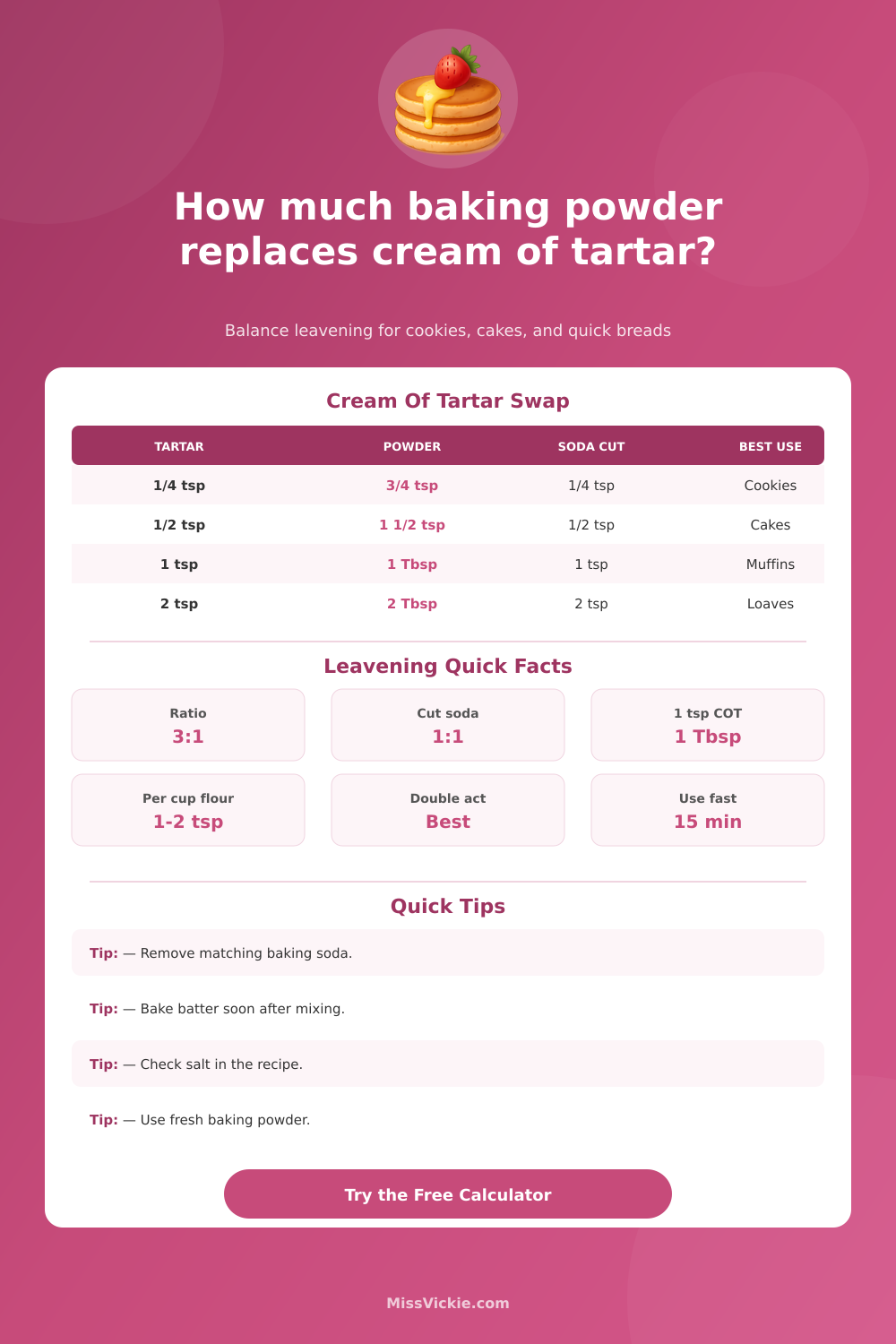
| 1/4 teaspoon | 3/4 teaspoon baking powder | 1/4 teaspoon baking soda | Small cookie batch or light pancake batter |
| 1/2 teaspoon | 1 1/2 teaspoons baking powder | 1/2 teaspoon baking soda | One cake layer, muffins, or quick biscuits |
| 1 teaspoon | 1 tablespoon baking powder | 1 teaspoon baking soda | Snickerdoodles, quick bread, or larger muffins |
| 1 1/2 teaspoons | 1 1/2 tablespoons baking powder | 1 1/2 teaspoons baking soda | Double batch cookies or large loaf batter |
| 2 teaspoons | 2 tablespoons baking powder | 2 teaspoons baking soda | Party batch or multiple pans |
| Recipe Type | Usual Baking Powder per Cup Flour | Swap Behavior | Practical Note |
|---|---|---|---|
| Cookies | 1/4 to 1 teaspoon | Keep modest to avoid cakey spread | Snickerdoodles may lose a little tang without extra acid. |
| Pancakes and waffles | 1 to 2 teaspoons | Handles baking powder well | Cook soon because wet batter spends gas quickly. |
| Muffins | 1 to 1 1/2 teaspoons | Usually forgiving | Do not overmix after the powder touches liquid. |
| Quick bread loaf | 1 to 1 1/4 teaspoons | Needs steady lift through baking | Double-acting powder is helpful for thick batters. |
| Cake batter | 1 to 1 1/2 teaspoons | Balance matters for crumb | Too much can dome, tunnel, or taste bitter. |
| Biscuits and scones | 1 to 2 teaspoons | Good replacement if handled cold | Fold gently and bake while dough is cool. |
| Original Ingredient Pattern | What the Calculator Does | Risk If Ignored | Best Fix |
|---|---|---|---|
| Cream of tartar plus equal baking soda | Replaces both with baking powder and removes matching soda | Soapy flavor and excess browning | Use the 3:1 powder swap and cut soda 1:1. |
| Cream of tartar with no baking soda | Gives powder amount but flags extra soda in powder | Extra alkalinity and less tart flavor | Use sparingly or add a small acidic ingredient. |
| Buttermilk, yogurt, lemon, or vinegar present | Allows some remaining soda for that acid | Flat or sharp batter if all soda is removed | Keep a small soda balance for the extra acid. |
| Already high baking powder recipe | Checks final powder per cup flour | Bitter flavor, tunneling, or collapsed center | Reduce other baking powder before adding more. |
| Egg white foam stabilization | Shows powder is not a true stabilizer | Foam may weep or deflate | Use lemon juice or vinegar instead when possible. |
| Batch Size | For 1/2 tsp Tartar | For 1 tsp Tartar | Soda Removed |
|---|---|---|---|
| Half batch | 3/4 tsp baking powder | 1 1/2 tsp baking powder | Half the tartar amount |
| Single batch | 1 1/2 tsp baking powder | 1 Tbsp baking powder | Same as tartar amount |
| Double batch | 1 Tbsp baking powder | 2 Tbsp baking powder | Double the tartar amount |
| Triple batch | 1 1/2 Tbsp baking powder | 3 Tbsp baking powder | Triple the tartar amount |
| Quarter batch | 3/8 tsp baking powder | 3/4 tsp baking powder | Quarter the tartar amount |
Best all-around substitute when the recipe also contains baking soda.
Useful for acid balance, but it adds liquid and flavor to the recipe.
Works in some batters, though it is not ideal for dry cookie dough.
Can replace acid, but other recipe liquids need to be reduced.
If you dont have cream of tartar, you must substitute cream of tartar with baking powder. Cream of tartar are an acid, and cream of tartar reacts with baking soda to create carbon dioxide. Baking powder is a mixture of an acid and a base, so baking powder does not simply replace cream of tartar and baking soda.
You will have to use a calculator to determine how much baking powder to use in place of cream of tartar to ensure the batter set and tastes correctly. To make the calculator work correctly, you need to enter the amount of cream of tartar that you have and the amount of baking soda that your recipe call for. You must also enter the amount of flour that you will use and the type of batter that you are making.
How to Use Baking Powder Instead of Cream of Tartar
For instance, recipes that include cookies will need to balance baking powder level because too much baking powder can make cookies cake like in texture. Batters for thick recipes may need baking powder to help them rise correctly. You will also have to tell the calculator for how long the batter will sit before being heated.
Cream of tartar provides a tangy flavor to the foods that you add it to. If you are removing cream of tartar from your recipe, the tangy flavor will dissapear from the recipe. To compensate for this, you can use other acid to supplement the flavor.
For instance, you could use lemon juice or buttermilk. The calculator will have an “other acid” setting to account for other acids in the recipe, such as buttermilk or yogurt. If you do not use the “other-acid” setting, there could be too much baking soda in the batter.
Too much baking soda can make the batter taste soapy. Baking powder contains sodium, which will make the recipe contain more salt than the recipe called for. You may have to consider how much salt is in the recipe because too much sodium may make the recipe taste more savory.
Depending on how much batter you are making, there will be changes in the salt levels of the batter. You may have to account for the salt levels in the recipe. Running the numbers through the calculator will ensure the batter contains the proper amount of salt so that the cookies, quick breads, or other items will not have an odd aftertaste.
Depending on the batch size of the batter, there will be different results. For instance, a large batch of batter will hold heat different than a small batch of batter. Additionally, a large batch will release the gases create from baking soda over a longer time span than a small batch of batter.
You must tell the calculator for how long the mixture will sit before baking. For instance, if you are making refrigerator dough that will sit in the refrigerator for 12 hour, the dough will rise in the refrigerator. However, if you do not adjust the amount of baking soda, the dough will be flatter than it should of be once baked.
The calculator will make an adjustment to account for the sitting time so that the final product will not be flatter than it should be when baked. The texture of the product will change depending on how you mix the batter. For instance, muffins and biscuits may become tough if you mix them too much.
However, pancake batter is thick enough that it can be mixed more. The calculator will let you know whether the recipe is sensitive to overmixing or sensitive to long waiting time. This will help you determine whether you must mix the ingredients together or if they must be baked immediately.
You cannot just use any acid in place of cream of tartar. For instance, lemon juice and vinegar are acidic. However, these ingredients will also add liquid to the recipe.
You must maintain the ratio of liquid to flour in cookie dough to get the right result with stiff cookie dough. Buttermilk, being another acid, will work well for muffins. However, it will change the texture of shortbread dough.
The calculator will indicate how much baking soda will remain after using these other acids so that the batter will not taste soapily. Baking powder products may have been opened and exposed to the air. Fresh baking powder creates more gas then old baking powder.
If you use too old of baking powder in the recipe, the baked products will not rise properly. The calculator will have a “low freshness” setting to account for this. Using “low-freshness” baking powder will ensure that a cake does not sink in the middle once baked.
The baking powder calculator will give a suggestion for the amount of baking powder to use in place of cream of tartar. However, it will not provide the perfect answer for every situation. For instance, you may need to round the number up or down depending on the ingredients already lifting the batter, such as whipped egg white.
The calculator will remove the guesswork in determining how much baking powder to use. If the baking powder substitution is successful, your cookies will spread correctly, your muffins will dome correctly, and your quick breads will rise correctly.