Baking Powder for Brownies Calculator
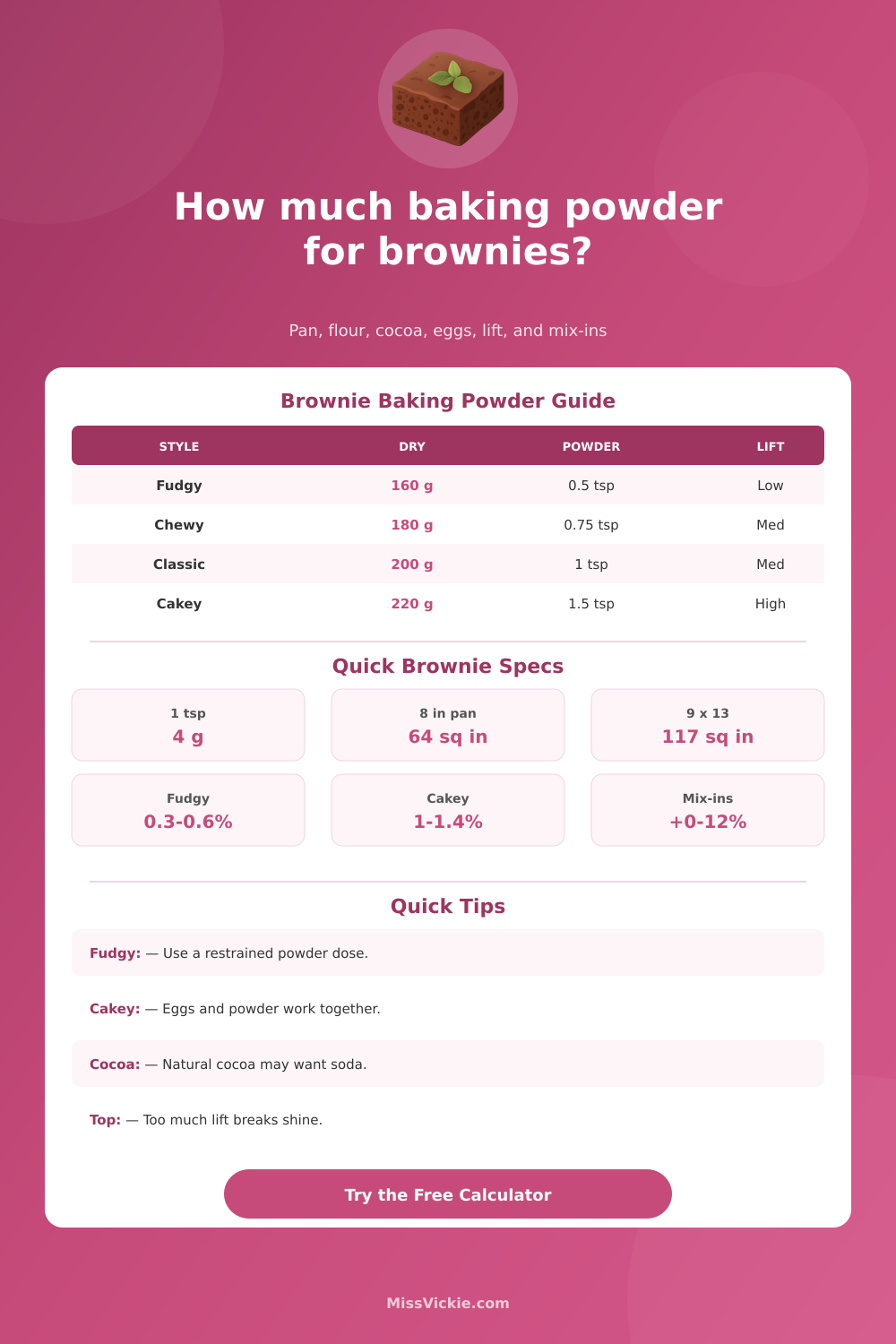
Estimate baking powder for brownies from pan size, flour and cocoa weight, fudgy or cakey target, egg count, cocoa acidity, desired lift, crackly top style, and mix-in load.
Start with a real pan: each preset loads a brownie style, dry weights, egg count, cocoa acidity, lift target, crackly-top goal, and mix-in load.
Brownie Leavening Breakdown
| Brownie style | Typical powder rate | Best pan depth | Texture cue |
|---|---|---|---|
| Dense fudgy | 0.25% to 0.45% of flour plus cocoa | 0.65 to 0.9 inch raw batter | Shiny top, moist center, minimal dome |
| Fudgy with lift | 0.4% to 0.65% of flour plus cocoa | 0.75 to 1 inch raw batter | Slightly raised edges with a soft middle |
| Chewy classic | 0.6% to 0.9% of flour plus cocoa | 0.8 to 1.05 inch raw batter | Flexible crumb and clean slices |
| Cakey brownie | 0.9% to 1.35% of flour plus cocoa | 0.9 to 1.25 inch raw batter | Lighter crumb, taller squares, more egg support |
| Loaded brownies | Add 3% to 12% to the powder result | Keep below 1.2 inch unless slow-baking | Chips and nuts should not sink heavily |
| Pan | Area | Fudgy dry weight | Cakey dry weight |
|---|---|---|---|
| 8 inch square | 64 sq in | 140 to 170 g flour plus cocoa | 170 to 210 g flour plus cocoa |
| 9 inch square | 81 sq in | 170 to 220 g flour plus cocoa | 220 to 270 g flour plus cocoa |
| 9 x 13 inch | 117 sq in | 260 to 330 g flour plus cocoa | 330 to 420 g flour plus cocoa |
| 9 inch round | 64 sq in | 135 to 170 g flour plus cocoa | 170 to 205 g flour plus cocoa |
| 23 cm square | 82 sq in | 180 to 225 g flour plus cocoa | 225 to 280 g flour plus cocoa |
| Cocoa type | Acidity behavior | Powder effect | Brownie note |
|---|---|---|---|
| Natural cocoa | More acidic | May need a soda check | Good for classic chocolate tang and reddish color |
| Dutch cocoa | Low acid | Baking powder carries the rise | Smoother flavor and darker crumb |
| Black cocoa | Very low acid | Use powder, avoid extra soda | Strong color, drier structure, Oreo-style flavor |
| Blend or unknown | Moderate | Use conservative powder | Best tested once before a large pan |
Kitchen note: The calculator estimates a leavening range from dry weight and pan geometry. Follow your recipe's doneness cues, especially for very fudgy brownies where the center sets after cooling.
Baking powder is a chemical leavening agent that can impact the texture of you’re brownies. The amounts of baking powder you use will determine whether your brownies is dense or cakey. Using too much baking powder will make your brownies rise more before they set, making them cakey when you cut into them.
Using too little baking powder will create densly brownies. Several variables will impact the amount of baking powder you need for your brownie recipe, including the type of cocoa you use, the size of your baking pan, the depth of your brownie batter, the amount of eggs you use in the recipe, the types of mix-ins you add to your batter, and the altitude at which you are baking your brownies. The type of cocoa you use will impact the amount of baking powder you need because natural cocoa powder is acidic, while cocoa that has been treated with alkali (Dutch-process cocoa powder) is not acidic.
How Baking Powder Affects Brownie Texture
Since baking powder reacts to acidity in the batter, you must consider the type of cocoa powder you use when preparing your brownies. The type of cocoa powder will change the chemical reaction of the baking powder in your brownies. The size of your baking pan and the depth of your brownie batter will impact the amount of baking powder you need.
Using a large pan will make your brownie batter thin. Thin brownie batter will require less baking powder to enable it to rise to the top of the pan. Using a small pan will force your brownie batter to be deep.
Deep brownie batter will require more baking powder because deep batter will trap more steam. By measuring the area of your pan and the depth of your brownie batter, you can calculate the correct amount of baking powder you need for your brownie recipe. The number of eggs you use and the way you mix them will also impact the amount of baking powder you need for your brownie recipe.
Mixing the eggs and sugar until they form a ribbon will trap air in the eggs. The air will help your brownies rise in the oven. Using more eggs or mixing the eggs and sugar more will produce more air.
More air in the brownie batter will make it possible for the brownies to rise more. Therefore, the more air the eggs produce in the brownie batter, the less baking powder your brownie batter will need to make your brownies rise in the oven. The number and size of the eggs will impact the total amount of lift that your brownie batter will produce.
Therefore, it is important to account for the eggs when calculating the amount of baking powder to use in your brownie recipe. The types of mix-ins you use will add weights to the brownie batter. The weight of the mix-ins will impact the texture of your brownies.
The more weight the mix-ins add to your brownie batter, the more baking powder you will need. You must be careful not to use too much baking powder because this will make the brownies cakeily. It is important to find the right amount of baking powder to balance with the weight of your mix-ins to ensure that the texture of your brownies remains as desired.
The altitude at which you bake your brownies will also impact the amount baking powder you require in your brownie recipe. At high altitudes, the air pressure surrounding your brownies is lower. The lower air pressure will allow the gases produced by the baking powder to expand more quick in your brownies.
The increased expansion of the gases will create a taller and drier brownie. Therefore, you will need to reduce the amount of baking powder you use when baking your brownies at high altitudes. While the calculated amount of baking powder will give you the start to your baking process, there may be adjustment you can make to fine tune your recipe to produce the perfect batch of brownies.
If the brownies are too tall when they cool, reduce the amount of baking powder you use in your next batch of brownies. If the brownies are too flat, increase the amount of baking powder. By changing only one variable at a time in the recipe, you can determine which variable impact your desired texture and which combination of ingredients will produce the perfect texture for your brownie recipe.