How Much Baking Powder for Pancakes
Calculate the baking powder needed for pancakes by flour amount, batter style, pancake size, add-ins, altitude, powder freshness, and batch count.
Load a real breakfast scenario, then adjust the fields for your flour, griddle size, and batter style.
Full Pancake Breakdown
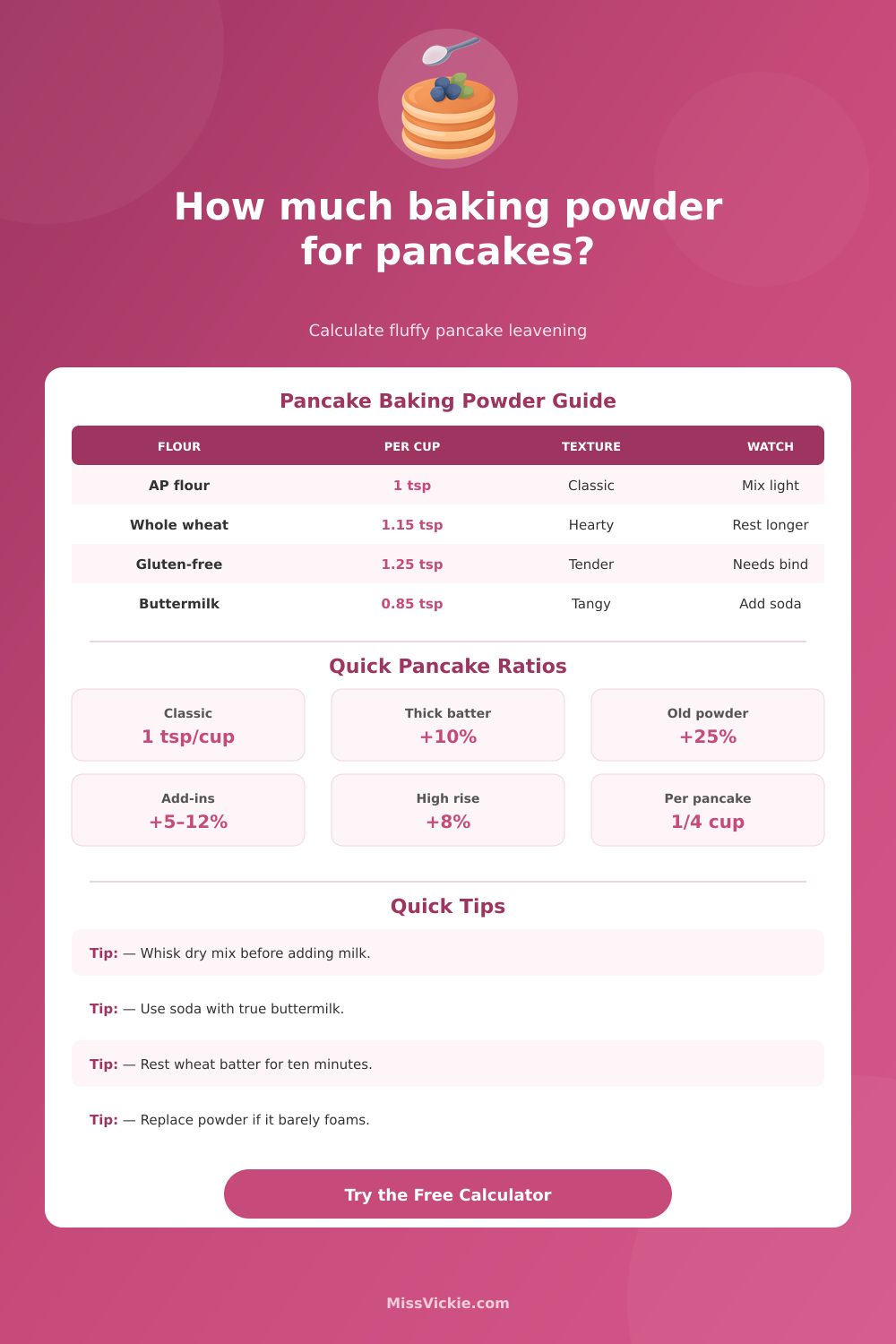
| Flour or Batter | Baking Powder per Cup Flour | Best Use | Adjustment Note |
|---|---|---|---|
| All-purpose flour with milk | 1 teaspoon | Classic fluffy pancakes | Good baseline for most family recipes. |
| Cake flour | 0.95 teaspoon | Very tender pancakes | Use a gentle mix because the crumb is delicate. |
| Whole wheat flour | 1.1 to 1.2 teaspoons | Hearty breakfast stacks | Rest batter so bran hydrates before cooking. |
| Gluten-free blend | 1.2 to 1.3 teaspoons | Tender gluten-free pancakes | Works best with xanthan or another binder. |
| Buttermilk batter | 0.75 to 0.9 teaspoon | Tangy, browned pancakes | Add a little baking soda for acid balance. |
| Thick diner-style batter | 1.1 to 1.25 teaspoons | Tall pancakes | Do not push too high or the center can taste bitter. |
| Measure | Approx Weight | Typical Pancakes | Baking Powder Range |
|---|---|---|---|
| 1 cup all-purpose flour | 120 g | 5 to 6 standard pancakes | 0.9 to 1.1 teaspoons |
| 1 cup whole wheat flour | 113 g | 5 standard pancakes | 1.1 to 1.2 teaspoons |
| 1 cup gluten-free blend | 135 g | 5 to 6 standard pancakes | 1.2 to 1.3 teaspoons |
| 1 cup pancake batter | 240 ml | 4 standard pancakes | Depends on flour already used |
| 1 standard pancake | 60 ml batter | 5-inch diameter | About 1/6 teaspoon from a 2-cup batch |
| Serving Plan | Flour Needed | Baking Powder | Expected Pancakes |
|---|---|---|---|
| Breakfast for 2 | 1 cup | 1 teaspoon | 5 to 6 standard pancakes |
| Family breakfast for 4 | 2 cups | 2 teaspoons | 10 to 12 standard pancakes |
| Brunch for 6 | 3 cups | 1 tablespoon | 15 to 18 standard pancakes |
| Big griddle batch | 4 cups | 4 teaspoons | 20 to 24 standard pancakes |
| Meal prep freezer stack | 5 cups | 5 teaspoons | 25 to 30 standard pancakes |
| Foam Test Result | What It Means | Calculator Setting | Kitchen Decision |
|---|---|---|---|
| Strong bubbling in hot water | Fresh and active | Fresh, foams strongly | Use the calculated amount. |
| Moderate foam, slower rise | Still usable | Opened a few months | Use a small safety bump. |
| Weak fizz only | Low lift | Older, weak foam | Replace if possible, or add cautiously. |
| Nearly flat water | Expired leavener | Unknown pantry age | Do not rely on it for fluffy pancakes. |
Best all-purpose starting point per cup of flour.
Lower powder and add soda for tang and browning.
Extra lift helps heavier bran and germ rise evenly.
More lift helps blends without gluten structure.
These values assume double-acting baking powder and moderate pancake thickness.
To achieve the correct lift in pancakes, you must determine the correct amount of baking powder to add to the pancake batter relative to the amount of flour you use. The amount of baking powder that you use is important to the pancakes because the amount of baking powder that you use will determine the amount that the pancakes rises. Too little baking powder will create flat pancakes, while too much baking powder will result in a bitter taste to the pancakes and the pancakes will collapse in the middle.
While many people may be accustomed to measuring the baking powder to use in there pancakes, a variety of factor will impact the amount of baking powder you need. The calculator that is provided will handle the math for you based on the amount of flour that you use and the other details about your pancake recipe. The type of flour that you use impacts the amount of baking powder.
How Much Baking Powder to Use for Pancakes
Different types of flour have different protein levels and moisture levels. All-purpose flour is a flour that is in the middle range in terms of its protein and moisture levels, so you can use the rule of one teaspoon of baking powder for each one cup of flour. Whole wheat flour contains extra bran that absorbs the liquids in the pancake batter.
To compensate for the heaviness of pancakes that contain whole wheat flour, you need to add more baking powder. Gluten-free flour blends dont contain the gluten protein that creates structure in pancakes. Therefore, more baking powder is needed in gluten-free flour recipes so that the batter set with enough gas.
Cake flour has a lower protein level than all-purpose flour. Because cake flour creates a delicate crumb in baked goods, it can over-rise with too much baking powder. The type of liquid in your pancake batter will also impact the amount of baking powder you should use.
If you use regular milk, the baking powder can perform its function without interference. Buttermilk and yogurt contain acids that react with baking soda. To compensate for the carbonation created by the interaction of the acid and baking soda, you must reduce the amount of baking powder.
The acidity in buttermilk also creates better browning and enhances the flavor of the pancakes. Plant milks vary in terms of there protein and fat content. Some plant milks contain less protein than other milks, so you will need to add more baking powder if you use plant milk.
The type of add-ins in your pancakes will influence how much baking powder is needed. Blueberries will release their juice when warmed, which will thin the batter. To compensate, you will need to add more baking powder.
Chocolate chips add weight to the batter. Furthermore, the fat content in chocolate chips will slow the escape of steam in the pancakes. To compensate for the increased weight and fat content of chocolate chips, add more baking powder to your pancake recipe.
Mashed banana and pumpkin add moisture and natural sugars to the pancake batter. These ingredients will make the pancakes cook more slow in the center, creating a structural issue in the pancakes. To compensate for the slow setting of pancakes containing mashed banana and pumpkin, you should increase baking powder in the pancake recipe.
The altitude in your area will affect the amount of baking powder in your pancake recipe. At higher altitudes, the air pressure is lower. This lower air pressure will allow the gas from the baking powder to escape the batter faster.
Bakers at higher altitudes increase the amount of baking powder that they use. Additionally, they may also lower the amount of sugar or fat that they use in their recipes to prevent the pancakes from spreading too much on the griddle. The baking powder calculator will include an altitude setting so that the baking powder adjustment is automatic.
The freshness of your baking powder can vary. Baking powder that has been open for many months may have lost some of its strength. To test the freshness of your baking powder, add it to hot water.
If the baking powder does not fizz vigorously in the hot water, it is weak. In this case, you should use more baking powder. Using baking powder that has lost its strength is another common reason that pancakes may be flat.
Testing the baking powder for strength is one easy way to fix this problem. The size of the pancakes that you prepare will impact the amount of baking powder needed. Small pancakes, like silver-dollar pancakes, require baking powder to allow the pancakes to rise before the outside of the pancake sets.
The longer it takes for large and thick pancakes to cook on the griddle, the more time the baking powder has to create lift. However, the longer it takes for pancakes to cook in the middle, the more risk there is of undercooked pancakes in the center of the pancake if you use too much baking powder. The baking powder calculator will factor in the diameter and thickness of the pancakes you prepare.
The length of time that the pancake batter rests will impact the baking powder requirement. A short resting time will allow the pancake batter to hydrate with the flour and allow the baking powder to work into the recipe. A short resting time will also reduce the chance of bitter pancakes.
If the pancake batter rests for a longer time, such as overnight, some of the gas created by the baking powder will escape the pancake batter. In this case, you will need to use less baking powder. The baking powder calculator will include an option to account for the resting time of the pancake batter.
The baking powder calculator will also include a yield check to ensure that you have enough flour to make the number of pancakes that you would like to make. The yield will compare the amount of flour that you have with the number of pancakes that you would like to prepare. This comparison will let you know if you will run out of pancakes batter.
This is another helpful feature of the baking powder calculator. Additionally, if you use the baking powder calculator to determine the amount of baking powder to use in your pancake recipe, the calculator will help you to determine the correct amount to add to your pancake batter. As a result, when you pour the pancake batter into the pan, you will see bubbles form at the appropriate rate.
Furthermore, you can flip the pancakes and they will even be golden brown on one side. Finally, the pancakes will hold their height when stacked on top of one another because the baking powder, flour, liquids, add-ins, and other variables are in the proper ratio with one another. You should of checked your proportions carefuly.
Use the calculator to make sure you dont make a mistake with the measurements and youre ready to cook. Making the batter is easier than it looks, especially if you follow the steps providid.