Fried Chicken Crust Planner
Baking Powder for Fried Chicken Calculator
Scale baking powder by dry dredge weight, chicken weight, flour-starch blend, double dredge style, oil temperature, brine acidity, crispness target, and coating loss.
🍳Start With a Fried Chicken Crust Scenario
Presets set realistic fried chicken conditions, then the calculator adjusts baking powder and usable dredge for coating pickup, oil temperature, brine acidity, and discard loss.
⚖Units and Batch Size
🍗Chicken, Dredge, and Coating Inputs
🔥Oil, Brine, and Frying Conditions
Crust Breakdown
📊Crust Benchmarks
📘Baking Powder and Frying Reference
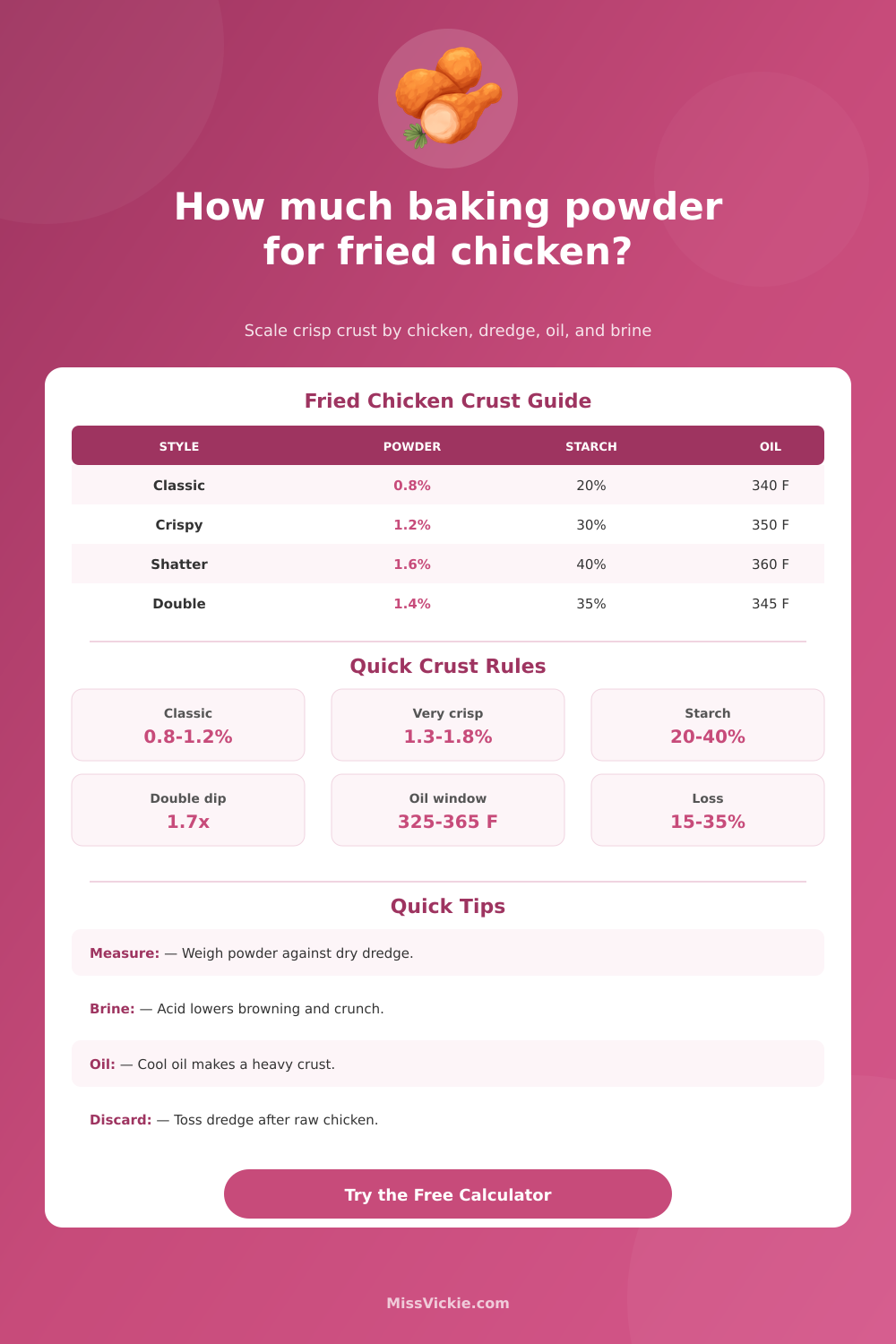
| Crust target | Baking powder range | Starch range | Best use | Watch for |
|---|---|---|---|---|
| Tender light crust | 0.4% to 0.8% | 10% to 20% | Cutlets, tenders, kids meals | Less puff and less craggy texture |
| Classic crisp crust | 0.8% to 1.2% | 20% to 30% | Bone-in chicken and drumsticks | Needs steady oil above 335 F |
| Crunchy diner crust | 1.1% to 1.5% | 28% to 38% | Sandwich fillets, wings, tenders | Can taste alkaline if oil is too cool |
| Shattery thin crust | 1.4% to 1.9% | 35% to 50% | Rice flour blends and small pieces | More fragile after saucing |
| Extra-craggy double dredge | 1.2% to 1.8% | 25% to 40% | Buttermilk double dredge | Needs rest time so flakes adhere |
Baking powder is calculated against total dry dredge weight. If your self-rising flour already contains leavener, lower the added baking powder.
🌡Oil Temperature and Coating Pickup Guide
| Chicken style | Pickup per lb | Usual oil | Dredge method | Crust note |
|---|---|---|---|---|
| Bone-in mixed pieces | 55 g to 75 g | 325 F to 350 F | Single or buttermilk double | Moderate surface, long fry time |
| Wings and flats | 70 g to 95 g | 350 F to 365 F | Single or light double | High surface area and fast crisping |
| Sandwich fillets | 75 g to 105 g | 340 F to 360 F | Full double dredge | Wide surface needs extra bowl margin |
| Tenders | 60 g to 85 g | 345 F to 365 F | Milk dip or buttermilk | Quick fry, easy to over-brown |
| Popcorn chicken | 90 g to 125 g | 350 F to 365 F | Light double or batter dip | Very high pickup and high loss |
🧂Dry Mix Ratios at a Glance
Works with 20% to 30% starch and bone-in pieces fried around 340 F.
Good for buttermilk chicken when the second dredge needs craggy flakes.
Best with rice flour or cornstarch and hot oil near 355 F.
Pickle juice or hot sauce brines can push the crust toward darker, sharper flavor.
💡Fried Chicken Crust Notes
The textures of the crust of the fried chicken is determined by the interaction of baking powders, starch, moisture, and heat. Baking powder react with moisture and heat, and the reaction create carbon dioxide. The carbon dioxide create tiny pocket in the coating of the chicken.
These tiny pockets creates the lift and texture of the fried chicken crust. Using too little baking powder will produce a flat fried chicken crust. Using too much baking powder can make the fried chicken crust have an alkaline flavor that interfere with the flavor of the seasoning.
How Much Baking Powder to Use for Fried Chicken
Because the amount of baking powder that cooks should use in the fried chicken recipe can change based on several variable, using a calculator will allow cooks to determine the correct amount of baking powder to use in the recipe. The cut of the chicken affect the amount of coating that should adhere to the chicken, and thus, the amount of baking powder that should be used. Using small piece of chicken, such as wings or popcorn chicken, will require more of the coating then using large pieces of chicken, such as thighs or drumsticks.
The same is true of a double-dredge recipe for chicken. Small pieces of chicken that use a double dredging process will have a different amount of baking powder than a single dredge process. The calculator for the recipe allow cooks to input the type of dredging process that they use to cook the chicken.
The baking powder calculator will provide an accurate measurement of the amount of baking powder that should be used. Other variable that impact the amount of baking powder that should be used are the oil temperature and the acidity of the brine that the chicken is soaked in prior to frying. If the oil temperature is too low, the formation of the crust will be slow.
Using low oil temperatures will make the flavor of the baking powder more noticeabley. If the brine contains acidic ingredients, the proteins on the surface of the chicken will behave different in the hot oil. Acidic brines will cause the chicken to brown more quickly in the oil.
Using acidic brines will require cooks to use less baking powder so that the fried chicken crust does not darken too quickly before the interior of the chicken is cooked. The type of starch that is used in the coating will impact the behavior of the fried chicken crust. Using different type of starch in the breading of the chicken will change the amount of baking powder that is required.
Using starches that contain a high percentage of starch will require more baking powder than other starch blends. Using a reference table of different types of starch blends and the percentage of starch in each blend will allow cooks to decide how much baking powder to use in relation to the amount of starch and flour that is used in the recipe. Using the baking powder calculator will allow cooks to prepare fried chicken with consistant results.
The calculator can be used to change the recipe from a small batch to a large batch of fried chicken. Using the calculator ensure that the ratio of ingredients will be the same. Cooks can change the recipe from a single dredge to a double dredge of the chicken.
The calculator will provide an appropriate amount of additional coating and baking powder for the second dredge. The calculator is a starting point for the amount of baking powder to use in the fried chicken recipe. However, cooks must monitor the frying process.
Cooks must observe the browning of the fried chicken crust. Additionally, cooks can listen to the sound that the bubbles make in the frying oil to ensure that the oil is at the proper temperature. If the batch of fried chicken created with the baking powder calculator did not have the desired results, cooks can use that information to adjust the amount of baking powder in the next batch of fried chicken.