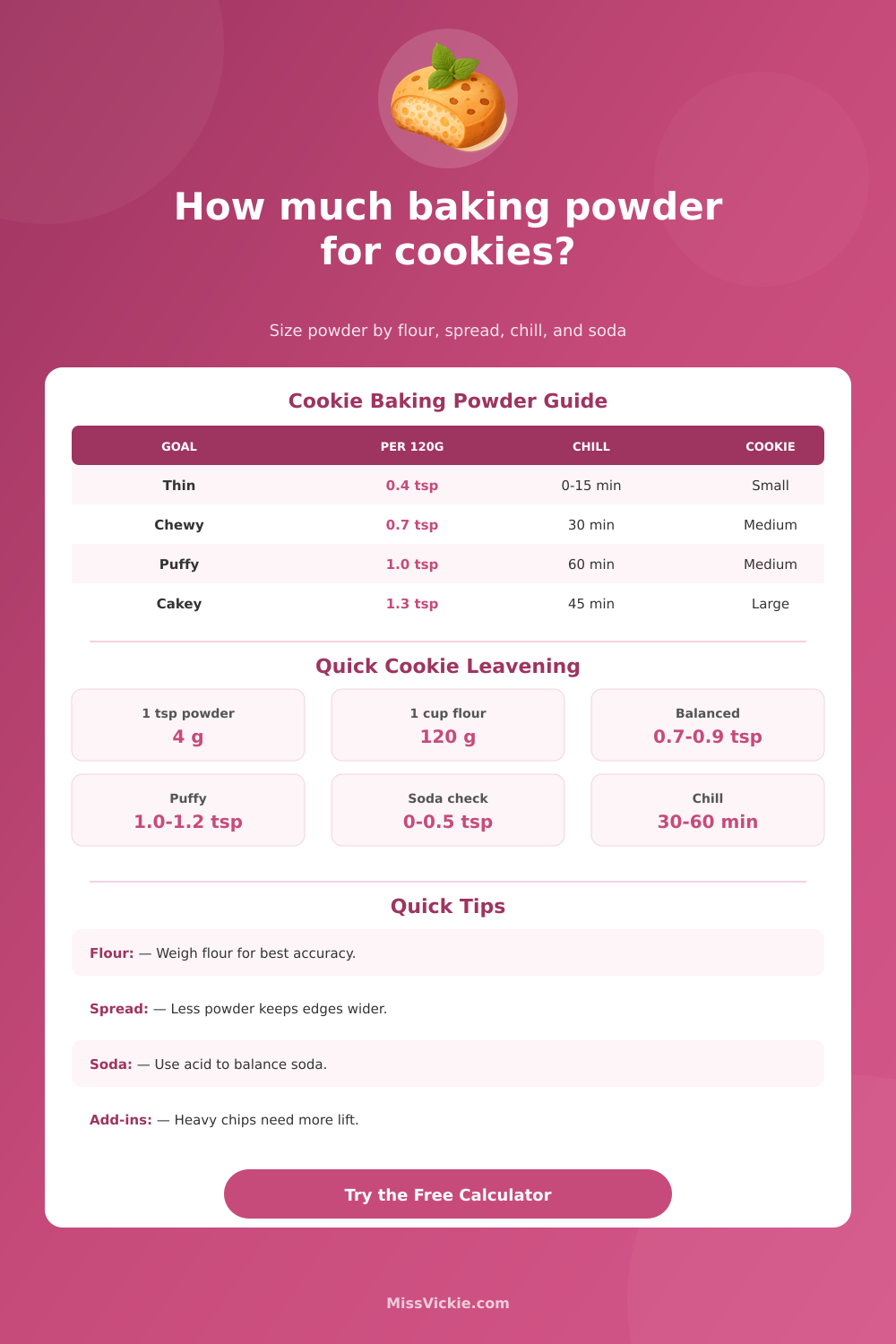
Baking powder is an leavening agent that help provide lift to cookie dough. The amount of baking powder that is included in the recipe will determine whether the cookies will be thin or puffy. Each person may desire one or the other, so the amount of baking powder will determine the textures of the cookie.
The baking powder calculator will help you to determine the amount baking powder that you should use in your recipe by utilizing several different variable. You will need to enter the weights of the flour that you will use, the number of cookies that you would like to bake, the chill time for the dough, the acidity of the ingredients that you will use, and the spread or puff of the cookies that you would like to achieve. The dough spread amount will determine the texture of the cookies before it sets.
How to Use the Cookie Baking Powder Calculator
Thin and crisp cookies will contain less baking powder than puffy cookies because less baking powder will allow the fat in the dough to melt and the dough to flow. Puffy cookies will have more baking powder than thin and crisp cookies to allow the cookies to hold there heights once the fat in the dough has softened. The baking powder calculator will determine the rate of baking powder to flour for the desired texture and then adjust for the other variables that you enters into the cookie baking powder calculator.
Chill time is one factor that will affect how much the cookies spread. Moreover, many people dont account for this factor in their cookie recipes. If you chill your cookie dough for thirty minutes, for instance, the butter in the dough will become firm, which will allow the baking powder to make the cookies taller.
If you chill your cookies for longer periods of time, or if you allow the dough to rest in the refrigerator overnight, the dough will hold its shape due to the cold temperature of the dough. If you chill the dough, the baking powder calculator will automatically reduce the amount of baking powder that you must use in your cookie dough. If you do not chill your cookie dough, however, the baking powder calculator will increase the amount of baking powder that is necessary to compensate for the additional flow of the dough that will occur without chilling.
The acidity of the ingredients will affect how much lift occur in the cookies, which will directly impact the amount of baking soda that you need to add to the cookie dough. Ingredients like brown sugar, molasses, natural cocoa and buttermilk will add acidity to the cookie dough. Because baking soda is already included in your cookie recipe, the baking powder calculator will reduce the amount baking powder that must be added.
It is critical to maintain a balance between baking soda and acidity in your cookie dough. If there is too much baking soda without enough acid, the cookies will have a soapy taste. If there is too little baking soda in the cookies that are acidic, the cookies will have a flatly taste.
The baking powder calculator will alert you to this so that you can decide whether to add more baking soda or baking powder to the cookie dough. The different add-ins to your cookie dough will affect the density of your cookie dough, thus affecting the amount of baking powder that you need. If you include large amounts of add-ins to your cookies, the baking powder calculator will increase the amount of baking powder because the add-ins will weigh the dough down.
The more heavy add-ins that are included in the cookie dough, the more baking powder will be required. The ratio of butter to sugar in your cookie dough will also impact the amount of baking powder that is required. If you have a higher ratio of butter to flour, for instance, the cookies will spread more, so more baking powder will be required.
The same is true of sugar. If you include more sugar to your cookie dough than others, the dough will spread more. Thus, you will have to increase the amount of baking powder to allow for the setting of the structure of the cookie.
Cookie size is another factor that you may need to adjust. Smaller cookies will bake at a faster rate than larger batches of cookies. Thus, if you bake smaller batches of cookies, they may over-puff if you use the same amount of baking powder as a medium batch of cookies.
If you bake larger batches of cookies, the center of the cookie may sink if there is not enough baking powder to allow the batch of cookies to rise to the same extent as the edges of the cookie. The cookie baking powder calculator will adjust for batch size when you select your scoop size for the cookie dough. Overall, the purpose of utilizing this cookie baking powder calculator is to help you to understand how each of these variables can interact with each other.
Thus, you can bake a batch of cookies using the calculated amount of baking powder. After tasting the cookies, you can adjust the ingredient for the next batch of cookies. If the cookies spread too much, you can increase the chill time for the next batch of cookies or decrease the amount of baking powder.
If the cookies are too flat, you can increase the amount of baking powder that you use or even increase the amount of baking soda in your recipe if you have enough acidity in your dough. Thus, the baking powder calculator will allow you to easily adjust the recipe if you change the weight of the flour, the number of add-ins or the chill time for the batch of cookies.