How Much Baking Powder for Chicken Wings?
Calculate the right baking powder coating for oven or air fryer wings by weight, piece count, dryness, crispness goal, salt level, and cooking style.
Choose a common wing batch to fill the calculator with realistic weights, piece counts, drying time, and coating intensity.
Coating Breakdown
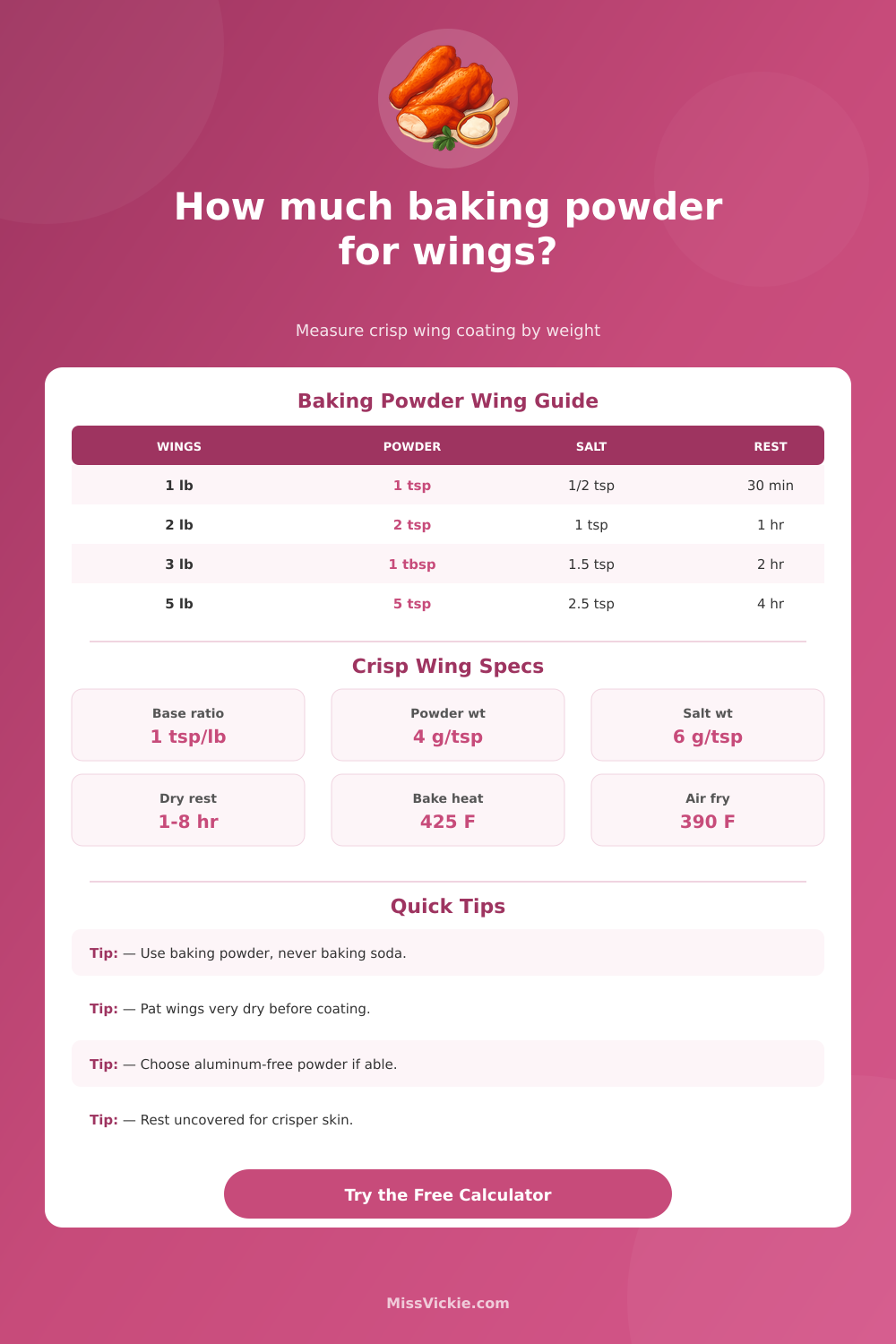
| Raw wing weight | Standard powder | Extra crisp powder | Approx grams |
|---|---|---|---|
| 1 lb / 454 g | 1 tsp | 1 1/4 tsp | 4-5 g |
| 1 1/2 lb / 680 g | 1 1/2 tsp | 2 tsp | 6-8 g |
| 2 lb / 907 g | 2 tsp | 2 1/2 tsp | 8-10 g |
| 3 lb / 1.36 kg | 1 tbsp | 3 3/4 tsp | 12-15 g |
| 5 lb / 2.27 kg | 5 tsp | 2 tbsp plus 1/4 tsp | 20-25 g |
| Coating style | Baking powder | Salt per lb | Best use |
|---|---|---|---|
| Unsalted base | 1 tsp per lb | 0 tsp | For salty sauces or brined wings |
| Lightly salted | 1 tsp per lb | 1/4 tsp | For dry rubs with salt already included |
| Balanced | 1 tsp per lb | 1/2 tsp | For classic oven wings before saucing |
| Seasoned crust | 1 1/4 tsp per lb | 3/4 tsp | For plain, lemon pepper, or dry wings |
| Rub heavy | 3/4 tsp per lb | as rub allows | For packaged rubs that contain salt |
| Method | Typical heat | Dry rest | Coating note |
|---|---|---|---|
| Oven on rack | 425 F / 218 C | 1-8 hours | Best all-purpose setup for crisp skin |
| Air fryer | 390 F / 199 C | 30-60 minutes | Use a slightly lighter coat to avoid dustiness |
| Convection oven | 400 F / 204 C | 1-4 hours | Strong airflow browns faster than still oven heat |
| Smoker finish | 375-425 F | overnight | Use powder after smoke if skin turns wet |
| Broiler finish | high broil | 1 hour | Use only after wings are already cooked through |
| Wing type | Pieces per lb | Weight each | Powder per piece |
|---|---|---|---|
| Small split wings | 11-13 pieces | 35-42 g | about 1/12 tsp |
| Party flats and drums | 9-11 pieces | 42-50 g | about 1/10 tsp |
| Standard split wings | 8-10 pieces | 45-57 g | about 1/9 tsp |
| Jumbo split wings | 6-8 pieces | 57-76 g | about 1/7 tsp |
| Whole wings | 4-5 wings | 90-115 g | about 1/4 tsp |
Good for air fryers, small wings, and heavily seasoned rubs.
The dependable oven wing ratio for crisp skin without a powdery finish.
Best when wings are dry, large, and cooked on a raised rack.
Use cautiously for very wet wings or very thick skin; toss thoroughly.
Baking powder are a tool that can be used to change the texture of the skin of chicken wings. You must apply the baking powder in a correct amount to the chicken wings, or the chicken wings will taste badly. If too many baking powder is used, the chicken wings will have a chalky and dust taste.
If the correct amount of baking powder is used, the wings will have a crispy texture. However, the success of the baking powder rely upon the moisture and weight of the chicken wings. To use baking powder on the chicken wings, you should first determine the weight of the chicken wings.
How to Use Baking Powder on Chicken Wings
One pound of chicken wings should contain one teaspoon of baking powder. However, this amount may change depending on the amount of moisture that is on the chicken wings. If the chicken wings have much moisture, they will absorb the baking powder.
If the chicken wings absorb the baking powder, then the powder will not be able to create a crust on the skin of the wings. If the chicken wings are dry, the cook will need less baking powder to coat the skin. The cooking method used will affect the performance of the baking powder on the skin of the chicken wings.
If the chicken wings are cooked on an oven rack, the steady amount of air will dry the skin of the wings and help the baking powder to set. If the wings are cooked in an air fryer, the high heat and fast movement of air will require a lighter coating of baking powder to the skin of the wings. If the wings are cooked in a convection oven, the medium amount of air will allow for medium performance of the baking powder.
Smokers will reintroduce moisture to the skin of the wings, thus allowing the baking powder to fail. Therefore, you will have to adjust the amount of baking powder according to the cooking tool in which the chicken wings will be cooked. Salts is often mixed with the baking powder.
However, the cook should balance the amount of salt and baking powder to create the correct flavor of the wings. If there is too little salt, the flavor of the wings will be flatly. If there is too much salt, the salt will interact with the baking powder.
Therefore, if the seasoning that is used for the wings already contain salt, less salt will be used in the baking powder mixture. After the baking powder is mixed with the skin of the chicken wings, the wings should be allow to rest. The chicken wings can rest for thirty minutes after the baking powder is applied.
However, an hour or more may be required to allow the wings to dry and the baking powder to draw moisture to the skin. For the most crispy skin, the chicken wings can be left uncovered in the refrigerator overnight to dry out the skin. The amount of baking powder that is use will change according to the length of time that the chicken wings are allowed to rest.
The size and type of the chicken wings may change the way in which the baking powder is applied. For instance, a pound of small party wing will have more surface area than a pound of large jumbo drumettes. Additionally, if the chicken wings are previously frozen, they will have more moisture than chicken wings that are purchase and fresh.
Mistakes should of been avoided when using baking powder on chicken skin. Using baking soda in place of baking powder will produce a taste of the chicken wings that has a soapy flavor. Additionally, the chicken wings should be patted dry prior to apply the baking powder.
If too much moisture is on the skin, the baking powder will not be able to produce a crispy skin. The goal in applying baking powder to the skin of chicken wings is to find the small amount of baking powder that will produce a crispy skin to the wings. Using the maximum amount of baking powder is not the goal; one does not want the chicken wings to contain a heavy amount of white powder on the skin.
If the cook calculates the correct amount of baking powder, the skin will be crispy and the baking powder will not be visible on the chicken wings when they are cooked.