
Sometimes you want to make that special treat, but you don’t have the right pan. The recipe says nine-inch round, but all you have is an eight-by-eight square. Do you just fill it up and pray it doesn’t spill out? Worse yet, do you end up with a sunken, dense cake because the heat doesn’t spread evenly?
There’s more than just chemistry at work when baking; there’s also geometry. Knowing about pan volume mean knowing whether you’ll be making a professional looking layer cake or a kitchen disaster. It eliminates guesswork and lets you bake confidently.
How to Choose the Right Baking Pan Size
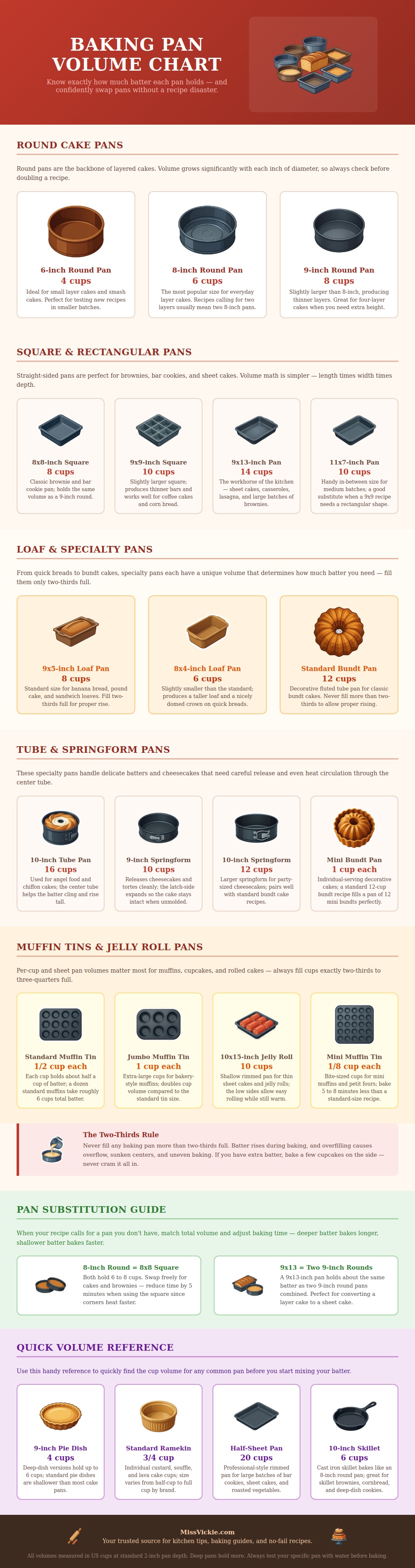
This is also the exact amount of batter that each vessel will hold (see graph above). It prevents you from having to do any math in your head when you reaches for a pan in your cupboard. When most bakers at home look at a nine inch round they figure it’s just barely smaller than an eight inch; however, the difference in volume between them is two entire cups of batter!
You’ll either have to adjust your batter or else that extra volume won’t fit into the smaller pan which means it will overflow. Or, you can fit your batter in the bigger pan if your recipe was meant for small, in which case your layers will be paper thin and dry out before center sets. The diagram explains those relationships so you can change out pans and not mess up the texture on your cake.
The secret behind the success of layered desserts is that round pans cooks evenly on all sides. For example, a regular six-inch pan fits roughly four cups of batter, making it ideal for test batches or for baking smash cakes for small celebrations. As you work your way up to the eight-inch pan you’re right in the sweet spot for everyday layer cake. And it is for good reason. It’s the most popular pan size.
A nine-inch round has an additional two cups of space. This makes it the choice of many bakers who want to make their layers even thinner for complex four tier designs. Always double check first before blindly doubling a recipe, as the volume increases much faster when you increase the diameter.
Other straight-sided pans has their perks. Because there’s less depth with more batter, square or rectangular pans such as an eight-by-eight (shown above) or the popular nine-by-thirteen are great for bar cookies and brownies. The latter holds fourteen cups, which is roughly equivalent to two nine-inch round pans combined. That makes it easy to take just about any layer cake recipe and turn it into a sheet cake, just adjust the timing accordingly. If making something square, cut the time by five minutes (since the corners will cook first); that way the edges don’t overbake.
Specialty pans and loaves gets special treatment. An eight-by-eight square holds eight cups, just like a nine-by-five loaf pan. But since it is taller or shorter, the bread will rise different. For example, quick breads such as banana bread require space to rise in a dome shape.
Bundt pans (which can be tricky due to their fluting) contains roughly a dozen cups, but never fill beyond two-thirds capacity. That headspace allows for the batter to expand upwards in all its many curves without overflowing into the inner tube. Overfilled Bundts result in loss of definition and a flat-top mess. The same applies to muffin tins, though on a smaller scale. Jumbo tins is twice as big; regular ones hold about one-half cup of batter per cup.
No matter what you’re baking in, here’s the golden rule: Fill them up, but not quite to the top. Leavening agents cause your batter to expand during baking, so if packed full it will overflow; leaving you with a lopsided baked good and a gunky mess to clean out of your oven. Apply this two-thirds rule to jelly roll pans, ramekins, and everything else.
And if you aren’t sure how much your pans actualy hold? Measure them out yourself with water. Metal thickness varies between brands. A 9-inch pan from one may be bigger (or smaller) than another’s. Simply fill up your real pan all the way to the top, pour it into a liquid measuring cup, and there you go: the exact amount of whatever size pan you have. No guessing necessary.
That’s the thing about baking, there’s no room for approximation here. It’s about knowing exactly what you’re doing. And once you get it down to numbers, you won’t fear making the switch anymore. Use what you’ve got, be confident when you bake, and enjoy the outcome.
When you grab a pan next time, you’ll be looking at more than just a hunk of metal. You’ll see the volume and capacity. You will also see where your batter should of go.