🍰 Baking Pan Conversion Calculator
Convert between pan sizes, find equivalent volumes, and get substitution suggestions instantly
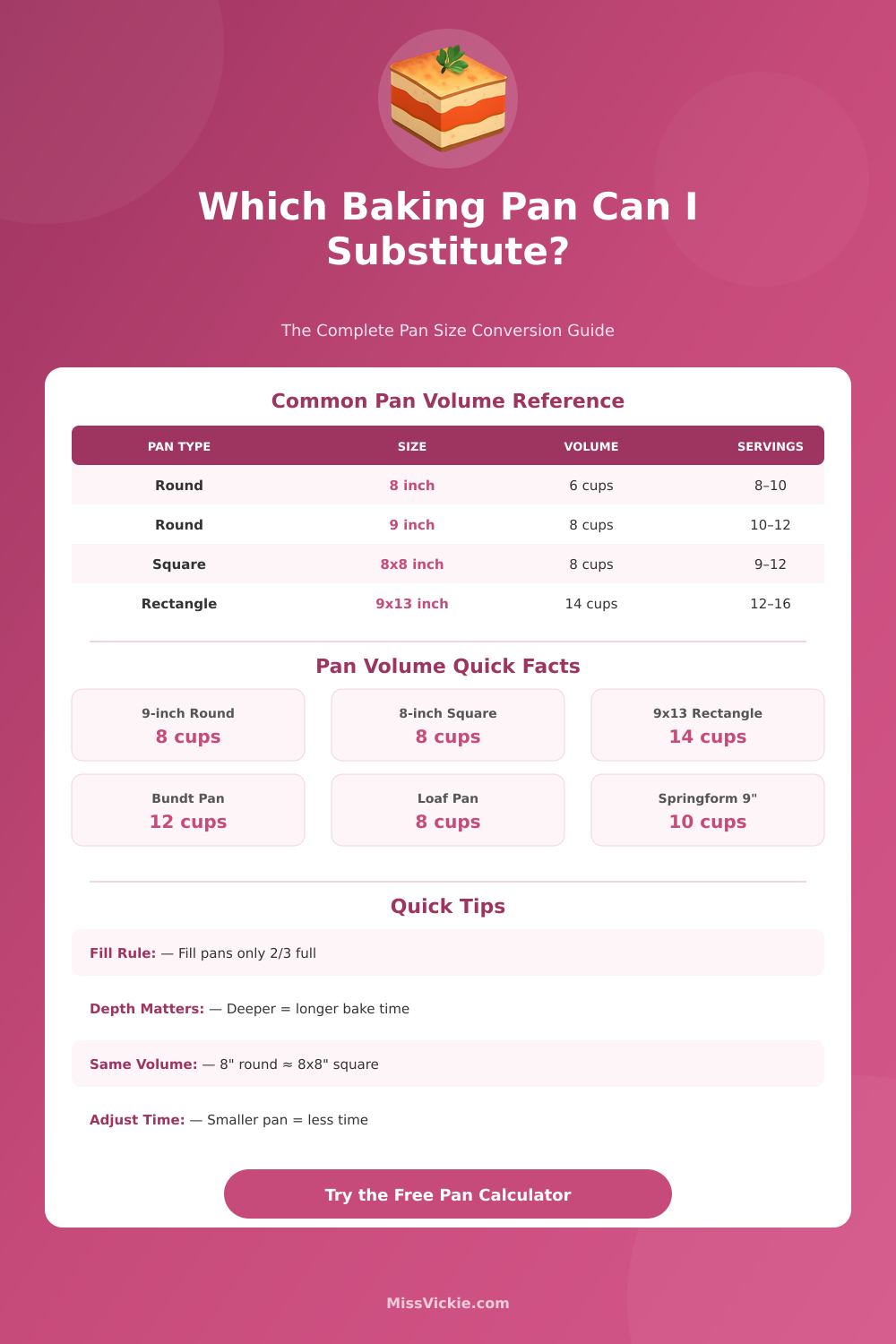
| Pan Type & Size | Dimensions | Volume (cups) | Volume (liters) | Common Use |
|---|---|---|---|---|
| Round 6" | 6" x 2" deep | 4 cups | 0.95 L | Small layer cakes |
| Round 8" | 8" x 2" deep | 6 cups | 1.42 L | Layer cakes, cheesecake |
| Round 9" | 9" x 2" deep | 8 cups | 1.89 L | Layer cakes, pies |
| Round 10" | 10" x 2" deep | 10.5 cups | 2.49 L | Large cakes |
| Square 8x8" | 8" x 8" x 2" | 8 cups | 1.89 L | Brownies, bars |
| Square 9x9" | 9" x 9" x 2" | 10 cups | 2.37 L | Brownies, cakes |
| Rectangle 9x13" | 9" x 13" x 2" | 14 cups | 3.31 L | Sheet cakes, lasagna |
| Rectangle 7x11" | 7" x 11" x 2" | 10 cups | 2.37 L | Casseroles, cakes |
| Loaf 8.5x4.5" | 8.5" x 4.5" x 2.5" | 6 cups | 1.42 L | Bread, pound cake |
| Loaf 9x5" | 9" x 5" x 3" | 8 cups | 1.89 L | Bread, meatloaf |
| Bundt 10" | 10" x 3.5" deep | 12 cups | 2.84 L | Bundt cakes |
| Springform 9" | 9" x 2.75" deep | 10 cups | 2.37 L | Cheesecake, tortes |
| Springform 10" | 10" x 2.75" deep | 12 cups | 2.84 L | Cheesecake, tortes |
| Jelly Roll 10x15" | 10" x 15" x 1" | 10 cups | 2.37 L | Sheet cake, rolls |
| Original Pan | Best Substitute | Volume Match | Scale Factor | Notes |
|---|---|---|---|---|
| 9" Round (2 pans) | 9x13" Rectangle | 16 vs 14 cups | 0.88x | Slightly less batter |
| 8" Round (2 pans) | 9x13" Rectangle | 12 vs 14 cups | 1.17x | Use extra batter |
| 8x8" Square | 9" Round | 8 vs 8 cups | 1.0x | Perfect match |
| 9x9" Square | 11x7" Rectangle | 10 vs 10 cups | 1.0x | Excellent swap |
| Bundt 12-cup | 10" Tube Pan | 12 vs 16 cups | 1.33x | Tube holds more |
| 9x5" Loaf | 8x8" Square | 8 vs 8 cups | 1.0x | Same volume |
| 9" Round | 9" Springform | 8 vs 10 cups | 1.25x | Springform is deeper |
| Two 8" Rounds | 9x13" Rectangle | 12 vs 14 cups | 1.17x | Scale up slightly |
| Pan Type | Imperial Size | Metric Size (cm) | Volume (L) |
|---|---|---|---|
| Round | 6" x 2" | 15 cm x 5 cm | 0.95 L |
| Round | 8" x 2" | 20 cm x 5 cm | 1.42 L |
| Round | 9" x 2" | 23 cm x 5 cm | 1.89 L |
| Square | 8x8" x 2" | 20x20 cm x 5 cm | 1.89 L |
| Square | 9x9" x 2" | 23x23 cm x 5 cm | 2.37 L |
| Rectangle | 9x13" x 2" | 23x33 cm x 5 cm | 3.31 L |
| Loaf | 9x5" x 3" | 23x13 cm x 8 cm | 1.89 L |
| Bundt | 10" x 3.5" | 25 cm x 9 cm | 2.84 L |
Baking is both an art and a science. Yet, one of the most common problem bakers face is when a recipe calls for a pan size that they dont have in there kitchen. Whether the recipe calls for a 9-inch round cake pan or an 8×8 cake pan, bakers often find themself in a situation where they need to make substitutions. Knowing how to perform baking pan conversion allows bakers to confidently substitute one pan for another and produce the same delicious result.
Baking pan conversion calculators rely upon the understanding of the volume of each type of pan. Pan volume determine how much batter that a cake pan can hold. The deeper a cake pan is, the more cake batter it can hold. A baking pan conversion calculator can perform pan volume calculation with the aid of these tools. These online tool make it easy for cooks to quickly calculate the volume of their baking pans in cups or liters. However, understanding the science behind these calculations allows cooks to successfully substitute pan without the aid of such a calculator.
Mastering Baking Pan Conversions
To understand baking pan conversions, cooks must first understand what volume mean for different types of pans. To calculate volume, cooks can use the equation: area multiplied by the depth of the pan. For round pans, the area is the product of pi and the square of the radius of the pan. For squares and rectangular pans, the area is the product of the length of the pan multiplied by the width of the pan. These calculations can determine the volume in cups or liters. The volume of a 9-inch round cake pan that is 2 inches deep, for example, hold 8 cups of batter. An 8×8 pan has the same volume, thus enabling cooks to substitute one for the other in their recipes.
The other component of baking pan conversions is understanding the scale factor. To determine the scale factor, cooks must divide the volume of the original pan by the volume of the pan that they intend to use in the recipe. Using the volume calculation above, cooks can determine a scale factor of 0.8 means that they need to reduce the ingredient in the recipe by 20%. A scale factor of 1.2 means that they must increase the amount of ingredients by 20%. Using the baking pan conversion calculator above, cooks can ensure that the batter in their recipe fill the pan to the appropriate level… No more than two-thirds of the pan should be filled with batter to avoid any spill of that delicious batter.
Beyond understanding volume and the scale factor, cooks must also understand how the shape of the pan can potentially impact the baking process. Round pans are best for cakes as they create a domed structure for the cake. Square pans are ideal for brownies and sheet cakes. Rectangular pan of 9 inches by 13 inches are ideal for baking large batch of cakes or biscuits. Bundt and tube pans have unique volume due to their designs. A bundt pan with a diameter of 12 inches, for example, may hold 12 cup of batter. An 8-inch round pan holds 8 cups of batter. Loaf pans are slightly tapered on the sides compared with other pans. Springforms have higher side and are best for baking cheesecakes. However, if cooks are using springforms for another type of cake, baking pan conversion will have to be made according to the depth of the pan.
Another important aspect of baking pan conversions is understanding how each pan may bake in different amount of time. The wider the pan and the shallower the depth, the longer it will take for the pans to bake the same number of items. Thus, cooks that bake recipes in 8×8 cake pans will have to reduce the baking time by 10% or 15% compared to recipes that require deeper pan. Those using deeper pans may have to extend the baking time by 10% or 25%. Once the baked item come out of the oven, cooks can test the doneness of the items by inserting a toothpick into the middle of the cakes. The cakes are done when the toothpick come out clean. The internal temperature of a cake should reach 200 to 205 degrees Fahrenheit. Finally, the type of pan that cooks use also impact the baking time. Metal pans are more conductive of heat than ceramic pans. Thus, cooks using metal pans may have to reduce the recipe baking time by 25 degree Fahrenheit. Dark metal pans will conduct heat more rapidly than lighter metal pans, meaning they may have to reduce the baking time for those pan by 15 degrees Fahrenheit.
Some common baking pan substitution that cooks can rely upon include using two 8-inch round pans instead of one 9-inch round pan. These two pans contain 12 cup of batter, while the 9-inch round pan holds 14 cups. Thus, cooks must increase the amount of ingredient by 17% for this pan substitution recipe. Additionally, cooks can use an 8×5 loaf pan for an 8-inch round cake pan. The 9-inch round pan holds 8 cups of batter while the loaf pan holds 8 cups as well. Lastly, cooks can use a round baking pan with a diameter of 23 centimeters (approximately 9 inches) in place of an 8-inch round pan. These two pans hold approximately 1.9 liter of batter each.
Beyond understanding baking pan conversions and the impact that pan size, shape and depth can have upon the baking process, cooks must also understand how the type of batter can impact baking pan substitutions. For instance, cakes that contain light batter and foams, like chiffon cakes, can fill up to 90% of the pan. However, cakes with denser batter, like pound cake and brownies, should fill no more than 75% of the pan. If cooks are using multiple smaller pan in place of a single pan, they should ensure that the batter is divided equally between the pans. Additionally, cooks should rotate the pan during the baking process to ensure that all cake are baked to the same degree.
Here are a few additional tip and trick for cooks to better master the art and science of baking pan conversions:
Always measure the depth of the pan to ensure accuracy in recipe calculations. One way to do this is to fill the pan with water and pour it into a measuring cup. The amount of water that fills the pan is the depth of the pan in cups.
Ensure that cooks properly grease and flour the pan that are used in baking recipes to ensure the easy removal of the baked goods from the pans.
Always preheat the pans according to the recipe before adding the baked goods into the pan.
Keep a journal of recipe attempts to track what type of baking pan were used and what change in baking time or recipe ingredients were required. This will allow cooks to more easily remember these substitution and baking times over time.
By learning the science and art behind baking pan conversions, cooks can find themself limited only by their imaginations and the number of person that they would like to feed with their delicious baked goods. Whether using a baking pan conversion calculator to find the perfect amount of recipe ingredient to pour into a specific type of pan, cooks can confidently create delicious treat for there friends, family and even for guest at their social events. Happy baking!