🍰 Baking Pan Conversion Calculator
Convert between pan sizes, find equivalent volumes, and get substitution suggestions instantly
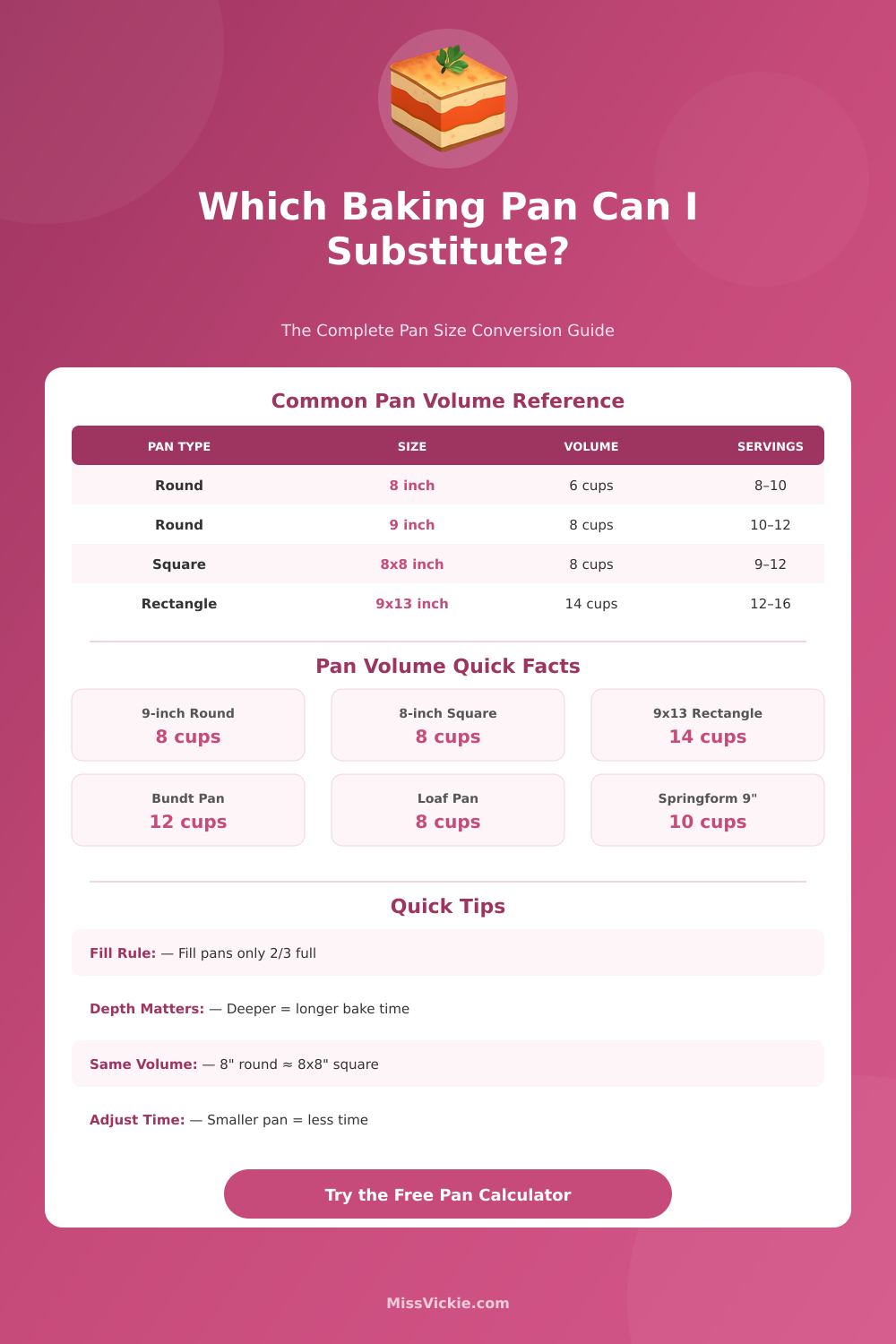
| Pan Type & Size | Dimensions | Volume (cups) | Volume (liters) | Common Use |
|---|---|---|---|---|
| Round 6" | 6" x 2" deep | 4 cups | 0.95 L | Small layer cakes |
| Round 8" | 8" x 2" deep | 6 cups | 1.42 L | Layer cakes, cheesecake |
| Round 9" | 9" x 2" deep | 8 cups | 1.89 L | Layer cakes, pies |
| Round 10" | 10" x 2" deep | 10.5 cups | 2.49 L | Large cakes |
| Square 8x8" | 8" x 8" x 2" | 8 cups | 1.89 L | Brownies, bars |
| Square 9x9" | 9" x 9" x 2" | 10 cups | 2.37 L | Brownies, cakes |
| Rectangle 9x13" | 9" x 13" x 2" | 14 cups | 3.31 L | Sheet cakes, lasagna |
| Rectangle 7x11" | 7" x 11" x 2" | 10 cups | 2.37 L | Casseroles, cakes |
| Loaf 8.5x4.5" | 8.5" x 4.5" x 2.5" | 6 cups | 1.42 L | Bread, pound cake |
| Loaf 9x5" | 9" x 5" x 3" | 8 cups | 1.89 L | Bread, meatloaf |
| Bundt 10" | 10" x 3.5" deep | 12 cups | 2.84 L | Bundt cakes |
| Springform 9" | 9" x 2.75" deep | 10 cups | 2.37 L | Cheesecake, tortes |
| Springform 10" | 10" x 2.75" deep | 12 cups | 2.84 L | Cheesecake, tortes |
| Jelly Roll 10x15" | 10" x 15" x 1" | 10 cups | 2.37 L | Sheet cake, rolls |
| Original Pan | Best Substitute | Volume Match | Scale Factor | Notes |
|---|---|---|---|---|
| 9" Round (2 pans) | 9x13" Rectangle | 16 vs 14 cups | 0.88x | Slightly less batter |
| 8" Round (2 pans) | 9x13" Rectangle | 12 vs 14 cups | 1.17x | Use extra batter |
| 8x8" Square | 9" Round | 8 vs 8 cups | 1.0x | Perfect match |
| 9x9" Square | 11x7" Rectangle | 10 vs 10 cups | 1.0x | Excellent swap |
| Bundt 12-cup | 10" Tube Pan | 12 vs 16 cups | 1.33x | Tube holds more |
| 9x5" Loaf | 8x8" Square | 8 vs 8 cups | 1.0x | Same volume |
| 9" Round | 9" Springform | 8 vs 10 cups | 1.25x | Springform is deeper |
| Two 8" Rounds | 9x13" Rectangle | 12 vs 14 cups | 1.17x | Scale up slightly |
| Pan Type | Imperial Size | Metric Size (cm) | Volume (L) |
|---|---|---|---|
| Round | 6" x 2" | 15 cm x 5 cm | 0.95 L |
| Round | 8" x 2" | 20 cm x 5 cm | 1.42 L |
| Round | 9" x 2" | 23 cm x 5 cm | 1.89 L |
| Square | 8x8" x 2" | 20x20 cm x 5 cm | 1.89 L |
| Square | 9x9" x 2" | 23x23 cm x 5 cm | 2.37 L |
| Rectangle | 9x13" x 2" | 23x33 cm x 5 cm | 3.31 L |
| Loaf | 9x5" x 3" | 23x13 cm x 8 cm | 1.89 L |
| Bundt | 10" x 3.5" | 25 cm x 9 cm | 2.84 L |
Every bakery needs reliable baking pan items for good baking. In big amounts they come in various shapes, square, rectangular, round, and currently they most commonly are made of non-stick materials. Like this they stay useful easily cleaned after use and built to last years of everyday work.
The variety here truly surprises with its wealth. One finds everything, from cake pans and cookie sheets to bread molds, muffin pans, pie plates, pizza pans and loads of special molds, that you never would imagine. Many folks buy baking pan sets, that combine cake pans, cupcake pans, brownie pans, tart pans and cookie sheets in one package, which works very well.
Different Baking Pans and How to Use Them
In almost every home bakery shows that basic 9×13-inch rectangular baking pan, sometimes called a quarter sheet. It at least holds three quarts of content and works for making anything, from brownies and vanilla sheet cake to lasagna, bars, sharply done cinnamon treats and rice crispy sweets. A simple sheet pan itself is a basic flat rectangular metal tray, that one puts in the oven to bake bread rolls, cookies, sheet cakes, Swiss rolls and pizzas, nothing fancy, only simply reliable.
The usual muffin pan carries twelve cups. Each of them measures outside around two and a quarter inches wide and has around one and a quarter inches of depth. That sameness of cup sizes ensures, that everything bakes evenly and results in ideally equal portions.
Here it gets specific: various baking pan sizes receive different amounts of batter. This truly matters, if you try too substitute one size for another in a recipe. The bake time adjusts too according to what is used.
In my experience, a 9×9 square baking pan usually ends baking around five minutes sooner than some others, and a 9-inch round baking pan maybe only one minute more quickly. The simplest way to estimate the volume of a baking pan, if it is not marked somewhere? Simply fill it with water and measure.
That easy.
Also the depth plays a role. Shallow pans have one to two fingers of depth, while deeper ones reach around the width of your hand. For most home ovens, half-sheet pans are the common choice, because full-size commercial ones simply do not fit.
What the baking pan is made of truly matters. Aluminum half-sheet pans are easy to clean and stay in good shape for five to six years without warping. Pyrex glass heats evenly, cleans without effort and looks quite nice for serving directly at the table.
Glass bread pans sometimes come with covers and handles, which helps during baking, carrying and storage. A basic half-sheet pan without non-stick coatings lasts forever and works for everything, from roasted vegetables to cookies. Covered pans work well for roasting vegetables, fish or single-serving brownies, but for sheet cakes, soft batters or long baking jobs you truly need sturdy rigid pans or proper glass tools.
Lining your pans with parchment paper works also great, it makesthe cleanup feel pointless.