Baked Potato Cooking Time Calculator
Estimate oven time for baked potatoes from average potato weight, count, oven temperature, foil, oil and salt, rack or pan placement, starting temperature, desired doneness texture, altitude, and rest time.
🥔Baked potato presets
Pick a common potato bake, then adjust the actual weight, oven setup, skin finish, texture, altitude, and resting window.
⚖Units
🌡Potatoes, oven, and starting temperature
🔥Wrapping, skin, rack, and doneness texture
Baked potato timing estimate
Use a probe or skewer to verify the largest potato.
Potato timing breakdown
📊Quick baked potato reference
A large russet is usually fully fluffy near this internal temperature.
A common dinner-size russet usually needs about 45 to 60 minutes.
Hot enough for tender centers and better skin when potatoes are unwrapped.
Resting lets steam settle so the inside opens fluffier when split.
🧾Baked potato time table
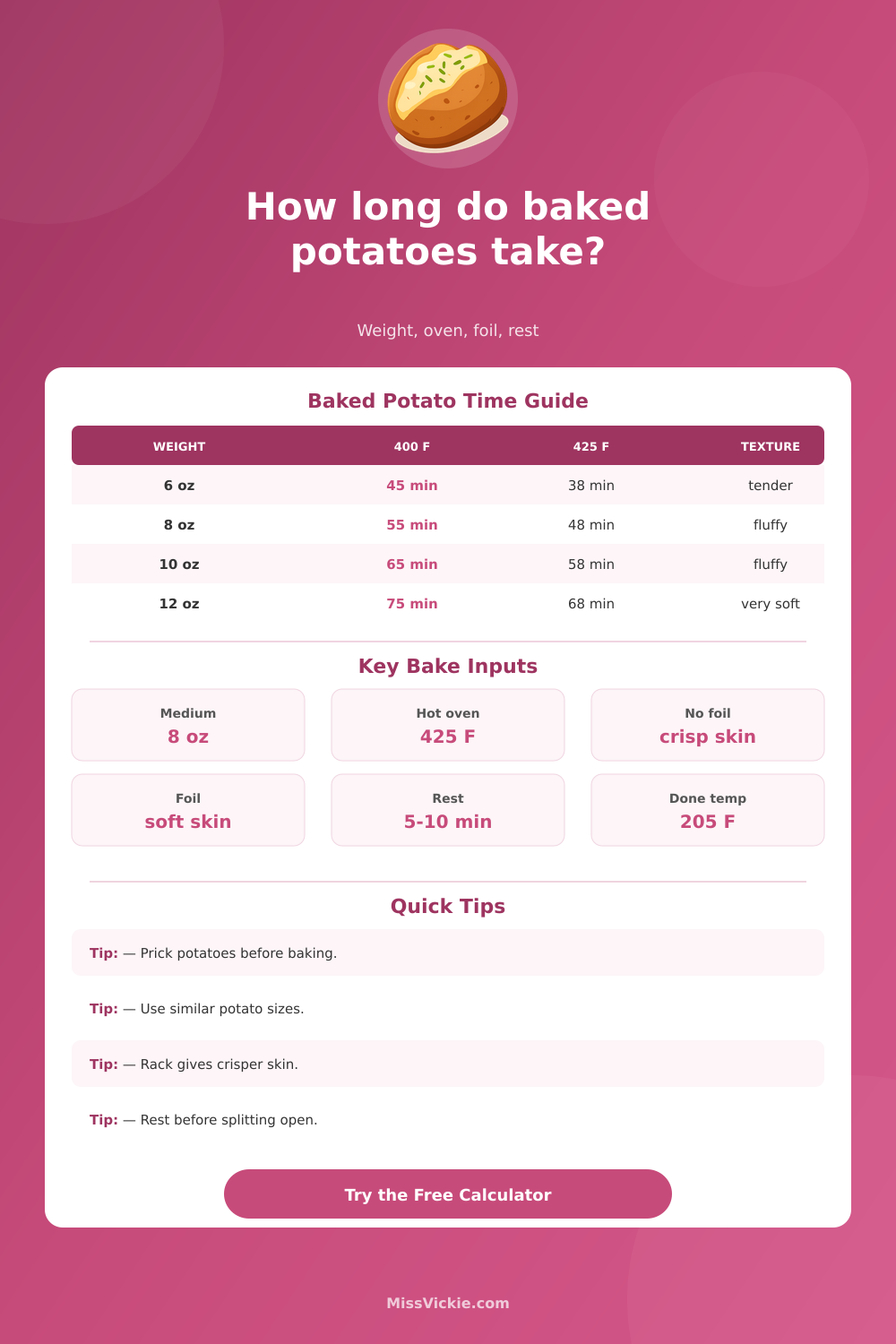
| Average potato weight | Best oven temperature | No foil, rack time | Foil wrapped time | Typical center temperature |
|---|---|---|---|---|
| 5 to 6 oz / 140 to 170 g small russet | 400 to 425°F / 205 to 220°C | 35 to 45 minutes | 40 to 50 minutes | 200 to 205°F / 93 to 96°C |
| 7 to 9 oz / 200 to 255 g medium russet | 400 to 425°F / 205 to 220°C | 48 to 60 minutes | 55 to 68 minutes | 205 to 210°F / 96 to 99°C |
| 10 to 12 oz / 285 to 340 g large russet | 400 to 425°F / 205 to 220°C | 60 to 75 minutes | 68 to 85 minutes | 205 to 212°F / 96 to 100°C |
| 13 to 16 oz / 370 to 455 g jumbo potato | 375 to 425°F / 190 to 220°C | 75 to 95 minutes | 85 to 105 minutes | 208 to 212°F / 98 to 100°C |
| 6 to 10 oz / 170 to 285 g sweet potato | 375 to 425°F / 190 to 220°C | 45 to 70 minutes | 50 to 78 minutes | 200 to 207°F / 93 to 97°C |
🛒Setup adjustment table
| Setup factor | Usually changes time by | Texture effect | Best check |
|---|---|---|---|
| Fully wrapped in foil | Adds about 8 to 14 percent | Soft skin, steamier center | Probe through foil into the largest potato |
| Directly on oven rack | Baseline to slightly faster | Drier, crisper skin | Squeeze gently with a towel or use a skewer |
| Crowded sheet pan | Adds about 5 to 15 minutes | Less even browning | Rotate pan and check corner potatoes |
| Cold refrigerated potatoes | Adds about 5 to 12 percent | Longer dense center phase | Check center temperature, not just skin color |
| High altitude above 5000 ft | Adds about 6 to 12 percent | Skin dries faster | Use tenderness and center temperature together |
💡Potato timing tips
Use weight first: count affects oven crowding, but average weight drives the center cooking time. If sizes vary, base timing on the largest potato.
Match skin to method: oil and salt work best with no foil and airflow. Foil is better when you want soft skins or need to hold potatoes warm.
Check texture: a fluffy baked potato should give easily when squeezed with a towel and usually reads about 205°F to 210°F in the center.
Rest before opening: split potatoes after a short rest so steam finishes softening the center instead of escaping immediately.
When timed just right, a tricky balance, the potato doesn’t turn out either mealy or dry come dinnertime. If it cook for even a few minutes longer then necessary, though, it will collapse onto itself like a puddle of soggy potato goo. If it is not done yet, it will become mealy.
That’s what happens when you leave things up to chance. You’re in charge of those details; you’re in charge of the process.
How to Cook Perfect Potatoes
The first thing’s first: Weight. The size of the potato matter because it determines how much cooking the center need until starch inside fully gels. It becomes fluffy instead of just warm. The bigger the potato, the more material there is in middle and the longer it’ll take for heat to work its way through and get everything fluffy. A single potato that weighs a couple of ounces more than another can end up done a whole lot later, despite being otherwise identical size-wise on exterior.
Once you input the average weight of your spuds, plus the number you’re putting into the pot at any given time, calculator above does math for you. That weight reacts different than oven temperature you might think, and a hotter oven will shorten total time; but it’ll do something else to the surface as well. Unwrapped potatoes tend to have soft skin, particularly at lower temperatures; they stretch out the bake and may not need foil for protection.
Another issue is starting temperature. A fridge-pulled potato requires an additional few minutes simply to warm through before any actual cooking take place. Cold centers introduce a delay between apparent doneness of exterior and true doneness of center.
Rack position (higher or lower) have an effect. The type of foil, the amount of oil you use, and the amount of salt also matter, with each one pulling it in a slightly different direction. For example, foil holds moisture in the skin and softens it; but salt and oil will promote crispness, unless there’s nowhere for the air to flow, i.e., if you crowd potato onto one baking sheet. Altitude also makes a difference. Lower air pressure cause water to evaporate faster. This leads to a drier potato before the inside cook through.
All this goes into equation, with the resulting estimate based off your specific conditions instead of some generic average.
The final factor is texture preference. Most home cooks treat this as an afterthought, but it affect when you should of remove the potatoes: Something that will be cut into slices (and thus exposed to more surface) require less time in oven than something intended to remain intact, perhaps in a loaded dish in which middle must be soft enough to cave in at pressure of a fork.
Oven rest time also plays into this: Because there’s moisture still in the potatoes, they’ll keep softening slightly even after coming out of the oven for a few minutes. The residual heat can also trick you into thinking the potato’s drier than it really is; split it right away and you might think so.
And so, here’s the takeaway: You start by measuring the biggest potato. Then you adjust finish time to match how you want to serve it, taking into account actual conditions in your oven. You notice that small adjustments to any variable add up. Most potatoes is within a few minutes of perfection or failure, depending on when you pay attention.