Equilibrium bacon cure, smoke, pellicle, and yield
Cure Per Pound of Bacon Calculator
Calculate Cure #1, kosher salt, sugar or maple, cure days, dry pellicle time, smoke temperature, finished yield, and estimated ingoing nitrite ppm for pork belly.
Choose a real pork belly curing setup, then adjust Cure #1 percentage, salt, sweetness, slab thickness, cure time, pellicle, smoke target, and expected yield.
Your Bacon Cure Batch
Cure, salt, sweetness, time, smoke, yield, and nitrite estimate.
Full Cure Breakdown
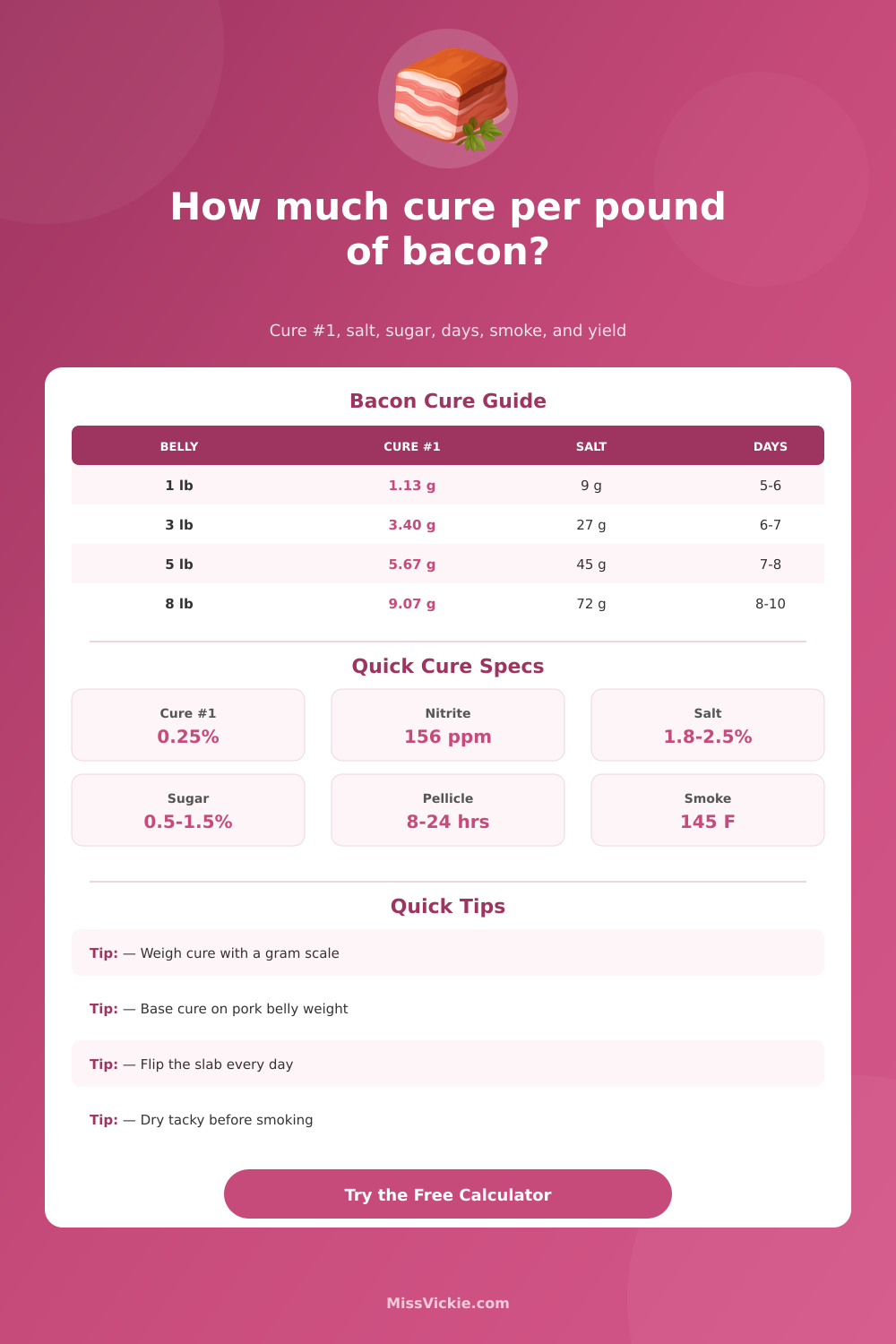
| Pork Belly Weight | Cure #1 at 0.25% | Total Salt at 2.0% | Sugar at 1.0% |
|---|---|---|---|
| 1 lb / 454 g | 1.13 g | 9.1 g | 4.5 g |
| 2 lb / 907 g | 2.27 g | 18.1 g | 9.1 g |
| 3 lb / 1.36 kg | 3.40 g | 27.2 g | 13.6 g |
| 5 lb / 2.27 kg | 5.67 g | 45.4 g | 22.7 g |
| 8 lb / 3.63 kg | 9.07 g | 72.6 g | 36.3 g |
| Thickest Point | Minimum Cure Window | Common Home Window | Handling Cue |
|---|---|---|---|
| 1.0 in / 2.5 cm | 4 days | 5 to 6 days | Flip daily |
| 1.5 in / 3.8 cm | 5 days | 6 to 7 days | Firm center |
| 2.0 in / 5.1 cm | 6 days | 7 to 8 days | Even cure |
| 2.5 in / 6.4 cm | 7 days | 8 to 10 days | No soft core |
| 3.0 in / 7.6 cm | 8 days | 10 to 12 days | Extra time |
| Cure Style | Salt Target | Sweetener Target | Best Use |
|---|---|---|---|
| Breakfast balanced | 2.0% | 1.0% | Pan frying |
| Maple sweet | 1.8% | 1.5% | Sweet slices |
| Pepper savory | 2.2% | 0.7% | BLT bacon |
| Low sugar | 2.1% | 0.2% | Cooking bacon |
| Thick cut | 2.3% | 1.0% | Hearty strips |
| Smoke Plan | Chamber Temp | Pellicle Dry | Finish Cue |
|---|---|---|---|
| Light warm smoke | 120 to 140°F | 8 to 12 hr | Tacky surface |
| Classic hot smoke | 145 to 170°F | 12 to 18 hr | Mahogany color |
| Fast hot smoke | 175 to 200°F | 6 to 10 hr | More shrink |
| Cold smoke style | Under 90°F | 18 to 24 hr | Use safe process |
Lower Cure #1 usage gives about 125 ppm with standard 6.25% Cure #1.
Standard equilibrium usage gives about 156 ppm before cure loss or cooking.
About 200 ppm with standard Cure #1; confirm your exact process first.
Total salt around 1.8% to 2.5% is common for sliced home bacon.
No more guesswork. With careful weighing, you’ll have bacon every time.
Why? Curing isn’t just cooking; it’s a science (chemistry). Exact quantities is necessary for safety (to prevent botulism), but also for flavor. Too little or too much nitrite, and you might get an unsafe or unappealing texture. The “bacon calculator” at this site take the guesswork out of equation (it does the math), you do the rest. Just enter weight of your raw pork, then it calculates the correct grams of salt, cure, and sweetener.
How to Make Safe Bacon with Exact Measurements
Equilibrium curing: Any bacon recipe begins with what’s called equilibrium curing. That is, you use ingredients at a certain percentage of overall weight of meat. Commonly, that starts out with 0.25 percent of the weight of belly being cure number one (which has sodium nitrite). That creates finished sodium nitrite level when absorbed of about 156 parts per million, which is typical starting point for most recipes. The tool automatically does that calculation for you.
Type in the weight of pork belly after trimming, and it will tells you how much pink salt in grams to combine with other two ingredients (kosher salt and sugar). The calculator also makes sure total percentage of salt isn’t too high or low; it’s set between 1.8 and 2.5 percent, which is enough to keep the meat safe but not so salty that it becomes inedible.
The thicker the slab, the longer it will take to cure. Rushing a thick cut can result in uncured pockets of softness toward center. On the other hand, a thin slab will cure fasterer. The reference table on the page indicates estimated number of days to allow the belly to sit wrapped in plastic in fridge. Because there’s more thickness involved, salts takes longer to migrate to the interior of a thick slab. Turning the package over each day helps ensure an even distribution; doing it for more days is better. For especially thick bellies, calculator advises a longer cure time. An unevenly cured belly results in uneven flavor and texture going forward.
Once cured you move on to next step: Smoking and Drying. Remove any excess salt from the surface and allow meat to air-dry uncovered for 12-24 hours. During this time, an outer layer will form called the “pellicle”. It will be slightly tacky. If it does not form, you can have trouble with smoke sticking to meat and washing away. It also allows smoke to penetrate the fat.
Depending on how hot you are going to smoke the bacon at, the tool takes that into account and then guesses what your end product will weigh. Expect a big reduction in weight during the smoking process. That’s because some of the fat will render out and there will be water evaporation too. So don’t think you’ll get eight pounds of finished bacon from an eight pound belly, it would of been better to expect less. More like four or five…more like 80% of the original weight is more reasonable.
To each his own. For sweetness, you have options. Depending on taste, maple syrup, brown sugar, or white sugar will all alter the flavor but won’t necessarily alter the math of safe curing (as long as you adjust the weight). Maple syrup does contain some water that could impact the drying time. But using its dry weight equivalent ensures the same cure consistency across batches. You can even toggle between sweeteners in the calculator which updates the grams based on what you choose. So get creative with your traditional maple mixtures or go full-on savory and know that the structure of the cure remains intact.
Once the bacon has been cured, place in fridge till firm to touch. When slicing, be sure it’s chilled so you can make a nice cut without crumbling in the pan. Once you break it down into smoke, dry, wait, weigh, it doesn’t seem like such an intimidating process. And the variables are all laid out in this calculator as a good starting point. Take the guesswork out of the risky steps and play with the tasty ones.
Next time you open up a package of homemade bacon you’ll know it was precision and patience that got you there… More better than just luck.