Bacon Cooking Time Calculator
Estimate bacon cooking time from cut thickness, cooking method, oven temperature or pan heat, crispness target, batch load, start temperature, rack setup, and drain rest.
🕓Bacon Presets
Choose a common bacon setup, then adjust heat, crispness, batch size, and rack or pan style to match your kitchen.
⚙Inputs
Bacon timing estimate
Adjust the bacon inputs above to calculate your cooking window.
Timing Breakdown
Batch Breakdown
- Preheat and arrange strips.
- Turn or rotate at the midpoint.
- Drain on towels or a rack.
- Pull just before final crispness.
📊Bacon Cut Reference
🔥Method Comparison Grid
Best for small batches, close control, and chewy-to-crisp breakfast strips.
Best for even family batches when the strips can sit in one flat layer.
Best for thick bacon because airflow reaches both sides while fat drips away.
Best for fast crisping, but crowded baskets need shaking or rotation.
📋Bacon Timing Tables
| Bacon cut | Best heat | Pan or rack | Typical window |
|---|---|---|---|
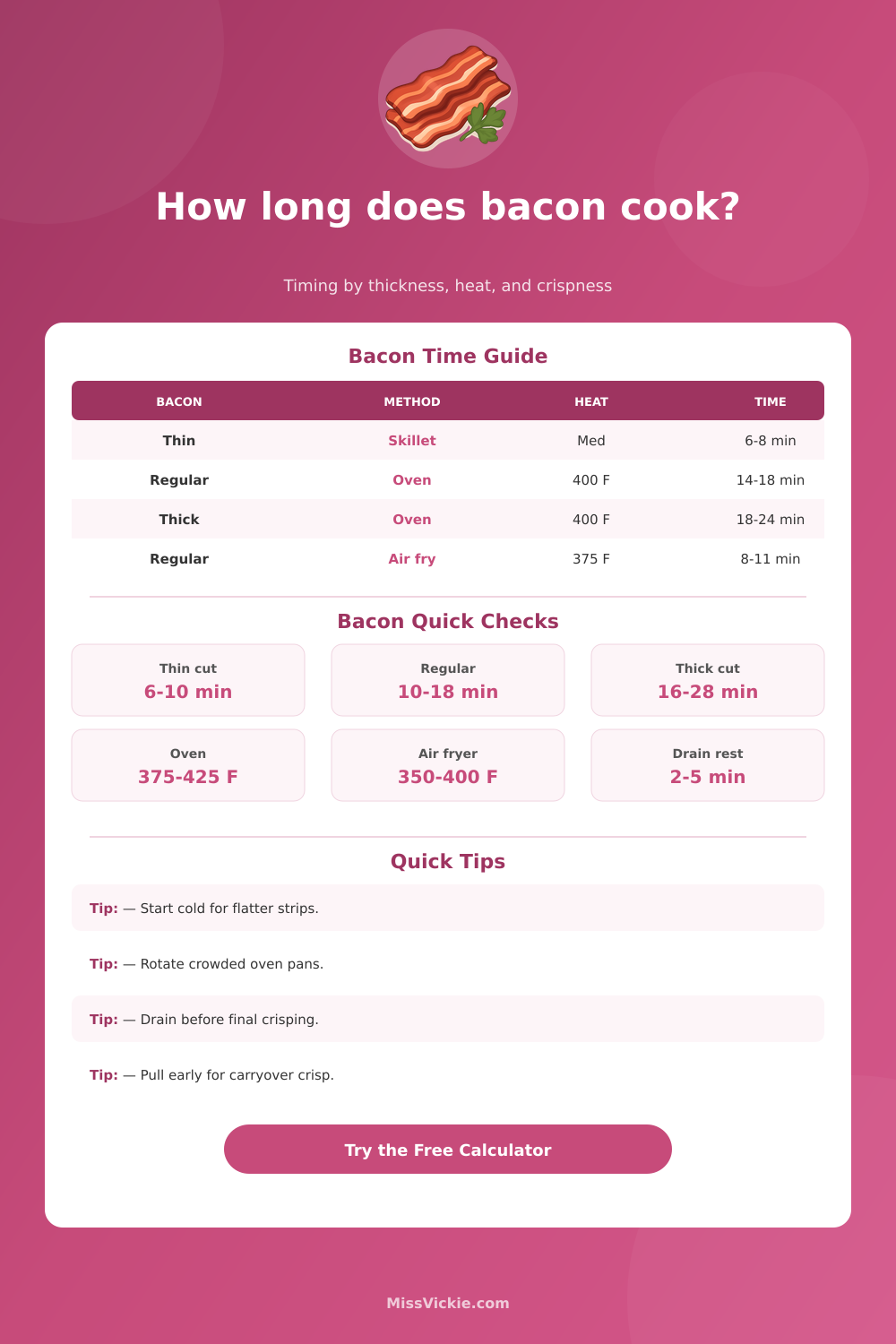
| Thin-cut pork bacon | Medium pan, 350-375°F oven | Skillet or parchment pan | 6-10 minutes |
| Regular sliced bacon | 375-400°F oven or medium pan | Sheet pan, skillet, or air fryer | 10-18 minutes |
| Center-cut bacon | 375-400°F | Sheet pan or skillet | 10-16 minutes |
| Thick-cut bacon | 375-400°F oven | Wire rack or drained pan | 16-26 minutes |
| Candied bacon | 325-375°F | Rack over lined pan | 20-30 minutes |
| Turkey bacon | 350-400°F or medium pan | Lightly oiled pan or air fryer | 6-12 minutes |
| Cooking method | Heat setting | When to check | Best use |
|---|---|---|---|
| Skillet | Medium to medium-low | After 4-5 minutes | Small batches with hands-on control |
| Oven sheet pan | 375-425°F | About 3 minutes before the low estimate | Flat, even batches for breakfast |
| Oven rack | 375-400°F | About 4 minutes before done | Thick bacon and cleaner rendering |
| Air fryer | 350-400°F | At the halfway mark | Fast crisp strips in small loads |
| Griddle | 325-375°F surface | When edges ripple and brown | Big diner-style batches |
| Microwave | High power | After 3-4 minutes | Quick small portions |
| Batch load | Timing effect | Texture effect | Adjustment |
|---|---|---|---|
| Single layer, spaced | Baseline | Even crisping | No extra time |
| Strips touching | Small delay | Softer edges | Add 5-8 percent |
| Crowded pan or basket | Moderate delay | Steamy center strips | Add 12-18 percent |
| Slight overlap | Large delay | Uneven browning | Separate and add time |
| Multiple trays | Oven recovery delay | Top and bottom differ | Rotate trays halfway |
| Serving style | Common portion | Cooked yield cue | Best crispness |
|---|---|---|---|
| Breakfast side | 2-3 strips per person | About 35-45 percent of raw weight | Balanced or crisp |
| Sandwich or burger | 2 strips per sandwich | Keep strips flat and wide | Crisp-chewy |
| Crumbles | 1-2 oz raw per salad batch | Cook until brittle after draining | Extra crisp |
| Appetizer platter | 2 strips per guest | Drain well before stacking | Crisp |
| Meal prep | 2 strips per portion | Pull slightly early for reheating | Chewy or balanced |
Timing is a planning estimate. Bacon thickness, sugar, pan color, appliance airflow, and actual heat can change the final window.
💡Bacon Timing Tips
The calculator above does it for you. It takes factors like pan crowding and thickness and spits out a specific timeframe in which to go wander around without worrying while your bacon sizzles.
Crispy strip of deliciousness, yes. Flaccid rubber band bacon, no. But neither do we want to burn the kitchen floor or set off the smoke alarm. Bacon cook time instinct say: crank up the heat and let’s get this party started. That is not usually so good. Because bacon cooking is much less a brute-force proposition different than a matter of controlling how the fat renders. And fat rendering is a slow chemistry experiment that demand patience.
How to Cook Bacon Perfectly
The one variable in determining cooking time that matters most for your bacon are thickness. Because thin-cut bacon doesn’t have as much meat between layers of fat, there is less meat to dehydrate. Look away for a moment and it’s gone, raw to burnt in a flash. With thick-cut bacon, there’s enough strength to let those strips stay on the heat longer without melting into nothingness. That’s what the algorithm accounts for when you choose your cut type in the tool, you’re giving it an idea of how much time it’ll take to draw moisture out of the meat before the sugars in the curing mixture start to caramelize. Ignore this variable and you’ll find yourself trying to treat thick bacon like thin, resulting in a tough, leathery piece that snap instead of bends.
But it’s not just about the temperature of your pan; it’s also about how you’re arranging the strips. Steam trapped inside (as happens if you crowd an oven rack or a skillet) doesn’t allow them to dry enough to get crispy on the outside. The tool takes that into account: Depending on if the strips are overlapping, touching, or spaced apart, it adjusts cook time accordingly. It is a little thing but it makes all the difference in the final product. For example, when you have a big batch going (like for a brunch spread), the calculator will recommend a longer time on crowded pans because they’ll need extra time to let the steam dissipate before taking on a crispiness from the browning process. You may be tempted to up the heat in an effort to make up for the overcrowding, but higher temps only burns the outsides and leave the insides raw.
When it comes to cooking, the physics are very different depending of method: if you’re using a skillet pan, you have full control; you can flip each piece of bacon one at a time (ideal for smaller batches), but crowding the pan traps steam and prevents it from crisping. If you bake them in the oven on a wire rack, gravity will pull some of the fat off the meat as it drips down. This makes each slice evenly crisp all around without ever having to turn them over. This is great if you need to make 10+ slices. Air fryers circulate hot air rapidly, which mimics the effect of deep frying with minimal oil. Different methods transfer heat differently onto the food’s surface and thus have a different pattern of timing.
That’s what the reference table on the page shows… You can visually see where maybe your instinct says your skillet time should be versus the time in your oven, etc. The one thing everybody ignores. This may be the single most critical step, is resting. After removing bacon from the heat, it continues to crisp a bit as the structure sets and the moisture dries out through the residual warmth. Take it off when it appears perfectly cooked in the pan, and chances are it will be overdone when plated. Let it get so brittle it falls apart when heated, and it will do the same on the plate. To compensate for this carryover cooking, the last number on the tool represent a rest period and guarantees you serve a piece that’s got just the proper combination of snap and flex.
You should of used it. Bacon’s no different: you need to respect the rendering process if you want good bacon. Pulling fat from the meat too quickly will ruin the texture. When you know which method to use, how thick or thin to slice the bacon, and how much space to leave between each piece, you don’t have to guess anymore. You’re cooking with purpose.
It’s about rendering the bacon properly, not simply cooking it, but getting the right amount of crisp and chew in every bite. With time, it’ll become naturaly. Once you get the rhythm down, the rest is instinctive. Having a starting point takes away the worry from your morning routine. Step back, breathe, make some coffee, and let the fat do its thing.