Apples Per Pie Calculator
Plan apple count for pie from pan diameter, apple variety, fruit size, slice thickness, filling depth, trim loss, top mound, and tartness target.
🥧Apple Pie Presets
Choose a pie style, then adjust the eight inputs to match your pan, apple bag, and filling texture.
⚖Apple Pie Inputs
Apple Pie Plan
Medium Granny Smith apples for a standard 9 inch pie.
Volume Breakdown
Apple Count Math
Prep Route
- Peel, core, and slice apples to the chosen thickness.
- Measure slices by cup if fruit size varies.
- Toss with sugar, starch, spice, and lemon.
- Mound fruit before adding the top crust.
🍏Apple Yield Snapshot
🧪Apple Variety Comparison
Great shape after baking with higher sugar needs.
Big slices and bright sweetness, often fewer apples per cup.
Silky filling and lower sugar, but more shrink risk.
Good all-purpose pie apple with steady structure.
Firm texture and lively flavor for tall pies.
Needs less sugar and a little lemon for lift.
Best mixed with firm apples or cut thick.
Half tart firm and half sweet aromatic apples.
📋Apple Variety Yield Table
| Apple variety | Bake behavior | Typical pie use | Sweetness adjustment |
|---|---|---|---|
| Granny Smith | Firm, lower shrink | Tart classic pies and deep dish | More sugar, modest lemon |
| Honeycrisp | Firm and juicy | Premium mixed pies | Moderate sugar, little lemon |
| Golden Delicious | Soft, mellow shrink | Silky filling and Dutch apple pies | Less sugar, more lemon |
| Braeburn | Firm with balanced juice | Reliable single-variety pie | Moderate sugar |
| Pink Lady | Firm and aromatic | Tall mound and lattice pies | Moderate sugar, light lemon |
| McIntosh | Soft and saucy | Blend with firmer apples | Lower sugar, thicker slices |
🥧Pie Size Apple Table
| Pie size | Prepared apple cups | Medium apples | Large apples |
|---|---|---|---|
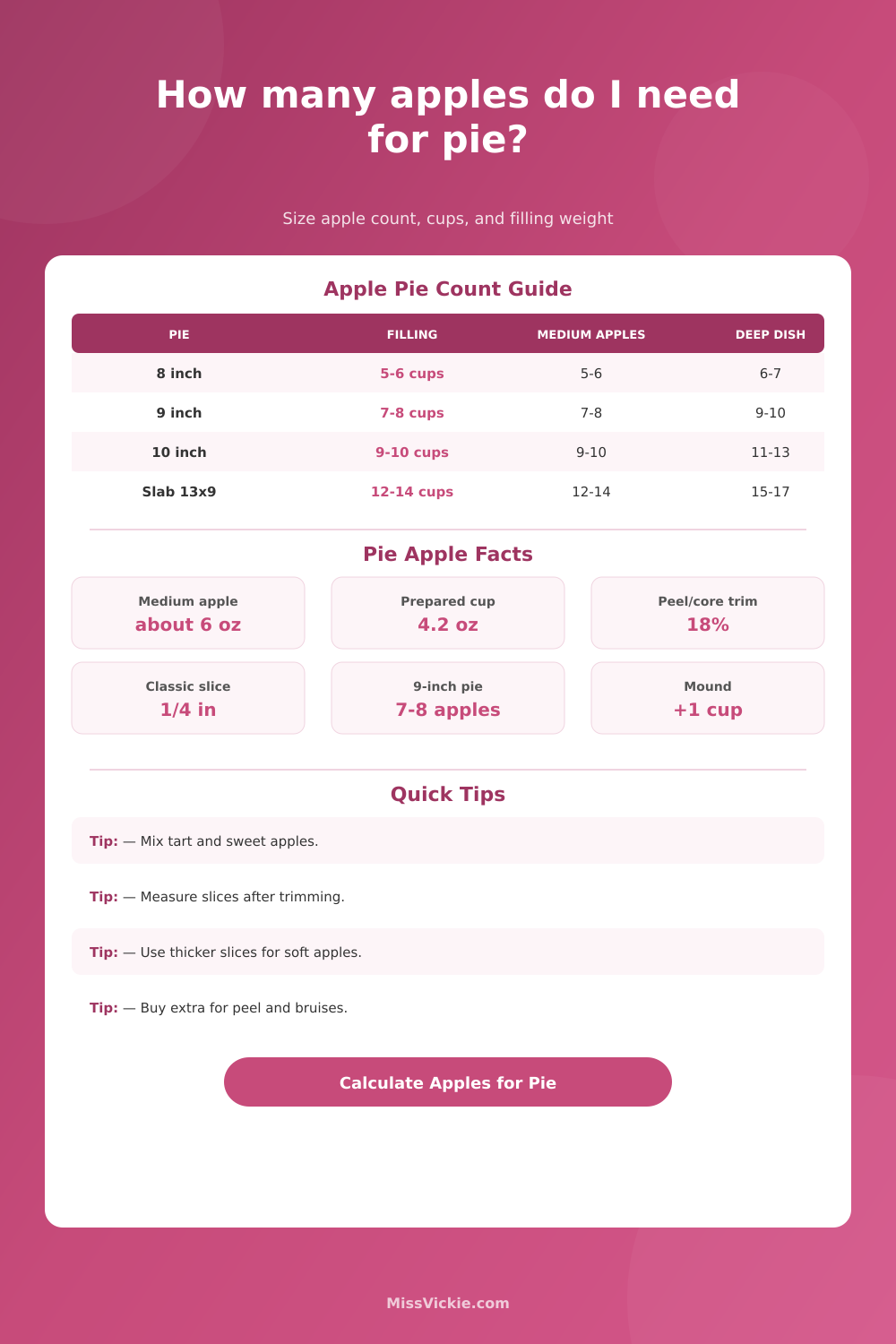
| 6 inch mini pie | 3 to 4 cups | 3 to 4 apples | 2 to 3 apples |
| 8 inch pie | 6 to 7 cups | 5 to 6 apples | 4 to 5 apples |
| 9 inch standard pie | 8 to 10 cups | 7 to 8 apples | 5 to 6 apples |
| 10 inch pie | 10 to 12 cups | 9 to 10 apples | 7 to 8 apples |
| Deep 9 inch pie | 10 to 12 cups | 9 to 10 apples | 7 to 8 apples |
| 13 inch round slab | 16 to 18 cups | 14 to 16 apples | 11 to 13 apples |
🔪Slice Thickness Table
| Slice style | Packing factor | Best apple type | Filling result |
|---|---|---|---|
| Thin 1/8 inch | 0.92x | Firm tart apples | Dense filling with fewer air gaps. |
| Classic 1/4 inch | 0.85x | Most pie apples | Balanced texture and reliable volume. |
| Thick 3/8 inch | 0.78x | Honeycrisp, Pink Lady, Braeburn | Chunkier bite and a higher apple count. |
| Chunky 1/2 inch | 0.70x | Soft apples or rustic pies | More gaps before baking, bold pieces after bake. |
🍬Tartness And Waste Table
| Setting | Calculator effect | Use when | Kitchen cue |
|---|---|---|---|
| Mellow and sweet | Lower lemon, lighter sugar for sweet apples | Fuji, Golden, family dessert pies | Warm spice leads the flavor. |
| Balanced pie tang | Classic sugar and lemon guide | Most apple pie recipes | Sweetness and acidity feel even. |
| Bright bakery tang | More lemon and a firmer tart profile | Rich crust, crumb top, or ice cream serving | Fruit flavor cuts through butter. |
| Sharp tart apple bite | Higher acid cue and careful sugar balance | Granny Smith fans | Tartness stays obvious after baking. |
| Normal peel and core | 18% whole-fruit loss | Clean grocery apples | Most pies fit this baseline. |
| Heavy trim | 24% to 30% whole-fruit loss | Bruised fruit or thick peel | Buy extra to protect filling volume. |
💡Apple Pie Tips
Amounts are practical kitchen estimates for apple pie filling. Follow your recipe for starch, sugar, crust handling, bake temperature, cooling, and food-safe storage.
Why didn’t I buy more apples? Will there be enough for a pie? Will it overflow and spill all over, looking like a puddle of filling? It’s a genuine concern.
Until you get to know how much fruit (or liquid) will fill your pan, it seems intuitive: You’ll just guess. When you start measuring by volume rather than by number, you’re in business. For instance, it computes how much apple is needed based off the type of apple (yes, they all behave slightly different in the heat) and the size of your pan. No more guessing what coefficient is or trying to do math in your head.
Why Use an Apple Pie Calculator?
Because if you’re using soft apples in a deeper dish pie, you’ll need to add extra fruit by weight. A McIntosh becomes sauce; a Granny Smith stays intact. The calculator take that into account automatically. It also accounts for shrinkage when it says how many apple to shop for. That way, you can plan for those eighteen percent trim losses that most home cooks leave themselves out of.
For example, people tend to believe that a medium apple yields six ounces of filling. In reality, it yield around four ounces when you remove the core, seeds, and skin. Thick slices create gaps in the pan, which is filled up with juice as they cook. Baked goods come out light and fluffy (less apple), but require more fruit to start. More time cutting; less apples needed by count.
Thin slices form tight stacks (like plates) and don’t waste much space. Less fruit needed by count, but it take longer to cut. Then there’s depth. In a typical pie, filling is roughly an inch beneath the lip of crust. A deep dish might be double that, and more. Depth doesn’t increase in proportion; it increases in cubes. Which is to say: One more apple won’t do job of that other half inch. Often, it take three more apples.
And then there’s that matter of the pile on top. The dome of fruit on the crust lip has to bear some serious weight to not slump over. If you want that domed-bakery-look, you’re going to have to build upward from the bottom without crushing all those apples below. For that, you should of needed more apples.
To determine how many fruits you’ll use, and adjust amount of sugar and acid (tartness) that’s part of your blend: When using sweet apples (such as Golden Delicious or Fuji), they naturaly release more juice and require less added sugar; with the tart ones (such as Granny Smith), less sweetness is released and they benefits from extra additions of honey or brown sugar to coax out their flavors. To get it right, combine equal parts sweet and tart varieties. This balances the tart-sweet ratio and adds enough body from firmer apples. It also add aromatic complexity through their softer counterparts.
Even though we have this tool, measuring prepped cups is still way to go. Apples come in all sizes from the grocery store. Some bags has giants, others have tiny ones. Counting or weighing each batch will eliminate that variation. Longer up front, less stressful down the road. Measure, Slice, Toss with Spices. Perfect layers of spice and fruit in each slice. No more boiled crust or thin fillings ever again.