How Much Sugar for Apple Pie Filling Calculator
Calculate sugar for apple pie filling from apple tartness, cup or weight batch size, thickener choice, crust sweetness, lemon, spice, and filling style.
Load a realistic pie scenario, then adjust the apples, thickener, crust, and sweetness target to match your kitchen.
Apple Pie Filling Sugar Breakdown
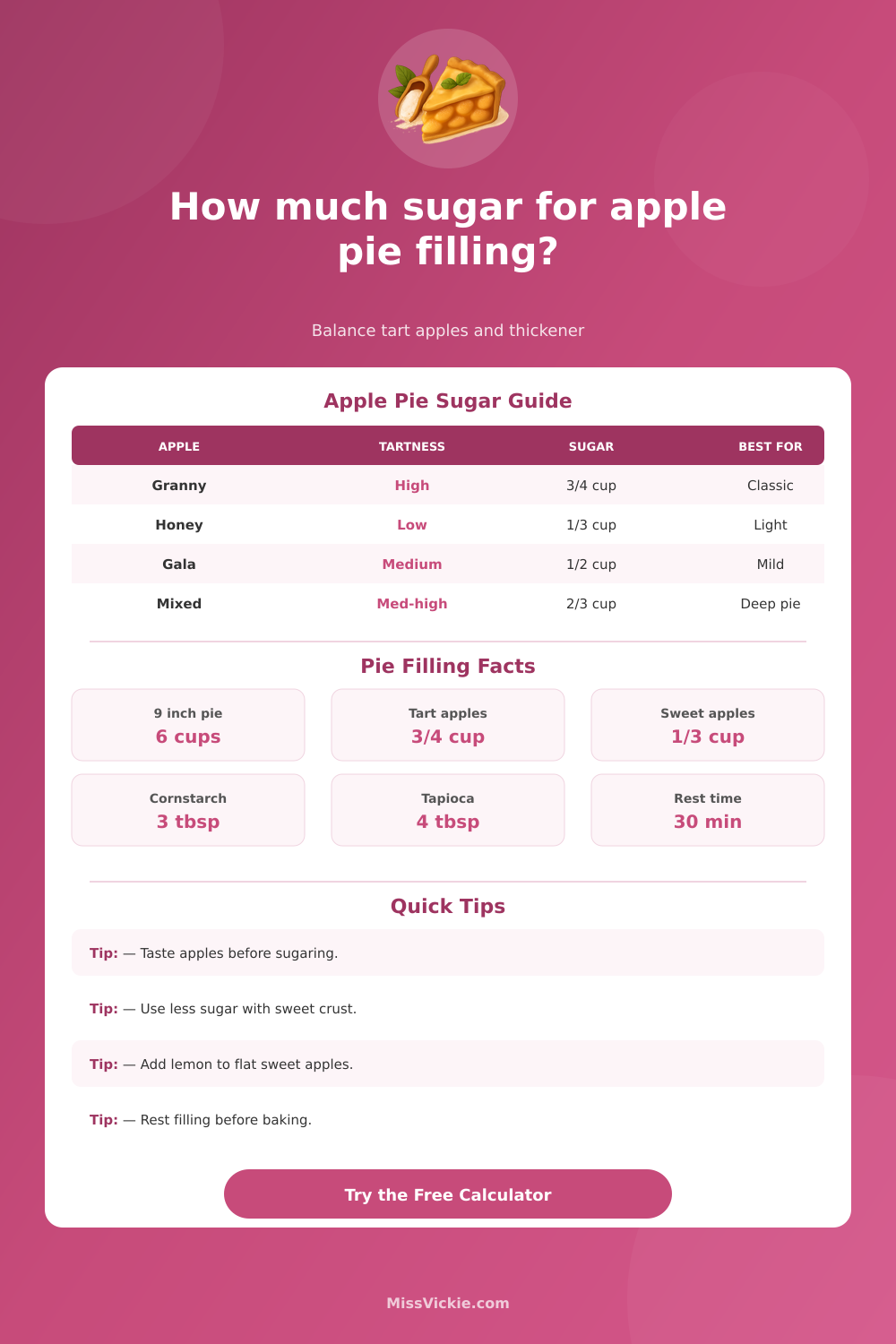
| Apple Type | Tartness Level | Sugar for 6 Cups Apples | Filling Note |
|---|---|---|---|
| Granny Smith | High, sharp acid | 2/3 to 3/4 cup | Classic bright pie flavor; needs enough sugar to round the edge. |
| Braeburn or Pink Lady | Medium-high | 1/2 to 2/3 cup | Good balance for double crust pies without tasting flat. |
| Honeycrisp or Jonagold | Balanced sweet-tart | 1/2 cup | Usually sweet enough for a lighter filling. |
| Gala or Golden Delicious | Mild and sweet | 1/3 to 1/2 cup | Use lemon to keep the filling lively. |
| Fuji | Very sweet | 1/4 to 1/3 cup | Best when blended with a tart apple for pie structure. |
| Mixed apples | Depends on blend | 1/2 to 2/3 cup | Taste after slicing and before adding thickener. |
| Thickener | Typical Amount for 6 Cups | Sugar Effect | Best Use |
|---|---|---|---|
| All-purpose flour | 1/4 cup | Needs moderate sugar to avoid pasty flavor | Rustic pies with soft, home-style filling. |
| Cornstarch | 3 tablespoons | Works well at classic sugar levels | Clean slices when the pie cools fully. |
| Instant tapioca | 4 tablespoons | Handles juicy sweet apples nicely | Deep dish and juicy apple blends. |
| Cook-type ClearJel | 3 tablespoons | Stable with lower or higher sugar | Freezer filling and make-ahead pies. |
| Starch blend | 2 tbsp cornstarch plus 2 tbsp flour | Forgiving when sugar is reduced | Balanced texture for family pies. |
| No thickener | None | Sugar draws juice faster | Only for very small tarts or reduced cooked filling. |
| Prepared Apples | Light Sugar | Classic Sugar | Deep Sweet Sugar |
|---|---|---|---|
| 4 cups / 480 g | 1/4 cup | 1/3 cup | 1/2 cup |
| 6 cups / 720 g | 1/3 cup | 1/2 cup | 2/3 cup |
| 8 cups / 960 g | 1/2 cup | 2/3 cup | 7/8 cup |
| 10 cups / 1.2 kg | 2/3 cup | 3/4 cup | 1 cup |
| 12 cups / 1.44 kg | 3/4 cup | 1 cup | 1 1/3 cups |
| 18 cups / 2.16 kg | 1 1/8 cups | 1 1/2 cups | 2 cups |
| Sugar Type | Weight per Cup | Flavor Impact | Adjustment Note |
|---|---|---|---|
| Granulated sugar | 200 g | Clean sweetness | Use as the baseline for most recipes. |
| Light brown sugar | 213 g packed | Caramel and molasses | Use slightly less if the crust or topping is sweet. |
| Half white, half brown | 206 g average | Balanced caramel | Good for cinnamon-forward fillings. |
| Maple sugar style | 180 g | Maple warmth | Use by weight for steadier sweetness. |
| Coconut sugar | 160 g | Toasty and darker | May taste less sweet, so avoid over-reducing. |
Sugar pulls juice while the oven preheats. Good for most everyday pies.
Drain or reduce the syrup, then use slightly less sugar in the final filling.
Cooked apples taste sweeter because moisture is reduced before baking.
A small sugar cushion protects texture and flavor after thawing.
Determining the correct amount of sugar for the apple pie filling are an important part of the recipe. The amount of sugar that is used will determine the flavor of the apple pie filling. If there is too little sugar, the filling will taste sharply.
However, if there is too much sugar, the apples will lose there flavor and the filling will taste like candy. Thus, the flavor of the apple pie filling will depend upon the way in which the apples behave when cooked and how the remaining ingredients interacts with the sugar. Some varieties of apples contain more acidity than others, as well as contain more natural sugars than other varieties.
How Much Sugar to Use in Apple Pie Filling
For instance, Granny Smith apples are more acidic than sweeter varieties like Honeycrisp or Fuji apples. The calculator allows for the type of apples and the tartness of the apples to be entered to determine the amount of sugar that is require for those specific apples. The type of thickener that is used will also affect the amount of sugar that is required for the filling.
For instance, cornstarch thickens with the standard amount of sugar, but flour-based thickeners may mute the tartness of the apples. If the tartness of the apples is to be muted by the use of flour, more sugar would be added to even out the flavor of the filling. Similarly, tapioca can handle extra juice from the sliced apples, which would prevent the filling from being too runny, meaning that less sugar would be require if tapioca was utilized as the thickener.
These thickeners is included in the calculator to indicate how the thickener can change the amount of sugar that is required for the filling. Finally, the type of crust for the pie will impact the amount of sugar that is required for the apple pie filling. For instance, if a double crust with unsweetened dough is used, the filling can be sweet.
However, if a crumb topping is utilized, that topping contains its own sugar. Thus, the amount of sugar can be less in the filling if a crumb topping is used. Finally, if hand pies or turnovers is utilized, the lack of moisture that remains in the filling will make the apple pie filling taste more concentrated.
These crust styles are included in the calculator to account for these variables. The use of lemon juice and butter will affect the taste of the sugar in the filling. The acid from the lemon juice will even out the sugar in the apples.
Additionally, the richness of the butter may allow for less sugar to be used. These ingredients are accounted for in the calculator to provide the proper amount of sugar based off the remaining ingredients. Many cooks use the same recipe for their apple pie fillings for every batch of pies that are prepared.
However, the amount of sugar that is required may change with the type of apples that are used. For instance, apples that are grown and harvested earlier in the season are often more tart than apples that are harvested later in the growing season. Additionally, apples that are stored for long periods of time may lose some of their flavor.
Thus, the tartness and target sweetness can be adjusted in the calculator for every batch of pie that is prepared. It is important to allow the apple pie filling to rest prior to baking the pie. Allowing the pie to rest permits the sugar to draw the juice from the sliced apples.
Thus, this is a means of testing whether the amount of sugar that is to be used in the pie is correct. For instance, if the apples release a great deal of liquid after resting the filling for twenty minutes, the sugar is performing its function within the pie. However, if the apples do not release any liquid, the amount of sugar is too low for the batch of apples to be used in the pie.
Finally, the batch size will affect the amount of sugar that should be used in the pie. For instance, a single batch of nine-inch pies will require a different amount of sugar than a slab pie or a double batch of nine-inch pies. However, the ratio of sugar to apples will remain the same for each batch size.
Freezer fillings and precooked fillings require a different amount of sugar than other fillings. For instance, because the apples are frozen and thawed, a small amount of extra sugar must be added for the proper texture of the apples after they have thawed. Additionally, because moisture will evaporate during the precooking process, less sugar will be required for precooked fillings.
These options are accounted for in the calculator. The reference tables include the amount of sugar for common varieties of apples and thickeners. These tables can help to determine whether the amount of sugar that is being used for a batch of apples is normal or abnormal.
The reference tables and calculator will help to ensure that the amount of sugar for the apple pie filling is correct. Finally, spices and types of sugar can impact the amount of sugar that is required for the pie. For instance, spices like cinnamon and other warm spice blends make the apple pie filling taste sweet, which may allow for the reduction of the amount of sugar that is used.
Additionally, the use of brown sugar introduces the sugar flavor that is often recognized as caramel flavor, which also allows for the reduction of the amount of sugar that is used in the pie. These variables may be adjusted in the calculator to determine the proper amount of sugar to be used in the pie. Another way to determine if the amount of sugar that is to be used in the pie is correct is to taste one of the pies once it is cool and cut into it.
The filling should hold its shape but not be stiff. Additionally, the apples should taste like fruit. If the filling is too runny or flat, the amount of sugar was incorrect.
If the filling tastes like candy, the amount of sugar was too high for the type of apples or crust. Baking numerous batches of pies will allow an individual to understand the behavior of their local apples and how their oven impacts the flavor of the pie. Furthermore, the calculator will help an individual to understand these relationships between the various ingredients in the pie.
After cooking numerous batches of pies using the calculator, an individual will be able to recognize the amount of sugar that is required for various types of apples without having to use measuring cups for the sugar. Thus, with time and experience, each individual can find the proper amount of sugar for various types of apples so that the pie has the proper flavor to it.