🍎 Sugar in Apple Juice Calculator
Find out exactly how much sugar is in your apple juice serving — in grams, teaspoons & % of daily limit
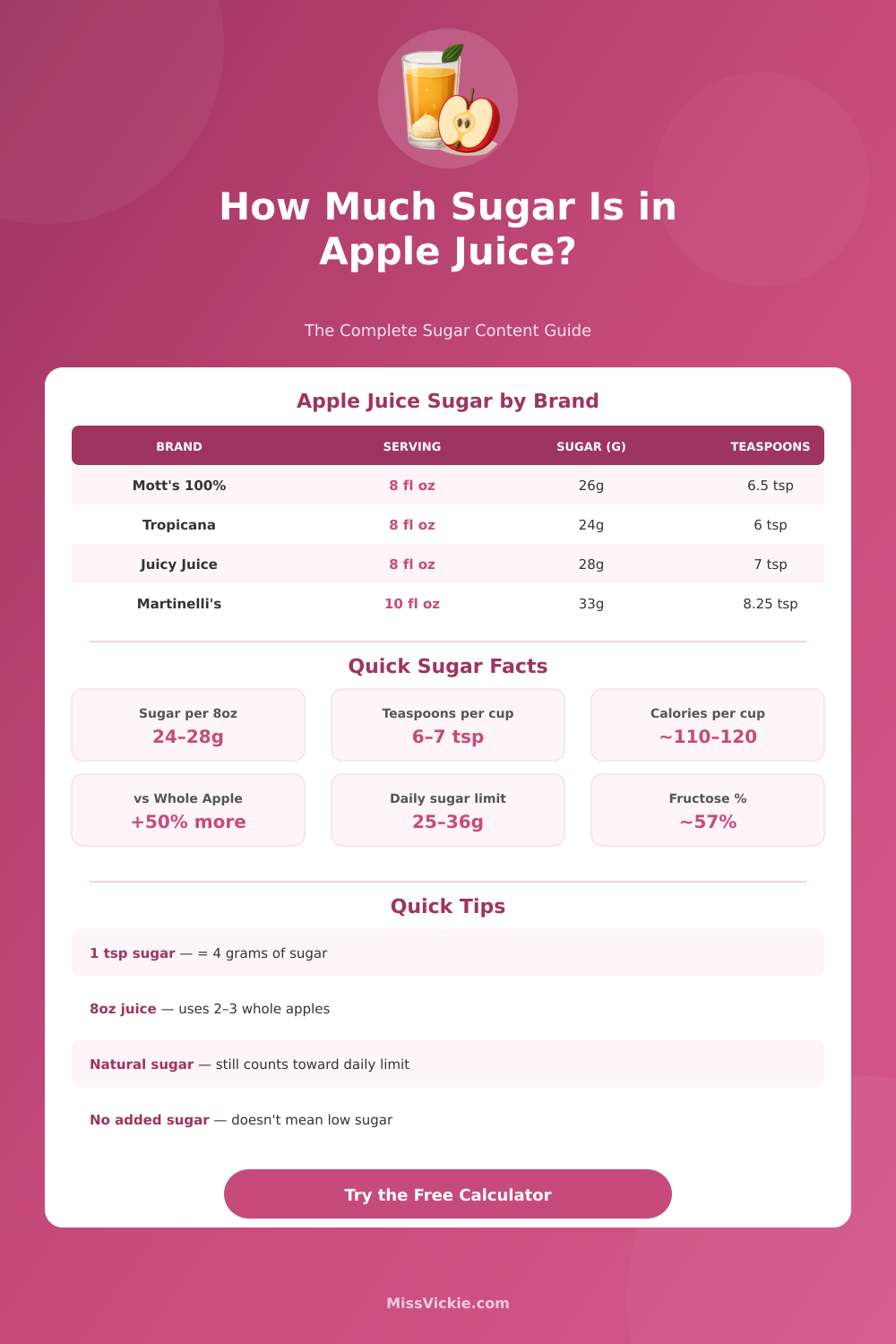
| Brand / Type | Sugar (g) | Teaspoons | Calories | % Female Daily Limit |
|---|---|---|---|---|
| Mott's 100% Apple Juice | 26g | 6.5 tsp | 120 | 104% |
| Tropicana 100% Apple | 24g | 6 tsp | 110 | 96% |
| Juicy Juice 100% | 28g | 7 tsp | 120 | 112% |
| Martinelli's Sparkling | 28g | 7 tsp | 120 | 112% |
| Great Value (Walmart) 100% | 27g | 6.75 tsp | 120 | 108% |
| Organic 100% Apple Juice | 26g | 6.5 tsp | 115 | 104% |
| Fresh Pressed / Cold Press | 24g | 6 tsp | 112 | 96% |
| From Concentrate | 26g | 6.5 tsp | 118 | 104% |
| Apple Juice Drink (10%) | 6g | 1.5 tsp | 40 | 24% |
| Apple Cider (unfiltered) | 24g | 6 tsp | 115 | 96% |
| Serving | fl oz | mL | Sugar (g) | Teaspoons | Calories |
|---|---|---|---|---|---|
| Kids Juice Box | 6.75 | 200 | 23g | 5.75 tsp | 97 |
| Half Cup | 4 | 120 | 14g | 3.5 tsp | 57 |
| Standard Glass | 8 | 240 | 27g | 6.75 tsp | 114 |
| Large Glass | 12 | 355 | 40g | 10 tsp | 171 |
| Juice Can | 11.5 | 340 | 38g | 9.5 tsp | 164 |
| Martinelli's Bottle | 10 | 296 | 33g | 8.25 tsp | 140 |
| 16 oz Bottle | 16 | 473 | 54g | 13.5 tsp | 228 |
| 32 oz Carton | 32 | 946 | 107g | 26.75 tsp | 456 |
| Source | Serving | Sugar (g) | Fiber (g) | Glycemic Index |
|---|---|---|---|---|
| Medium Apple (raw) | 1 apple (~182g) | 19g | 4.4g | 36 |
| 100% Apple Juice | 8 fl oz (240mL) | 27g | 0.2g | 44 |
| Apple Cider (unfiltered) | 8 fl oz (240mL) | 24g | 0.5g | 40 |
| Applesauce (unsweetened) | 1/2 cup (122g) | 10g | 1.3g | 35 |
| Sugar Type | % of Total Sugar | Per 8 fl oz (g) | Notes |
|---|---|---|---|
| Fructose | ~57% | 15.4g | Metabolized by liver |
| Glucose | ~27% | 7.3g | Direct blood sugar raise |
| Sucrose | ~16% | 4.3g | Glucose + fructose bond |
| Sorbitol | trace | ~0.5g | Sugar alcohol |
| Group | Daily Limit (g) | Teaspoons | 8oz Juice = % of Limit |
|---|---|---|---|
| Women (AHA) | 25g | 6 tsp | 108% |
| Men (AHA) | 36g | 9 tsp | 75% |
| Children age 2–18 (AHA) | 25g | 6 tsp | 108% |
| WHO Recommendation | 25g (ideal <12.5g) | 6 tsp | 108% |
apple juice is made up of fruit liquid, that one prepares by pressing apples. One can process it with enzymes and spinning methods to remove starch and pectin. Those materials care about keeping tiny particles floating.
At the end one heats the juice, so that it can be stored in glass bottles or other containers.
Making Apple Juice and What It Is
Bright apple juice comes from ripe and juicy apples, without extra sugar or too much corn syrup. The organic kinds choose ripe and juicy organic apples, while one keeps everything simple and healthy. Some bottled organic apple juices appear packed in 32-ounce glass bottles and they are without gluten, USDA-organic and verified by the No-GMO-Draft.
Between apple juice and apple cider there is a clear difference. Apple juice usually is a more processed product compared to apple cider. One prepares cider from whole apples, with skins and seeds almost not squeezed.
It genuinely looks like puree. On the contrary, juice passes through screening and stays clear. When one can see the back of teh label through the bottle, it is juice.
When the liquid seems cloudy, it is cider.
apple juice stores more calories and sugar than orange juice. Even so it does not have much sodium. The juice gives liquid energy, that does not fill you as well as solid food.
Full fiber in hole apples helps you feel full. Apple juice lacks fiber, because it exists only as liquid. It well kills thirst, but the belly stays hungry.
Use apple juice in the right amounts, just like any other drink.
The kind of apples that one uses makes a big difference. Apples with high bitterness give bitter taste to the juice. Sweet apples of low bitterness result in a sweeter drink.
By blending apples with high and low bitterness one reaches a final balance between sweetness and bitterness. Apple juice has high sweetness with only gentle flavor. Other juices, especially the bitter and strong ones, commonly beat the apple flavors.
In the kitchen apple juice is also very useful. It goes well with dressings, sauerkraut, stuffings, sauces and marinades. With it one adds a bit of sweetness, to balance salty and bitter tastes.
Reduced apple juice, with herbs, spices and bourbon, creates a wonderful glaze for pig and chicken. One can use it even for marinating, although long marinating times with apple juice can change thestructure of the meat.
Home prepared apple juice is possible. One method includes softly boiling apple peels and cores with water and sugar, to have a light and refreshing drink. Homemade juice commonly looks like skin water, but it has wonderful taste.
The polyphenols in the juice have antioxidant traits, that could help defend the brain against harm caused by unstable molecules, called free radicals.