🍎 Fiber in Apple Juice Calculator
Find out exactly how much fiber is in your apple juice serving — and how it compares to whole apples
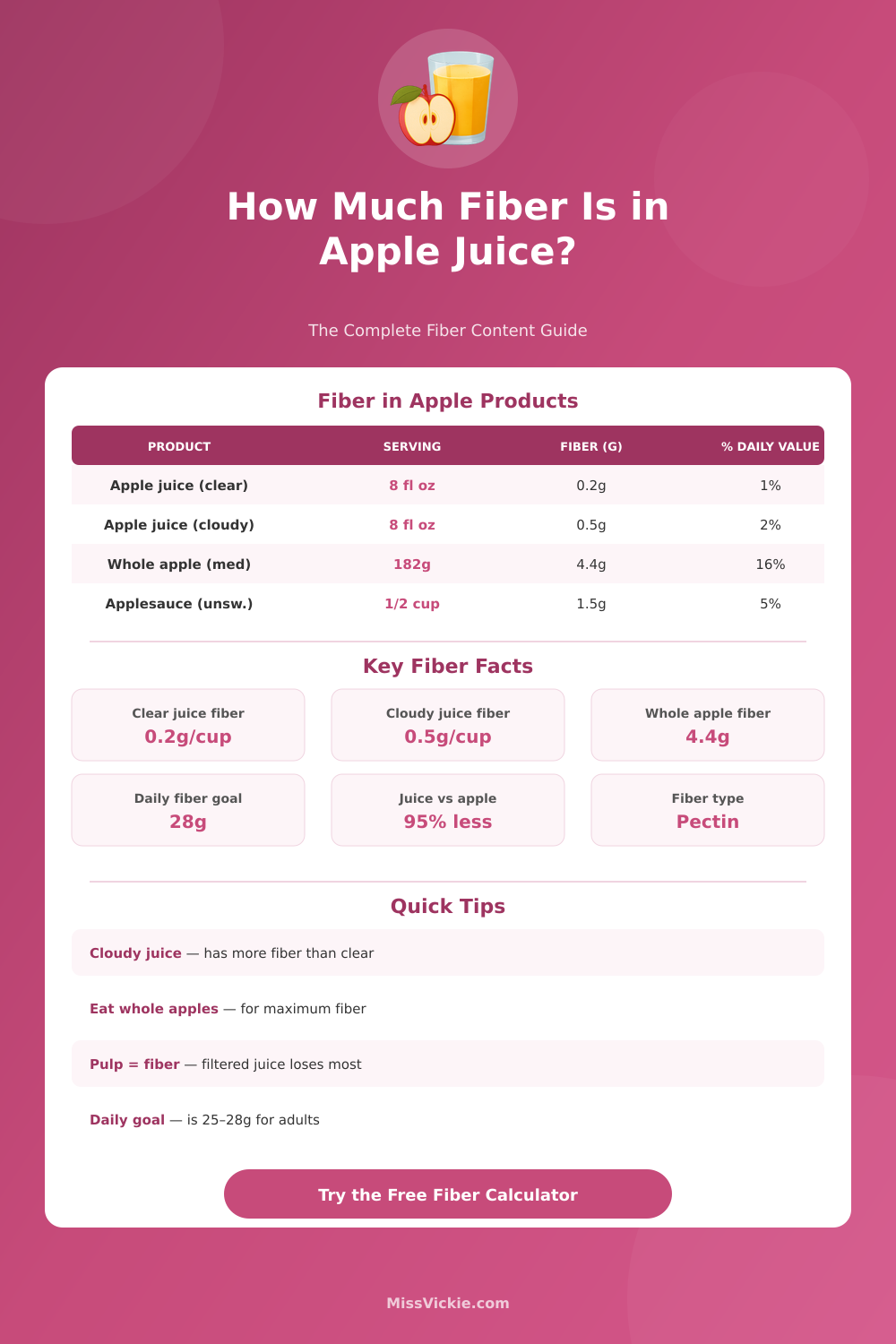
| Product | Serving Size | Fiber (g) | % Daily Value | Fiber Type |
|---|---|---|---|---|
| Clear apple juice (filtered) | 8 fl oz (240mL) | 0.2g | 1% | Mostly soluble |
| Cloudy apple juice (unfiltered) | 8 fl oz (240mL) | 0.5g | 2% | Soluble + pectin |
| Apple juice with pulp | 8 fl oz (240mL) | 1.0g | 4% | Soluble + insoluble |
| Fresh-pressed apple juice | 8 fl oz (240mL) | 0.7g | 3% | Pectin + soluble |
| Apple juice from concentrate | 8 fl oz (240mL) | 0.2g | 1% | Minimal |
| Whole apple (with skin) | 1 medium (182g) | 4.4g | 16% | Soluble + insoluble |
| Whole apple (without skin) | 1 medium (182g) | 2.1g | 8% | Mostly soluble |
| Unsweetened applesauce | 1/2 cup (122g) | 1.5g | 5% | Soluble + pectin |
| Dried apple rings | 1/4 cup (27g) | 2.0g | 7% | Concentrated fiber |
| Apple cider (unfiltered) | 8 fl oz (240mL) | 0.5g | 2% | Soluble + pectin |
| Serving | fl oz | mL | Fiber (g) | % DV (28g goal) |
|---|---|---|---|---|
| Juice shot | 2 fl oz | 59 mL | 0.05g | <1% |
| Kids juice box | 4 fl oz | 118 mL | 0.10g | <1% |
| Standard glass | 8 fl oz | 240 mL | 0.20g | 1% |
| Large glass | 12 fl oz | 355 mL | 0.30g | 1% |
| Extra-large glass | 16 fl oz | 473 mL | 0.40g | 1% |
| Juice can (standard) | 11.5 fl oz | 340 mL | 0.29g | 1% |
| Juice bottle | 32 fl oz | 946 mL | 0.80g | 3% |
| Half gallon | 64 fl oz | 1893 mL | 1.60g | 6% |
You get Apple Juice by simply pressing the apples, clearly and without problems. Later, one treats the juice with enzymes and runs it through a centrifuge to remove the starch and pectin, those are the substances that keep the good particles and block clear juice. When that ends one heats it and pours it in glass bottles or in that packaging that most suits.
The best Apple Juice depends on what enters in the bottle. One wants rich, juicy apples without extra sugar and certainly without that high-fructose corn syrup. The organic version follows the same idea (rich organic apples), nothing added, nothing extra.
How Apple Juice Is Made and Used
Many bottled organic options come in 32-ounce glass bottles and have all the marks: without gluten, certified by USDA as organic and confirmed by Non-GMO Project.
Here something useful to know: Apple Juice stores more calories and sugar than orange juice. For an 8-ounce serving of plain Apple Juice, there are only around 10 milligrams of sodium, so sodium really does not matter. The problem is that juice gives liquid caolries that does not fill you like solid food does for your body.
If one replaces water with big amounts of Apple Juice, that does not help a lot. One apple gives maybe a third of a cup of juice, but when you drink it, you usually consume more than that, which means that you pick up much more sugar without you noticing.
Apple Juice has polyphenols that work as antioxidants and can protect your brain against damage from free radicals. Also, there are signs that it can help your gut bacteria. It seemingly relates to improvements for constipation, hart health and liver work, and some studies link it also to benefits for asthma.
Apple Juice and apple cider are not the same, not even close. Juice is the cleaner product. One does cider from whole apples, only removing the stems and seeds, so it is basically puree.
Juice on the other hand one filters until it becomes crystal clear. The simplest way to tell? Raise the bottle to light.
If you can clearly see through it to the label left, that is juice. If it is cloudy and dark, you see cider.
Besides drinking it directly, Apple Juice works surprisingly for cooking. It goes well in brines and sauerkraut, where the little sweetness balances the sourness and salt. One can use it in stuffings, sauces and marinades.
For a marinade of pork, Apple Juice goes well with lemon juice, flavor and a bit of sweet. It helps even in big amounts, when one brines ham.
The kind of apple matters more than many folks know. Apples with high bitterness give bitter juice, while sweeter, low-bitter kinds make something sweeter and gentle. Mixing the two kinds helps to reach balance.
Apple Juice itself has enough sweetness, but the tastes are really subtle. Strong juices can easily beat it. So itmatters to balance with any pure juice, so that it does not hurt.