
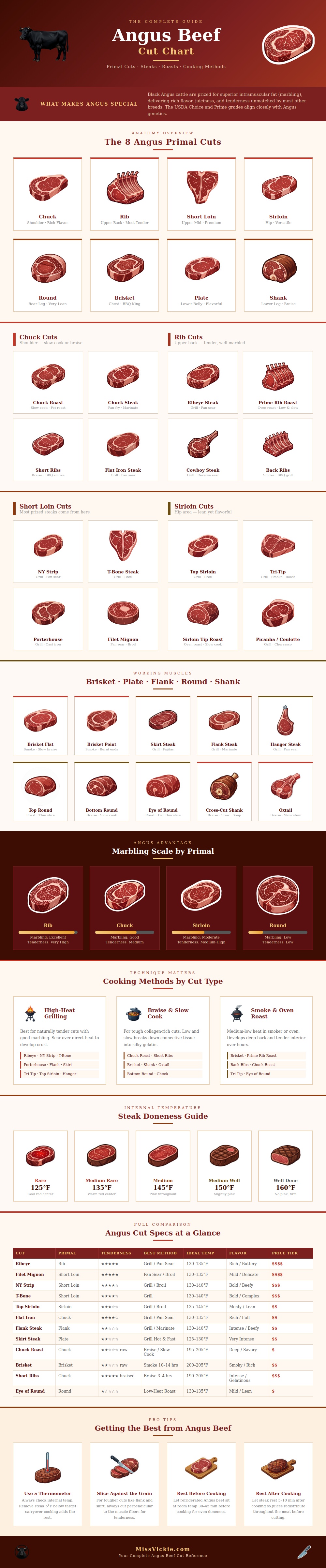
An Angus beef cut chart is a map of the animal to the dish. Without this chart you’re largely guessing when picking the right cut, You’ll see cuts called sirloins and chucks, tenderloins. These names mean nothing until you know their location on the animal. Once you have that, the rest make sense.
This is called marbling which means there is more intramuscular fat in Black Angus cattle. It is more than just how it looks. As fat melts when cooked, it bastes meat from within, giving you a richer flavor then leaner meats.
How to Cook Different Beef Cuts
Marbling also differ greatly by primal section. Because the rib area is a relatively inactive muscle, it ranks high on both tenderness and fat content. Compare that to cuts from rear leg (round). They’re dense, lean muscles that does all the work of walking and standing. Treat them accordingly.
Three general cooking philosophies are grouped on the chart: roasting in the oven, braising (low and slow), and grilling (high heat). There’s no point in trying to grill a chuck roast for three minutes on a hot grill. That shoulder meat is loaded with connective tissue (collagen) that require time and moisture to break down into gelatin. Cook it quickly, and it will remains tough.
This is where people go astray. They think all beef should of being cooked like steak, unaware of the differences among different parts of animal.
At the top of the chain are the rib and short loin. From there you get steaks like ribeye, New York strip, filet mignon, and T-bones. They’re naturaly tender because the corresponding muscles didn’t have much to do. This is where the marbling in the Angus realy comes into its own.
Fat distribution on a quality ribeye is just great. It prevents drying out. Cook these over high heat until the outside form a nice crust, but inside stays rare/medium-rare. Control the temperature, baby. If you pull it five degrees shy of done, the carryover cooking will take care of it for you without destroying the texture.
Then there’s the other end of the spectrum with chuck and sirloin cuts. They are flavorful, but potentially tougher. While top sirloin will work well on the grill (as long as it doesn’t get cooked to much) it’s not going to have that same rich fat cap as a ribeye. And then there’s the chuck: patience pays off big time here. Slow-cooked pot roasts and braised short ribs goes from chewy to tender.
Connective tissue dissolves, turning what was once hard work into melting tenderness. Chemistry is at work. Respect must be paid to the hard-working muscles such as round, skirt, flank and brisket. To make brisket tender requires many hour of smoking. Flank and skirt steaks makes great fajitas, if sliced across (against) the grain.
Shortening those muscle fibers by cutting perpendicular to their direction allow for easier chewing in every bite. It is a little trick, but it makes all the difference between a tough meal and a pleasing one. Eye of round is highly lean with potential for being lightly roasted at low temperatures, ideal for deli-style slices.
But no matter what cut, no matter the cooking time (from a 10-hour-smoked brisket down to a quick grilled hanger steak), resting the cooked meat is not optional. Without it, juices spill out onto the cutting board and don’t get re-distributed throughout the rest of the meat. If you want a juicy, flavorful piece of meat, you need to let it rest.
Knowing about the cuts will transform the way you shop. Instead of just “beef” you’ll see specific cuts for specific dish. By knowing what muscle is attached to each of those names, you’re able to plan your meal confidently, pairing the cut to the technique that will bring out its best. Knowing this turns an overwhelming counter into a well-lit path of potential.