Miss Vickie Kitchen Calculator
Almond Flour to Coconut Flour Conversion Calculator
Convert an almond flour amount into a coconut flour starting point, then adjust the eggs, liquid support, recipe moisture, recipe type, and final texture target before you bake.
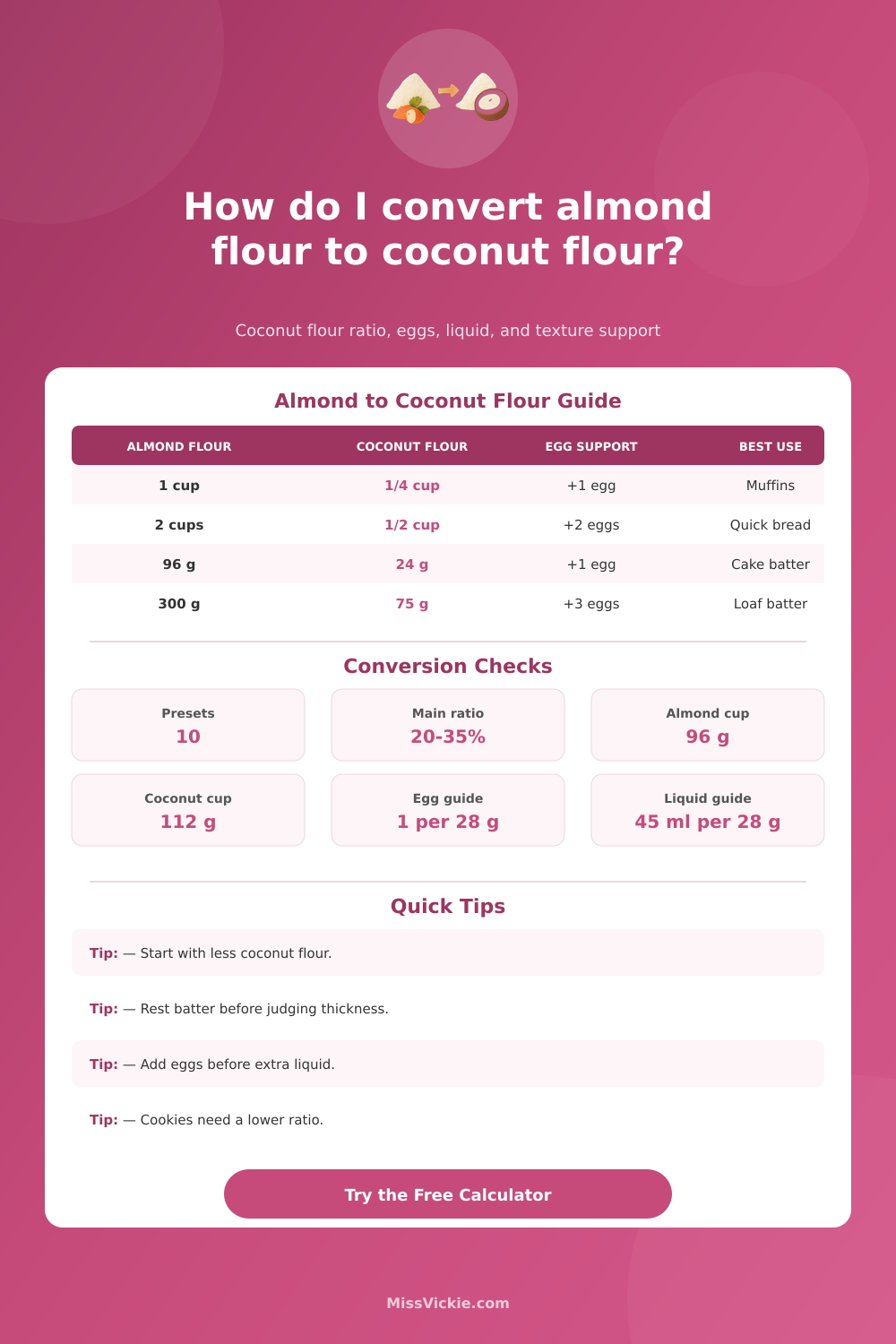
Coconut flour is more absorbent than almond flour, so these presets start with conservative ratios and add structure support instead of making a one-for-one swap.
Coconut Flour
0 g
about 0 cup
Egg Support
0 eggs
structure support
Liquid Support
0 ml
add gradually
Batter Rest
8 min
balanced crumb
Classic Muffin Starting Point
Cookie and Bar Starting Point
Quick Bread Starting Point
Pie Crust Starting Point
Egg support
Liquid support
Moisture level
Texture target
Almond Flour
Higher fat, mild sweetness, tender crumb, and less absorbency. It adds richness and bulk but can bake dense if overused.
Coconut Flour
Very absorbent, high fiber, and lighter by volume. It needs eggs and liquid because a small amount thickens batter quickly.
Almond Meal
Coarser than fine blanched almond flour. It can make rustic cookies and crusts but is not an exact cup match for fine flour.
Oat Flour
More starchy and less fatty than almond flour. It behaves differently and does not need the same egg support as coconut flour.
All-Purpose Flour
Contains gluten-forming proteins. It cannot be compared directly with almond or coconut flour in low-carb recipes.
Nut-Free Blends
Often combine seed flour, starch, and binders. Treat them as their own formula rather than a direct coconut flour swap.
This grid is meant for recipe troubleshooting. The calculator focuses on almond flour to coconut flour only because coconut flour absorption changes the whole batter system.
When converting a recipe that use almond flour to one that uses coconut flour, there are some important considerations. Because almond flour and coconut flour behave differently in the batter when cooked, a simple substitution of one for the other will produce incorrect results. To create the correct texture for the baked goods, you must find a method of converting almond flour to coconut flour that takes into account the types of flour that is to be used, the amount of fat that is contained in that flour, and how each type of flour will interact with the other ingredient in the recipe.
Coconut flour is made from the solids that remain after the milk or oil is pressed out of an coconut. These solids contain mostly fiber. Almond flour, in contrast, is made from ground almonds, which contain natural oil.
How to Change Almond Flour Recipes to Use Coconut Flour
Because coconut flour is deficient in the amount of fat that almond flour contains, you must add additional liquid and egg to the batter made with coconut flour. A conversion calculator can be used to determine the amount of coconut flour that should be used in the recipe in place of almond flour, as well as the additional amount of both liquid and eggs that will be necessary. The conversion ratio is the amount of coconut flour that is used relative to the weight of the amount of almond flour that was used in the original recipe.
Coconut flour is highly absorbent, so many recipe use a ratio of coconut flour to almond flour of between 20 and 30 percent. The ratio may need to be higher for items like bread, compared to items like cake. Additionally, the moisture content of other ingredients in the recipe should also be considered.
Ingredients like applesauce, yogurt, or pumpkin will add moisture to the recipe, which will impact the amount of additional liquid that is to be added. Eggs are used in baked goods for their ability to bind the ingredients together. Coconut flour does not contain the same binding properties as almond flour.
However, almond flour contains natural fats that provides some binding properties to the baked goods. The binding properties of coconut flour are essentially nil, which is why eggs is required in baked goods that use coconut flour instead of almond flour. A conversion calculator will provide an egg rate based on 28 gram of coconut flour.
For items like delicate cakes, it is best to use the full amount of eggs that are indicated in the recipe. For items like cookies and pie crusts, however, it may be necessary to use less of the additional liquid because too much liquid can make the cookies soft rather than crisp. It is also important to allow the baked goods to rest after the ingredient have been mixed together.
Coconut flour absorbs the liquid in the batter over a period of several minute. Therefore, when you first mix the batter, it may appear thin. However, as the mixture rests and the oven preheats, the batter may become very thick.
Thus, it is important to allow the rest period to elapse before any additional liquid is added to the batter. Adding additional liquid prior to the resting period may lead to the addition of too much liquid to the batter, which may ruin the recipe altogether. The type of recipe that is being prepared will have an impact upon the specific conversion ratios for coconut flour and almond flour.
For instance, muffins are best baked with a thick, scoopable batter. However, pancakes require a batter that will spread on a griddle. Additionally, items like pie crusts and cookies should be dry to achieve the desired texture.
Thus, there are different conversion suggestions for each type of recipe. For instance, quick breads that contain moist ingredients will require less added liquid than plain cookie recipes. When measuring the amount of coconut flour that is to be used in the recipe, it is best to measure it by weight rather than using cups.
Almond flour may settle in the measuring cup, while coconut flour may pack down in the cup depending upon the brand of flour and the humidity in the kitchen. Thus, when measuring the flours with cups rather than a kitchen scale, you should spoon the flour into the cup until it reaches the top of the cup. The flour should then be leveled with a knife to ensure accuracy in the recipe.
Pressing the flour with your hand into the measuring cup will result in the use of too much flour in the recipe. There are a few problems that may occur when baking with coconut flour. Using too much coconut flour compared to the almond flour in the recipe can lead to the baked goods containing too little moisture, leading to dryness.
Using too little coconut flour or too few eggs compared to the amount that is recommended for recipes that contain coconut flour will lead to the baked goods contain too much moisture, which can lead to the baked goods appearing eggy. Finally, if there is not enough binding ingredient in the recipe, the baked goods will be crumbly. In this case, it may be helpful to add an additional egg to the recipe, or to incorporate a binding agent such as gelatin or flax meal.
Additionally, the flavor of some brands of coconut flour is quite strong. However, flavors like lemon or cocoa can be used to even out the flavor of coconut flour, though these flavors do not have an impact upon the mathematical calculation of the conversion. Not all recipes that use almond flour will have an easy conversion to recipes that use coconut flour.
For instance, recipes that require the baked goods to be very crisp, like crackers or shortbread cookies, may not easily convert coconut flour for almond flour recipes. Additionally, if baking a large cake, it is best to first test the recipe on a small scale of baked goods. The recipe may indicate the additional amount of liquid for coconut flour to use.
However, the size of the eggs can vary slightly from recipe to recipe, and baking recipes can vary in how evenly the baked goods cook within the oven. Thus, the goal of the recipe for converting almond flour to coconut flour is to redesign the batter to ensure that the coconut flour contains the proper amount of moisture and structure.