🍸 Alcohol Mixer Calculator
Dial in final ABV, dilution water, spirit-to-mixer ratio, sugar load, and batch scaling for cocktails and highballs.
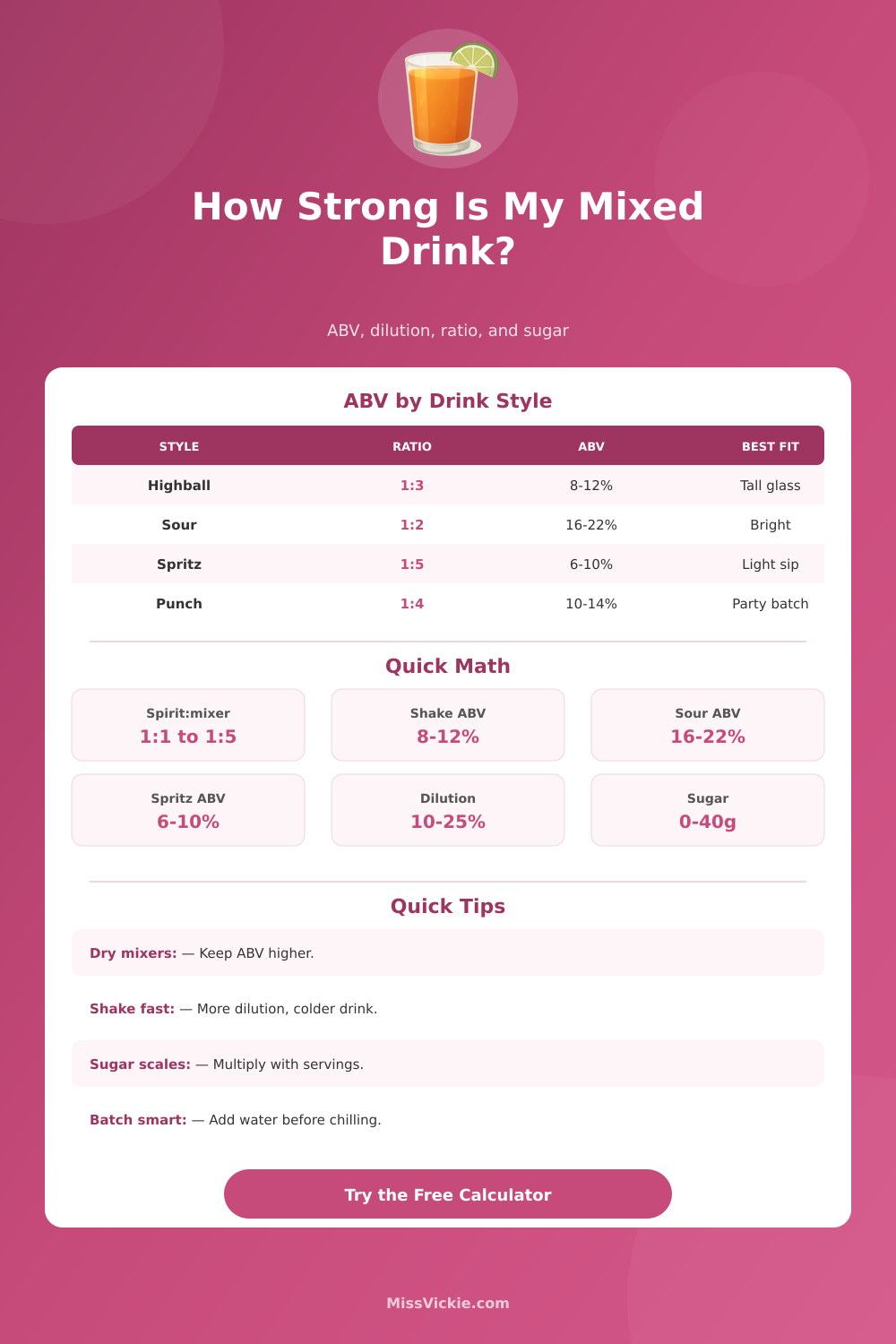
| Style | Spirit:Mixer | ABV Range | Best Use |
|---|---|---|---|
| Highball | 1:3 to 1:5 | 8-12% | Long glass |
| Sour | 1:1.5 to 1:2 | 16-22% | Short pour |
| Spritz | 1:4 to 1:6 | 6-10% | Brunch sip |
| Punch | 1:3 to 1:5 | 10-14% | Batch bowl |
| Mixer Type | Sugar / oz | Typical Ratio | ABV Shift |
|---|---|---|---|
| Soda water | 0g | 1:3+ | Low |
| Tonic | 9g | 1:3 | Low |
| Juice | 6-12g | 1:2 | Mid |
| Syrup mix | 20g+ | 1:1 to 1:2 | High |
| Mixer | g/oz | 1 Drink | 4 Drinks |
|---|---|---|---|
| Soda water | 0 | 0g | 0g |
| Cola | 11 | 44g | 176g |
| Tonic | 9 | 36g | 144g |
| Simple syrup | 25 | 100g | 400g |
| OJ | 9 | 36g | 144g |
| Cranberry | 12 | 48g | 192g |
| Servings | Spirit Oz | Mixer Oz | Sugar Load |
|---|---|---|---|
| 1 | 1.5 | 4.0 | 36g |
| 4 | 6.0 | 16.0 | 144g |
| 6 | 9.0 | 24.0 | 216g |
| 8 | 12.0 | 32.0 | 288g |
To create a balanced cocktail, you must have a good understanding of the relationship between the spirits, the mixers, the dilution, and the sugar contents of the cocktails. All cocktails is a mixture of various ingredients. The ratio of these ingredients determine both the flavor of the cocktail and its final alcohol by volume (ABV) ratings.
If you dont manage these ingredients proper, the cocktail may be too watery due to the melt of the ice in the cocktail or too sweet due to the mixer itself. The ratio of the spirit to the mixer are one of the first and most important variables to consider when creating a balanced cocktail. The ABV of the spirits is 40% or more.
How to Make a Balanced Cocktail
Mixers reduce the ABV of the spirits. A 1:3 ratio of spirit to mixer to one that creates a light and refreshing cocktail. A 1:2 ratio of spirit to mixer creates a cocktail that is stronger and more intense.
The type of mixer will alter the cocktail in different ways. For instance, soda water contain no sugar and only acts to dilute the cocktail. Juices and cola drinks contains high amounts of sugar and only act to even out the intensity of the alcohol in the cocktail.
Dilution is achieved through the melting of the ice in the cocktail. When mixing cocktails, some amount of dilution is necessary to allow the aromas to open up from the spirit. Different types of ice will cause different rates of dilution.
A large ice cube will melt slow and lead to a slow rate of dilution. Crushed ice will melt quickly and create a fast rate of dilution. When shaking cocktails, some water and air are incorporated into the drink.
When stirring cocktails, less air and water are mixed, leading to a silkier cocktail. The type of ice to be used when preparing the cocktail will alter the final ABV. Sugar is another important element of the cocktail.
Spirits contain no sugar however mixers do. Therefore, you must account for the sugar content in mixers when creating a balanced cocktail. Tonic water contains 9 grams of sugar per ounce whereas cola contains 11 gram of sugar per ounce.
If there is too little sugar in the cocktail, it will be too acidic. If there is too much sugar in the cocktail, it will be too sweet. If preparing large batches of cocktails, you should of calculated the total amount of sugar.
The total amount of sugar in the cocktail will increase with the number of servings of cocktail that are to be produced. Batching cocktails involve producing large batches of cocktails at once. Creating cocktails in batches require more mathematical precision to ensure that they taste the same as when they are prepared individually.
For individual cocktails, the ice will provide the dilution for that batch of cocktails. For batches of cocktails made in a pitcher, the ice will unevenly dilute the cocktails in that batch. To even out the ABV levels for each batch of cocktails, you should add some amount of water to the batch to mimic the ABV from melting ice.
If no water is added to the batch of cocktails the first batch will be strong yet the last batch will be weak. Another important element of cocktails is the ABV of the mixers. Mixers like soda water have an ABV of nearly 0% however mixers like vermouth have an ABV of 15-20%.
The ABV of the cocktail will be higher if a mixer of high ABV is used vs. A mixer of low ABV. When creating cocktails with various ingredient, each variable should be adjusted one at a time. If you are to change the ratio of the spirit to the mixer, the amount of sugar and the dilution should remain the same.
The type of ice can be changed but the ratio of spirit to mixer should remain the same. By controlling these three variables- the ratio of spirit to mixer, the dilution, and the amount of sugar- the cook can ensure the cocktail taste the same from the first last sip of each batch of cocktails produced.